
US–Iran War Impact on Indian Stocks: Middle East Exposure Raises Market Risk
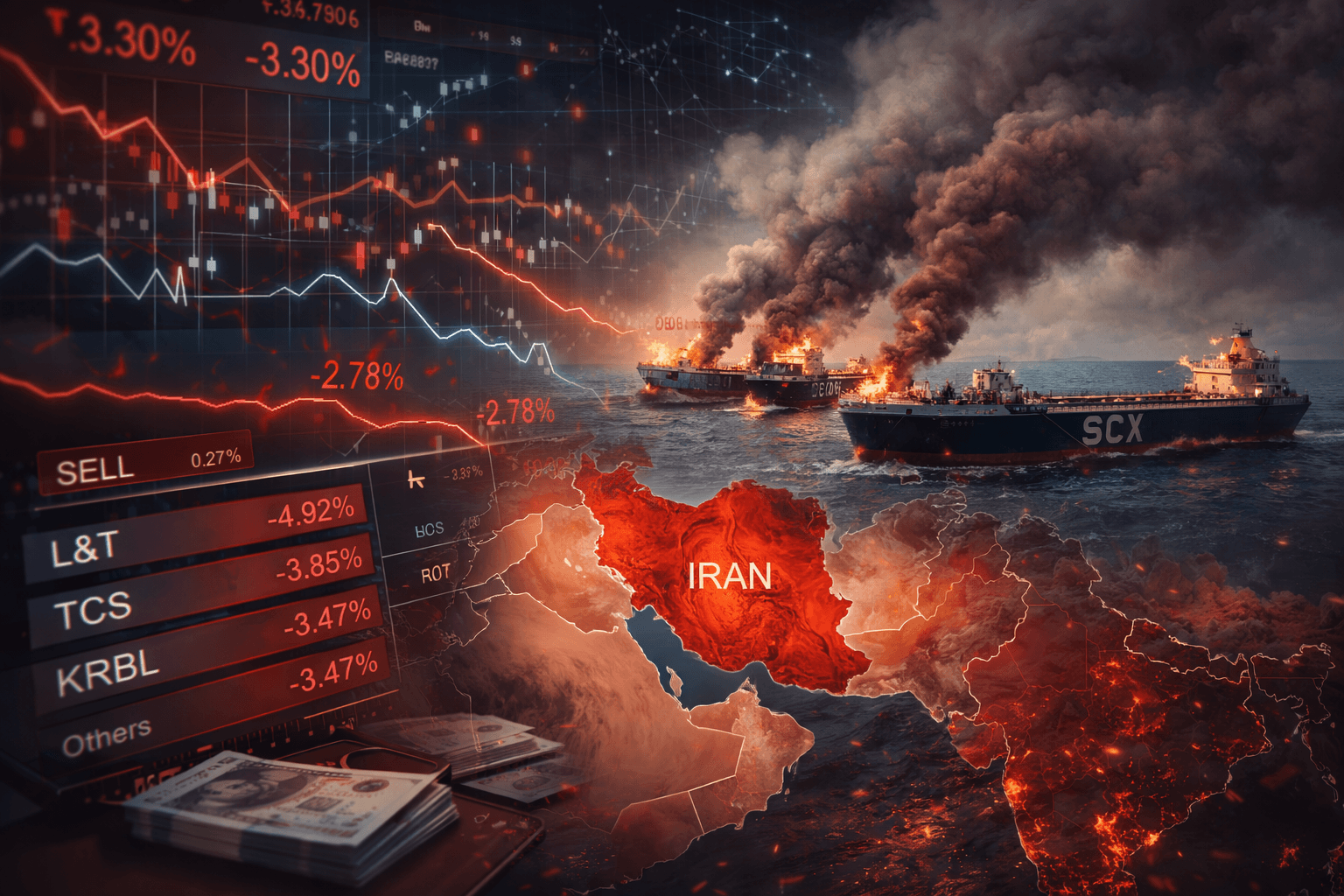
The US Iran war impact on Indian stocks has become a defining factor for market sentiment. Escalating tensions in the Middle East have triggered sharp volatility in Indian equities, with companies exposed to the region facing immediate pressure.
The reaction was swift. Benchmark indices dropped sharply, reflecting investor concerns over rising crude oil prices and operational disruptions. The situation highlights how geopolitical conflicts can rapidly translate into financial risk.
This is not a localized issue. It is a systemic risk affecting multiple sectors of the Indian economy.
Market Reaction: Immediate Shock to Indian Equities
The initial response to the conflict was visible in market indices. The Sensex plunged over 2,700 points in early trade before recovering partially, still trading significantly lower.
This sharp fall reflects two major concerns.
First, rising crude oil prices. Second, uncertainty around companies with exposure to the Middle East.
Oil is a critical input for the Indian economy. A sustained increase affects inflation, fiscal balance, and corporate profitability.
As a result, the market reacted with caution.
Why the Middle East Matters to Indian Companies
The Middle East is a key economic partner for India. Several Indian companies derive a significant portion of their revenue from the region.
These include sectors such as infrastructure, IT services, construction, consumer goods, and exports.
A prolonged conflict creates multiple risks.
Operations may be disrupted. Projects can be delayed. Payment cycles may stretch. Currency volatility may increase.
This combination directly impacts earnings visibility.
Key Companies Under Pressure
Several major Indian companies have significant exposure to the Middle East, making them particularly vulnerable.
Larsen & Toubro: High Operational Exposure
Larsen & Toubro has one of the highest exposures to the region. International revenue accounted for 54% of total revenue in Q3FY26, driven largely by Middle East projects.
The company has secured large infrastructure contracts in the region. However, geopolitical instability raises execution risks.
The stock fell sharply, reflecting investor concern over project delays and revenue uncertainty.
Tata Consultancy Services: Strategic Market Dependency
TCS has a strong presence in the Middle East and North Africa region. Its revenue from the region grew 8.3% year-on-year in Q3FY26, contributing significantly to overall performance.
Despite this growth, the conflict has raised concerns about future demand and operational continuity.
The stock declined as investors reassessed risk.
KEC International and VA Tech Wabag: Project Execution Risks
Engineering and infrastructure companies like KEC International and VA Tech Wabag have active projects in the Middle East.
The region remains a key growth market for these firms.
However, on-ground projects depend heavily on stability. Any disruption can delay execution and increase costs.
Stocks in this segment saw sharp declines in response to the conflict.
KRBL and Rice Exporters: Trade Disruption Risk
Companies like KRBL are exposed through exports.
Iran is a major buyer of Indian basmati rice. Escalating tensions raise concerns about trade disruptions and payment risks.
As a result, rice stocks declined sharply amid uncertainty.
Sector-Wide Impact of the US–Iran Conflict
The impact extends beyond individual companies. Multiple sectors face indirect pressure.
Infrastructure companies face execution delays. IT firms deal with travel restrictions and client uncertainty. Exporters face trade disruptions.
Aviation, logistics, and energy sectors are particularly vulnerable.
Disruptions in airspace and shipping routes increase operational complexity.
The ripple effect spreads across the economy.
The Central Risk: Crude Oil Prices
Crude oil remains the most critical variable.
India imports nearly 90% of its crude oil, with a large portion passing through the Strait of Hormuz.
Any disruption in this region can significantly impact supply and prices.
Higher oil prices increase:
- Input costs for industries
- Transportation expenses
- Inflationary pressure
This directly affects corporate margins and economic growth.
Even a small increase in oil prices can have a measurable impact on fuel costs and overall inflation.
Strategic Implications for Investors
The current situation highlights the importance of geographic exposure.
Companies with significant international operations, especially in conflict-prone regions, carry additional risk.
Investors are increasingly differentiating between:
- Domestic-focused businesses
- Globally exposed companies
This is leading to selective selling in stocks with Middle East exposure.
At the same time, some sectors may benefit. Defence companies, for example, could see increased demand amid rising geopolitical tensions.
Future Outlook: Volatility Likely to Continue
The trajectory of the US Iran war impact on Indian stocks will depend on the duration and intensity of the conflict.
If tensions escalate further, the impact could deepen.
Higher oil prices, supply chain disruptions, and reduced business activity in the Middle East could weigh on corporate earnings.
If the situation stabilizes, markets may recover.
However, uncertainty is likely to persist in the near term.
Topics
Covering startup news, AI, technology, and business at ThePrimely. Delivering accurate, in-depth reporting on the stories that shape the future.