
Four New Astronauts Arrive at ISS, Restoring Operational Stability
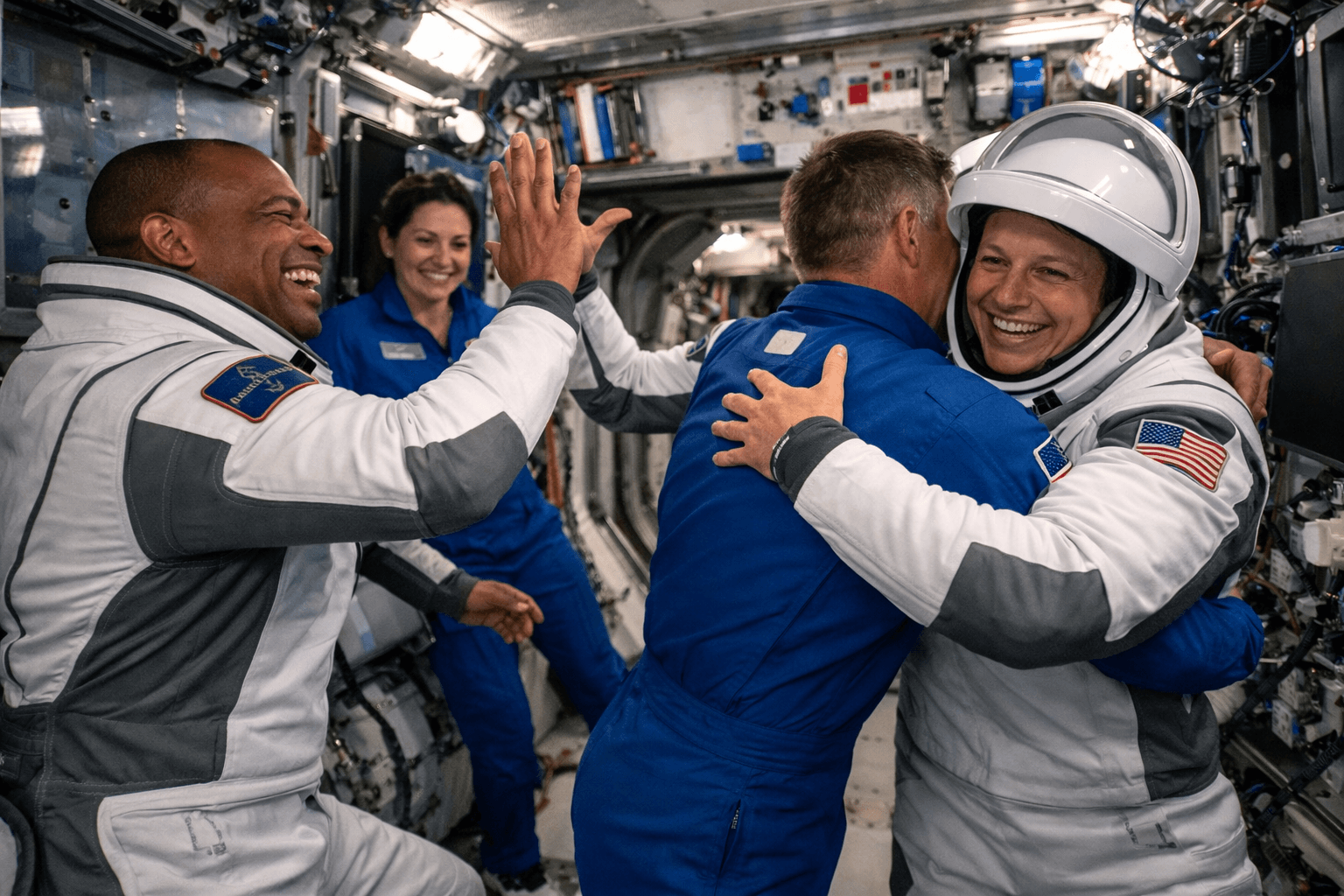
Four new astronauts arrive at ISS at a critical moment for the International Space Station. Their arrival marks a structured transition after NASA evacuated part of its earlier crew due to spacecraft safety concerns.
The successful docking restores the station’s full operational capacity. It also reinforces the resilience of global space collaboration.
This mission is more than a routine crew swap. It reflects operational discipline, risk management, and strategic continuity in human spaceflight.
A Carefully Managed Crew Transition
The new team traveled aboard a SpaceX Crew Dragon spacecraft, launched by SpaceX under its Commercial Crew partnership with NASA.
The spacecraft docked smoothly with the ISS. Hatch opening followed standard pressure checks. Shortly after, astronauts exchanged hugs and high fives in microgravity a tradition that marks both continuity and trust.
The four-member crew now joins ongoing Expedition operations. Their arrival enables scientific experiments, maintenance tasks, and research schedules to proceed without disruption.
Why NASA Evacuated Its Crew
NASA’s earlier evacuation stemmed from technical concerns involving a Boeing Starliner spacecraft. The spacecraft had delivered astronauts to orbit but later faced propulsion and system performance issues.
After extensive analysis, NASA chose caution over risk. The agency returned astronauts via an alternative spacecraft to ensure safety.
This decision reflects NASA’s conservative safety framework. Human spaceflight allows no margin for ambiguity.
The temporary crew reduction required swift replacement planning. That plan has now executed successfully.

The Strategic Importance of ISS Crew Rotations
Crew rotations are routine. But they are mission critical.
The ISS operates as a continuously staffed laboratory. It supports experiments in medicine, materials science, climate monitoring, and deep space research. Reduced crew capacity limits research throughput and maintenance bandwidth.
With four new astronauts on board, the station regains full productivity.
The ISS partnership includes the United States, Russia, Europe, Japan, and Canada. Every crew change reinforces international cooperation in space.
Operational continuity sustains diplomatic continuity.
The Role of Commercial Spaceflight
This mission underscores the growing role of private industry in government space programs.
Under NASA’s Commercial Crew Program, companies like SpaceX transport astronauts to orbit. This model reduces cost, increases launch frequency, and introduces redundancy.
The contrast between SpaceX’s Crew Dragon reliability and Boeing’s Starliner challenges remains under review. However, NASA continues to support multiple providers to avoid dependency risk.
Diversification is not optional in critical infrastructure. It is strategic insurance.
Operational and Industry Impact
The return to full staffing stabilizes scientific output. Ongoing microgravity experiments now proceed without delay.
It also signals confidence in current launch systems. Markets watch these missions closely. Reliability influences future contracts, international partnerships, and long term commercial space station development.
Beyond immediate logistics, this transition strengthens NASA’s Artemis roadmap and long-duration mission planning.
Crew stability in low Earth orbit supports ambitions beyond it.
The new crew will spend approximately six months aboard the ISS. Their mission includes:
- Conducting biomedical and technology experiments
- Performing station maintenance and system upgrades
- Supporting Earth observation programs
- Preparing for future deep space mission research
NASA will continue evaluating spacecraft performance data. Boeing’s Starliner program remains under technical assessment.
Meanwhile, ISS operations proceed without interruption.
Stability Restored, Strategy Intact
The moment four new astronauts arrived at ISS carried symbolic and operational weight.
NASA acted decisively when safety concerns emerged. It then executed a seamless replacement mission through commercial partnership.
The result is stability. The station operates at full strength again. International collaboration remains intact. Research output continues.
Human spaceflight depends on disciplined transitions. This mission demonstrates that the system works even under pressure.
Topics
Covering startup news, AI, technology, and business at ThePrimely. Delivering accurate, in-depth reporting on the stories that shape the future.