
Elon Musk Merges SpaceX and xAI Creating a $1.25 Trillion AI Space Powerhouse
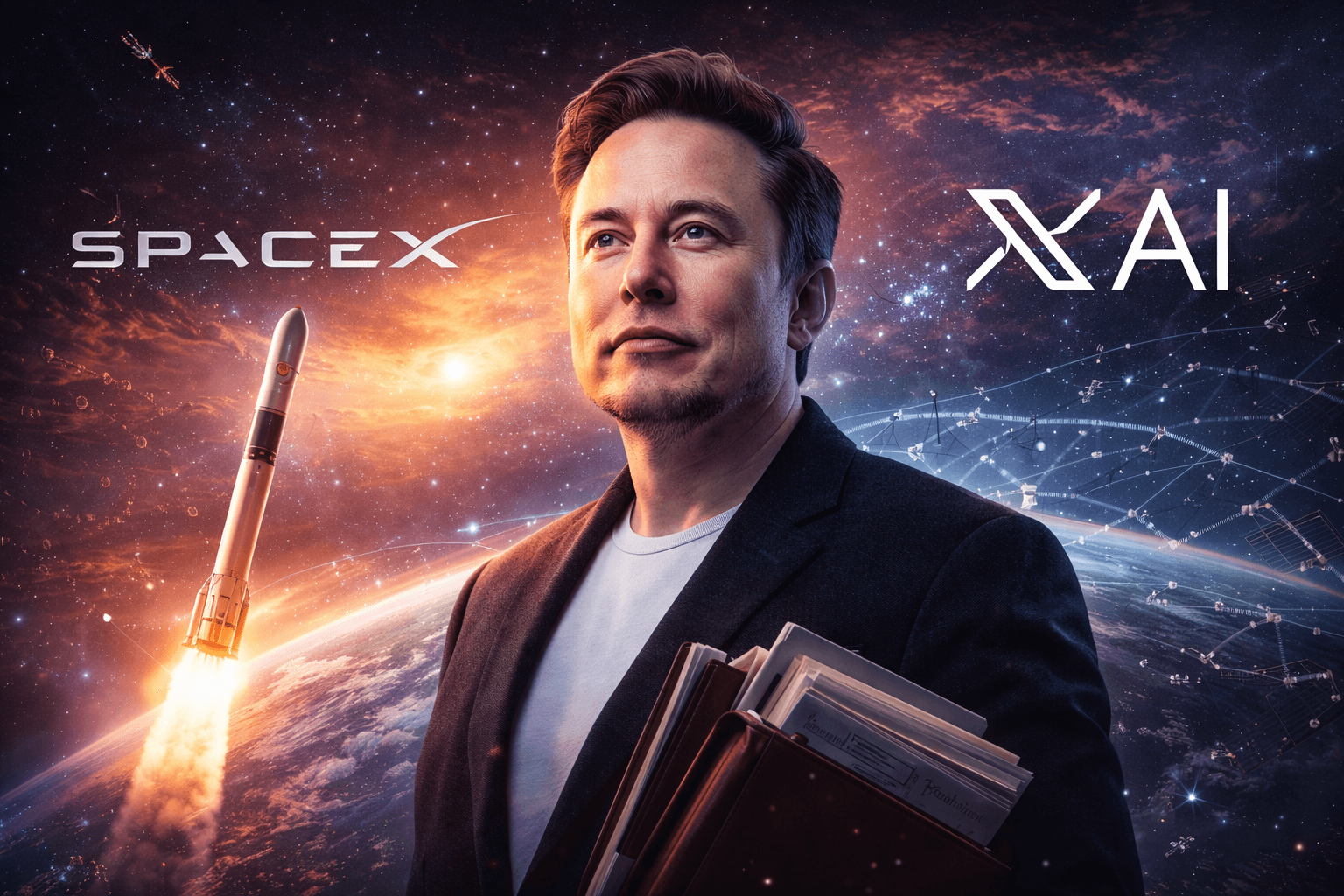
In one of the most ambitious corporate moves of the decade, Elon Musk has merged his rocket and space transport company SpaceX with his artificial intelligence startup xAI to form an integrated technology giant valued at approximately $1.25 trillion. Musk’s bold vision seeks to combine rocket technology, satellite networks, and artificial intelligence into a unified platform that goes beyond traditional terrestrial limits.
This merger reflects a shift in how Musk views the future of compute, infrastructure, and innovation — positioning the combined entity to tackle the soaring energy and data demands of AI by moving computing capabilities into space while preparing for an eventual blockbuster initial public offering (IPO).
Why the Merger Matters
The SpaceX-xAI deal is far more than a traditional acquisition. It is a vertical integration strategy that breaks down barriers between hardware and intelligence. SpaceX brings decades of rocket engineering, satellite deployment through its Starlink network, and reusable launch systems. xAI contributes advanced AI models, software talent, and assets like the Grok chatbot and connections to the social media platform X (formerly Twitter).
By uniting these technologies, Musk aims to build a new class of infrastructure where AI compute isn’t limited by Earth’s resource constraints — a major pivot from how data centers are traditionally built and operated.
The Core Vision: AI in Space
One of Musk’s central arguments is that terrestrial data centers will not be able to meet exponential AI compute demand sustainably. Current AI infrastructure consumes vast amounts of electricity and cooling resources, putting strain on grids and the environment. Musk’s idea is to leverage solar power and orbital environments to create space-based data centers that harness near-constant energy without terrestrial limitations.
The plan includes launching potentially millions of satellites into orbit that function as distributed compute nodes, each capable of contributing to a global mesh of AI processing power. The goal is for these orbital systems to collectively generate hundreds of gigawatts to possibly terawatts of AI compute capacity annually — far beyond what today’s ground systems can handle.
Strategic Benefits for xAI and SpaceX
For xAI, which has been burning capital rapidly to compete with giants like Google and Microsoft, the merger provides access to SpaceX’s stable revenue streams from satellite launches and Starlink internet services, alleviating financial pressure. SpaceX’s global brand strength and investor appeal also give xAI strategic leverage it lacked on its own.
SpaceX benefits equally. Its technological assets — reusable rockets, satellite networks and launch infrastructure — now support a vertical stack that includes AI logic, data processing, and future compute delivery directly from orbit. This fusion accelerates timelines for next-gen AI systems and expands SpaceX’s role from space transport to core AI infrastructure provider.
IPO and Financial Positioning
The merger is also a IPO positioning strategy, with plans to take the combined company public possibly in mid-2026. Analysts expect the combined entity’s valuation to exceed $1.5 trillion, marking one of the largest public market debuts in history. This timing could leverage investor enthusiasm for both aerospace and AI innovation.
Investors see benefits in Musk’s expansive vision, though some caution that combining a large, capital-heavy aerospace business with an AI startup introduces complexity into financial forecasting and shareholder value assessments. Still, many believe that technological alignment and long-term synergy outweigh these risks.
Technical Ambitions and Challenges
Musk’s space-based AI compute plan is futuristic but scientifically grounded in emerging engineering principles. Solar power in orbit is more consistent than Earth-bound systems, and reusable rockets significantly lower launch costs. However, executing this vision faces real hurdles:
- Radiation and hardware durability in space environments
- Cooling and maintenance of orbiting compute hardware
- Communication and latency limits between satellites and Earth
- Debris and collision risks in crowded orbits
Experts acknowledge the ingenuity of Musk’s concept but emphasize that overcoming these challenges will require novel engineering breakthroughs and significant international regulatory cooperation.
Wider Implications for AI and Space Industries
This merger blurs industry lines. AI companies have traditionally relied on big tech for data centers. Now, aerospace firms enter the compute space, and Musk’s integrated model pushes traditional boundaries. Vertical integration could give the new company a strategic advantage by capturing compute, data, transport, and deployment layers — key components in the future of AI.
Closer ties between space infrastructure and AI compute also reflect broader industry shifts. Competitors like Amazon, Microsoft and Google are exploring low-Earth orbit or space-based services, but none have integrated a launch system with AI development as directly as Musk’s unified entity plans to.
Ethical and Regulatory Considerations
While Musk highlights innovation and the push toward sustainable AI compute, regulatory and ethical concerns remain. xAI’s history with the Grok chatbot has drawn scrutiny over content moderation and misuse issues in regions like Europe. Bringing such platforms into a larger aerospace and communications ecosystem raises questions about governance, data control, content safety, and adherence to international norms.
The Future of a Space-Based Tech Empire
Elon Musk’s vision extends beyond orbiting data centers. Discussions around potential future collaborations with other companies in his portfolio — like Tesla — hint at even broader integration, from energy storage and robotics to planetary infrastructure. This could position Musk’s merged enterprise as a multi-trillion-dollar technology powerhouse shaping both AI and space exploration in the decades to come.
Topics
Covering startup news, AI, technology, and business at ThePrimely. Delivering accurate, in-depth reporting on the stories that shape the future.