
China Imposes Export Controls on Japan Firms
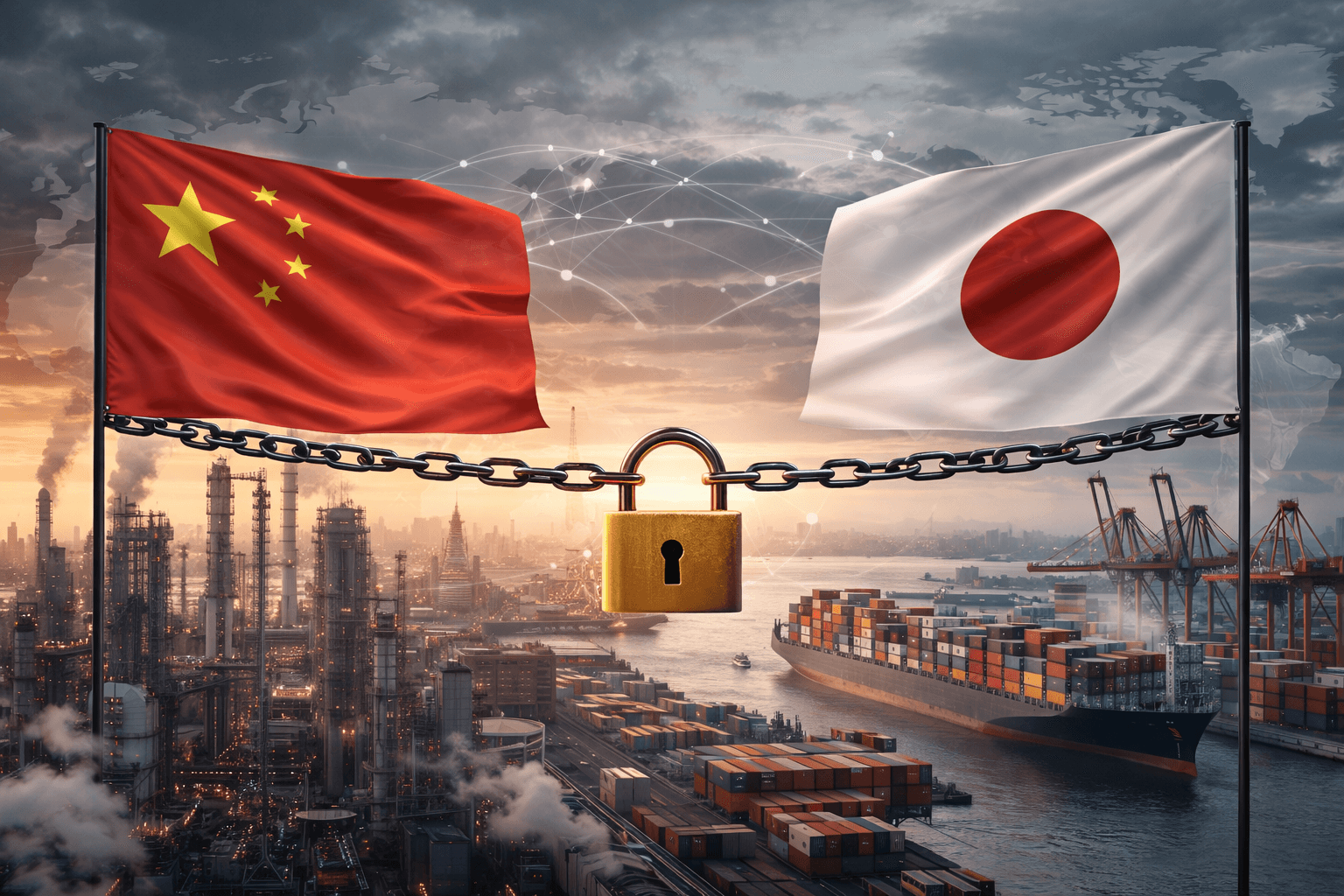
A New Phase in China–Japan Relations
The latest China Japan export controls signal a sharp escalation in economic and geopolitical tensions.
China has placed multiple Japanese companies on export control and watch lists.
The move highlights growing friction between Asia’s two largest economies.
What Is Happening
China’s Commerce Ministry has taken action against 40 Japanese entities.
- 20 companies have been placed on an export control list
- 20 additional firms have been placed on a watch list
Companies on the control list are barred from receiving dual-use goods from China.
These goods can be used for both civilian and military purposes.
Firms on the watch list face stricter regulations.
Exporters must apply for licenses and provide assurances about usage.
Background: Rising Political Tensions
The decision comes amid worsening diplomatic relations.
Tensions increased after Japan signaled a stronger stance on regional security, including Taiwan.
China has accused Japan of supporting “remilitarisation” and expanding defense capabilities.
This dispute has led to economic measures on both sides.
You might Like this :- Iran-China Missile Deal Signals Rising Global Tensions
Key Developments
1. Major Companies Affected
Several major Japanese firms are impacted.
These include subsidiaries of:
- Mitsubishi Heavy Industries
- Kawasaki Heavy Industries
- Fujitsu
Some companies are directly linked to aerospace and defense sectors.
2. Control Over Critical Materials
China dominates the supply of rare earth elements.
These materials are essential for:
- Electronics
- Automobiles
- Defense systems
Restrictions could disrupt supply chains globally.
3. Watch List Mechanism
Companies on the watch list are not banned.
However, they face tighter scrutiny and regulatory checks.
They must prove that imported materials will not be used for military purposes.
4. Diplomatic Fallout
Japan has strongly criticized the move.
Officials called the restrictions “unacceptable” and demanded reversal.
This indicates rising diplomatic friction.
Industry and Market Impact
Supply Chain Disruption
Japan depends heavily on China for critical minerals.
Export controls could disrupt production in key industries.
Impact on Technology and Defense
Many affected firms operate in high-tech sectors.
Restrictions could slow innovation and manufacturing.
Global Economic Ripple Effects
The dispute could affect global markets.
Industries such as automotive and electronics rely on stable supply chains.
Strategic Implications
1. Economic Leverage by China
China is using supply chains as a strategic tool.
Control over critical resources provides strong leverage.
2. Rising Regional Rivalry
The move reflects deeper geopolitical competition.
China and Japan are competing for influence in Asia.
3. Shift Toward Economic Security
Countries may reduce reliance on single suppliers.
Diversification of supply chains is becoming a priority.
Future Outlook
The China Japan export controls could lead to prolonged tensions.
Possible developments include:
- Further trade restrictions
- Supply chain diversification
- Increased regional alliances
The situation remains dynamic and could evolve rapidly.
Topics
Covering startup news, AI, technology, and business at ThePrimely. Delivering accurate, in-depth reporting on the stories that shape the future.