
AMD and TCS Build 200MW AI Data Centres in India
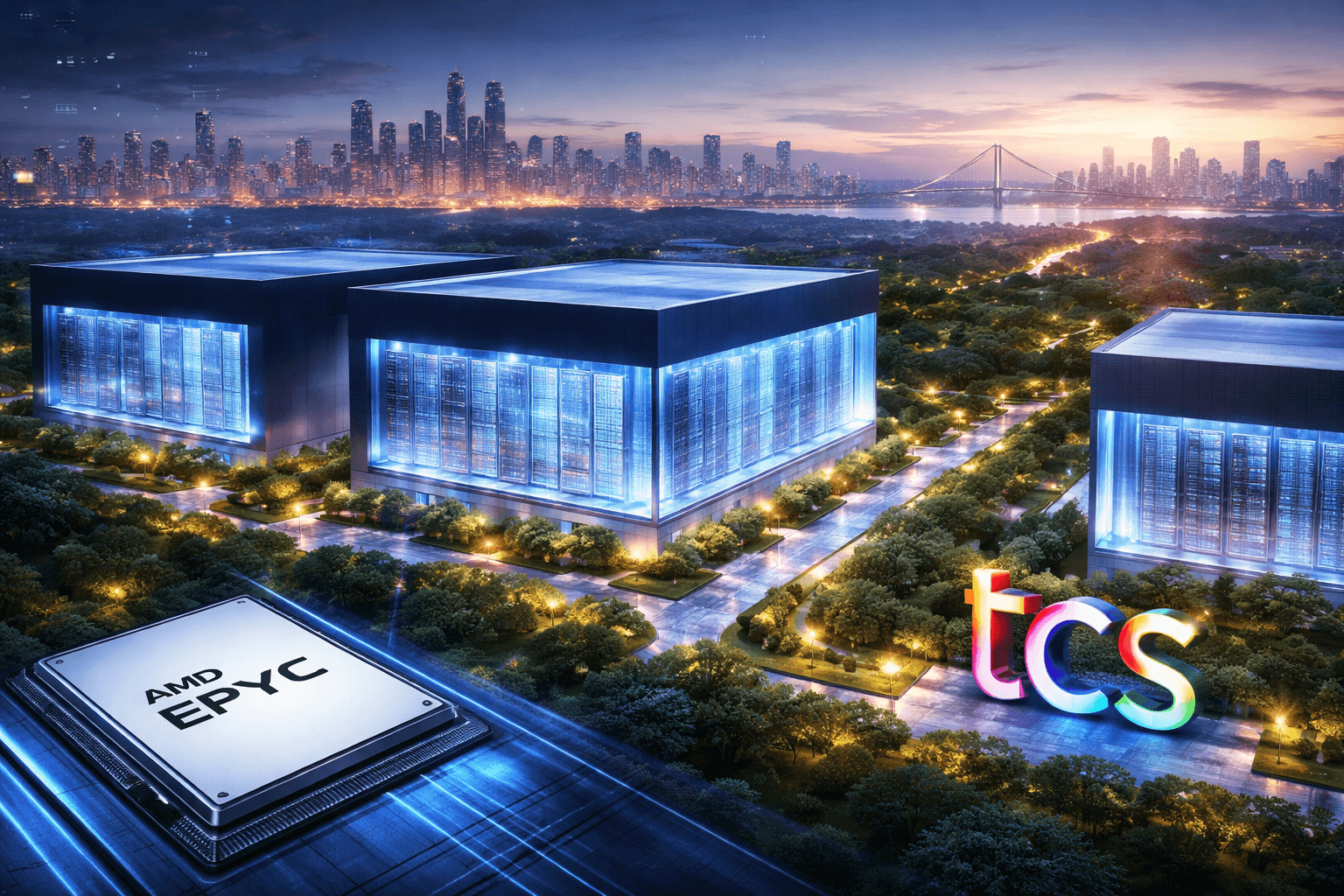
The expansion of AMD TCS AI data centres India marks a decisive moment in the country’s AI infrastructure strategy. In a significant move, Advanced Micro Devices (AMD) and Tata Consultancy Services (TCS) have expanded their partnership to build 200 megawatts of AI-ready data centre capacity across India.
This is not a routine technology collaboration. It signals India’s push to strengthen domestic AI infrastructure amid intensifying competition between AMD and NVIDIA in the global AI hardware market.
Why the AMD–TCS Partnership Matters
India’s AI ambitions require large-scale compute infrastructure. Training and deploying advanced AI models demands high-density processing power. Traditional data centres cannot handle this load efficiently.
The new initiative will focus on building AI-ready infrastructure in India, with advanced cooling systems, high-performance compute architecture, and scalable cloud integration. The targeted capacity of 200MW positions this as one of the largest AI-focused infrastructure expansions in the country.
TCS will leverage AMD’s AI and high-performance computing portfolio, including Instinct accelerators and EPYC processors, to power next-generation AI workloads.
This is both an infrastructure play and a strategic positioning move.
The 200MW Commitment: Scale and Significance
The planned 200MW capacity is not symbolic. It represents industrial-scale AI infrastructure designed for:
- Large language model training
- Enterprise AI deployment
- Cloud-based AI services
- High-performance computing workloads
Data centre capacity measured in megawatts reflects real compute capability. At 200MW, the project signals long-term commitment rather than experimental investment.
India’s digital economy continues to expand rapidly. Enterprises are moving toward AI-first strategies. Without domestic compute infrastructure, dependence on foreign cloud capacity increases both cost and strategic vulnerability.
This partnership addresses that gap.
AMD’s Position in the NVIDIA Rivalry
Globally, NVIDIA dominates AI accelerators. However, AMD has aggressively expanded its AI chip portfolio in recent years. The India partnership strengthens AMD’s foothold in one of the fastest-growing AI markets.
By aligning with TCS, AMD gains:
- Enterprise integration capabilities
- Access to large corporate clients
- Strong government and public sector relationships
- Scalable deployment channels
For TCS, the partnership enhances its ability to deliver AI transformation programs with optimized hardware integration.
This is not merely procurement. It is co-development of AI ecosystem infrastructure.
India’s AI Infrastructure Gap
India has strong software capabilities. However, AI infrastructure capacity has lagged behind global leaders.
Countries like the United States and China have rapidly scaled AI-ready data centres. India now aims to build domestic capacity to support:
- Sovereign AI initiatives
- Enterprise innovation
- Startup ecosystem growth
- Public sector digital transformation
The AMD–TCS expansion aligns with this broader policy and market direction.
Building 200MW of AI-ready capacity strengthens India’s position as both a technology services hub and an AI compute destination.
What Changes for Enterprises
For Indian enterprises, this development reduces dependency on offshore AI compute providers. It can improve:
- Data residency compliance
- Latency performance
- Cost efficiency over time
- Infrastructure reliability
For startups, local high-performance infrastructure lowers barriers to scaling AI models.
For policymakers, it enhances digital sovereignty.
The ripple effect could extend across fintech, healthcare, manufacturing, telecom, and public services.
Strategic Implications for the AI Ecosystem
This partnership reflects three broader shifts:
1. Hardware and Services Convergence
AI success requires integrated stacks. Chips alone are not enough. Services alone are not enough. The AMD–TCS collaboration merges silicon expertise with enterprise execution.
2. Regional AI Infrastructure Competition
India is positioning itself as a regional AI infrastructure hub. The 200MW commitment signals serious intent.
3. Diversification Beyond NVIDIA
Enterprises increasingly seek alternatives in AI hardware. AMD’s growing presence in India introduces competitive balance into the market.
Strategically, this reduces single-vendor risk in national AI infrastructure planning.
What to Watch
Several developments will determine long-term impact:
- Speed of deployment across the 200MW pipeline
- Adoption by large Indian enterprises
- Integration with public cloud and sovereign cloud initiatives
- Government policy alignment with AI compute expansion
If executed effectively, the AMD–TCS AI data centres in India could become foundational to the country’s next phase of digital transformation.
A Defining Infrastructure Bet
The expansion of AMD TCS AI data centres India represents more than capacity addition. It reflects a strategic shift toward domestic AI compute strength.
India is moving from being primarily a services powerhouse to becoming an AI infrastructure player.
For AMD, this strengthens its competitive stance against NVIDIA in a high-growth market. For TCS, it reinforces its role as a systems integrator for AI transformation at scale.
also For India, it marks progress toward technological self-reliance in AI.
The next phase will depend on execution discipline and enterprise adoption. However, the direction is clear: AI infrastructure is now central to national competitiveness.
Topics
Covering startup news, AI, technology, and business at ThePrimely. Delivering accurate, in-depth reporting on the stories that shape the future.