
Neuralink Patient 100 Days: A Breakthrough in Human Machine Integration
A Milestone That Moves Beyond Theory
The Neuralink patient 100 days update marks a turning point in neurotechnology. For the first time, a human subject has shared real world results after receiving a brain chip implant.
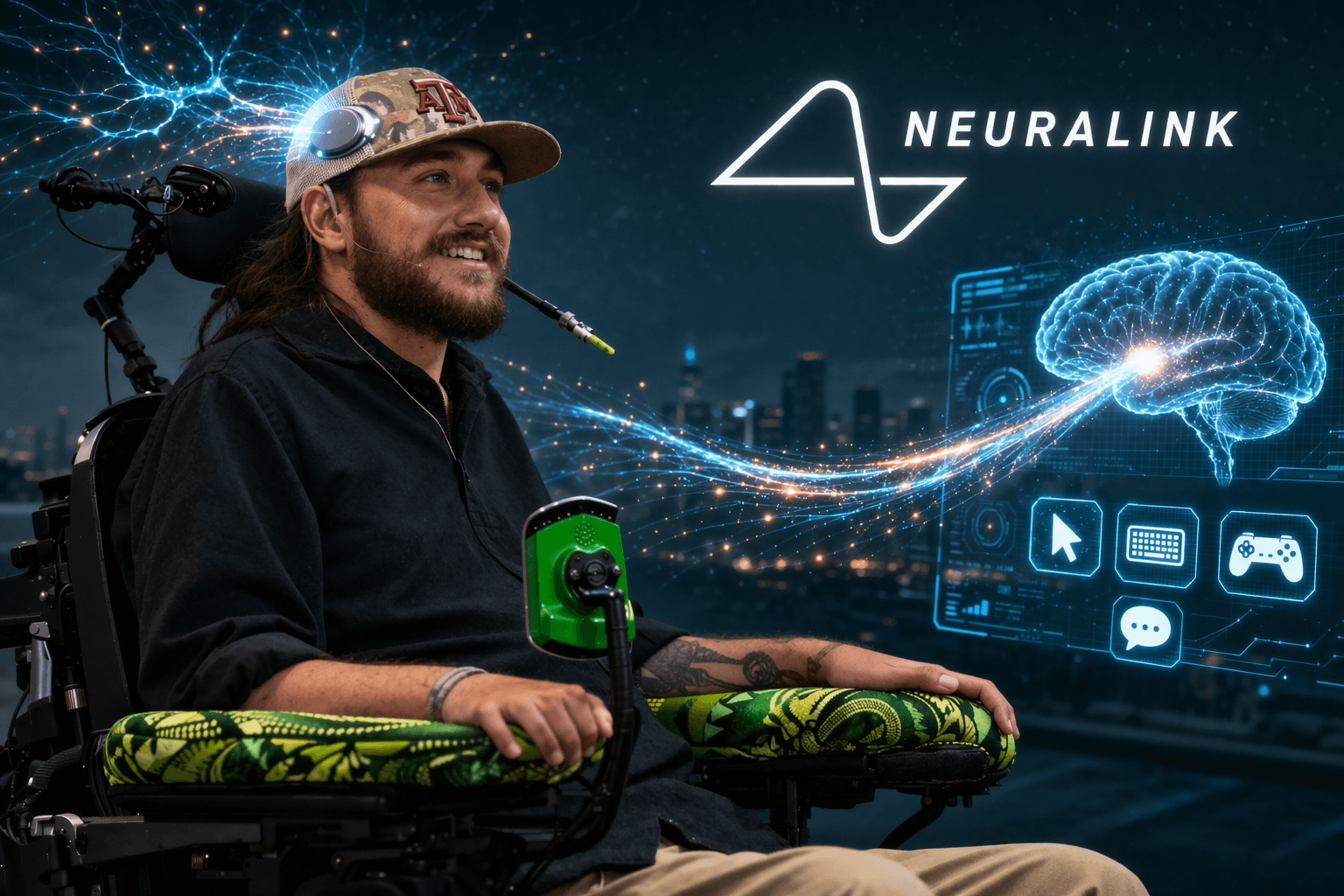
Noland Arbaugh, the first Neuralink patient, described the experience as transformative. His statement reflects a major shift. Brain computer interfaces are no longer experimental concepts. They are becoming practical tools.
What Neuralink Has Achieved So Far
Neuralink, founded by Elon Musk, aims to connect the human brain directly with computers. The first human trial represents a critical milestone.
Key Confirmed Developments
- Noland Arbaugh received the Neuralink implant successfully
- He has been using the device for over 100 days
- The chip allows him to control digital devices using thoughts
- He reported significant improvement in daily functionality
Arbaugh stated that he cannot imagine life without the device now. This reflects strong early adoption at a personal level.
Patient Experience, From Limitation to Capability
Restoring Digital Interaction
Before the implant, Arbaugh faced severe physical limitations. After the procedure, he regained the ability to interact with computers.
now he can Move a cursor using brain signals, Play digital games, Communicate more effectively
This level of control demonstrates the practical potential of the technology.
Psychological and Functional Impact
The impact goes beyond physical ability. Arbaugh described the experience as life changing.
His statement that science fiction feels like reality highlights the emotional and psychological shift.
How the Technology Works
Neuralink’s system uses a brain implant that captures neural signals.
Core Process
- Electrodes are implanted in specific brain regions
- Neural activity is recorded and processed
- Signals are translated into digital commands
This enables direct communication between the brain and external devices.
The system relies on advanced AI algorithms to interpret signals accurately.
Redefining Healthcare and AI
The Neuralink patient 100 days milestone has wide implications.
Healthcare Transformation
Brain computer interfaces could help patients with paralysis, neurological disorders, and mobility limitations.
This could reduce dependency on physical assistive devices.
Expansion of Human Computer Interaction
The technology may redefine how humans interact with machines. Traditional input devices could become less relevant over time.
Acceleration of Neurotechnology Investment
The success of early trials will likely attract more investment. This could accelerate innovation in the field.
Strategic Implications for Technology Leaders
Early Stage Validation
The success of this trial validates years of research. It reduces uncertainty around feasibility.
Ethical and Regulatory Focus
However, the technology raises ethical concerns. Data privacy and long term safety will be critical.
Competitive Landscape
Other companies working on brain computer interfaces may accelerate development. The race for neurotechnology leadership is intensifying.
The next phase will focus on scaling and safety. More clinical trials will be required.
If results remain positive, applications could expand beyond healthcare. However, widespread adoption will depend on regulatory approvals and long term reliability.
A Defining Moment in Human Technology
The Neuralink patient 100 days update represents a major breakthrough. It shows that brain computer interfaces can deliver real value.
This is not just a medical milestone. It is a shift in how humans may interact with technology.
The journey ahead is complex. Yet, the foundation is now firmly established.
Topics
Covering startup news, AI, technology, and business at ThePrimely. Delivering accurate, in-depth reporting on the stories that shape the future.