
Elon Musk AI Race Prediction: China vs US
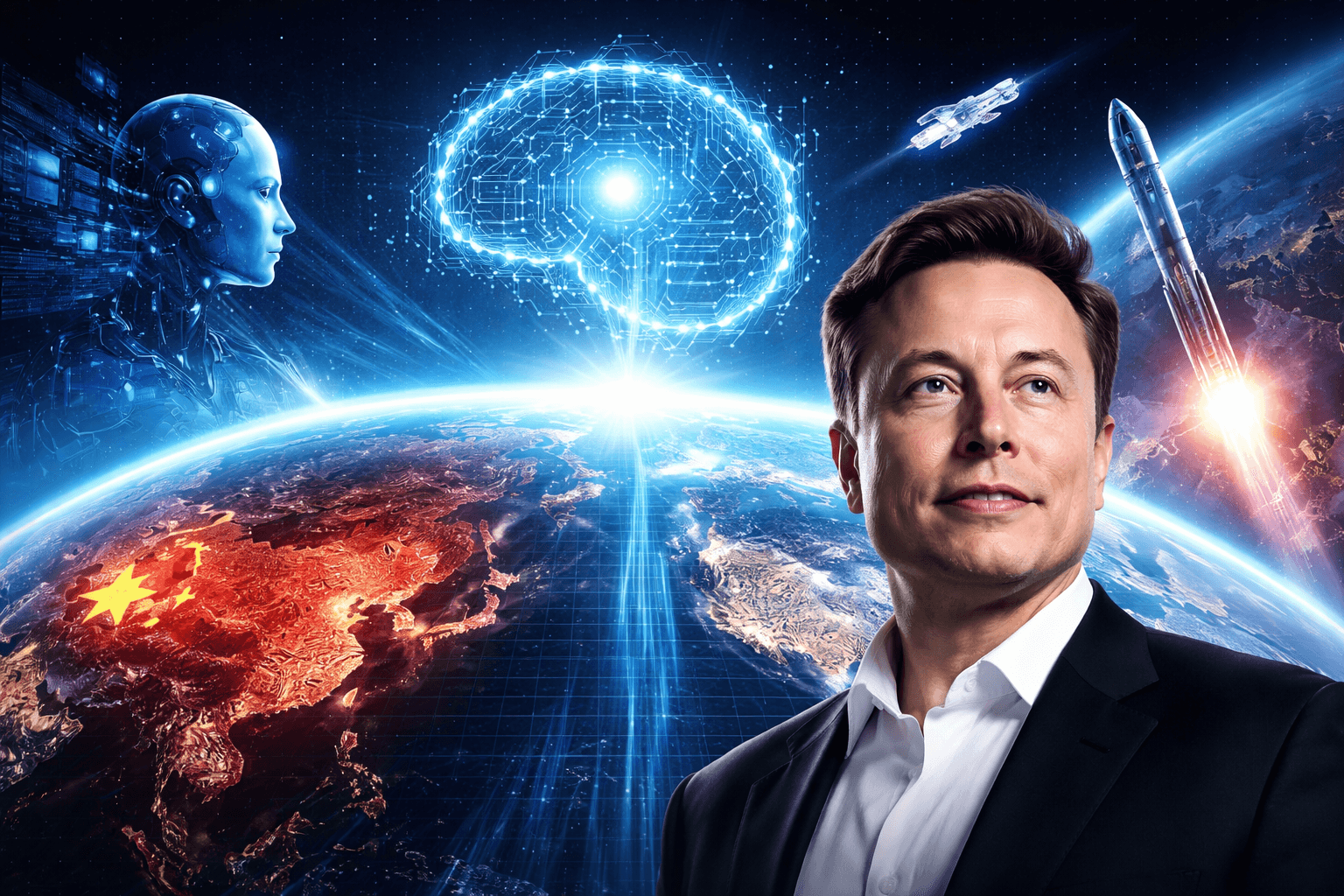
The global AI race has entered a decisive phase. However, Elon Musk has offered a strikingly different perspective. He believes China will dominate AI on Earth. At the same time, he aims to win the next frontier, space.
This statement does more than provoke debate. Instead, it reframes how leaders should view artificial intelligence. It shifts focus from pure competition to domain specific dominance.
Understanding Elon Musk’s AI Race Prediction
Musk’s view is direct and strategic. He has stated that China is likely to lead the AI race on Earth. Meanwhile, he positions his own ambitions beyond terrestrial limits.
He links this vision to companies like SpaceX and xAI. His belief is clear. Earth based AI leadership may not define the ultimate winner.
Therefore, the competition may split into two arenas:
- Earth based AI dominance
- Space driven intelligence systems

Why China Holds a Strong Position
China’s advantage is not accidental. Instead, it stems from structural and strategic factors.
Scale and Data Advantage
China operates with vast population scale. As a result, it generates enormous datasets. These datasets power machine learning systems effectively.
Government Backing
The Chinese government actively supports AI development. It funds research, infrastructure, and deployment at scale.
Rapid Implementation
Unlike many Western markets, China moves quickly from testing to deployment. Consequently, AI applications reach real world usage faster.
Musk’s prediction aligns with these realities. China’s ecosystem supports rapid and sustained AI growth.
The US and Big Tech Position
While Musk highlights China, he also acknowledges strong competition within the United States.
He has suggested that companies like Google could ultimately lead the AI race. This is a notable admission, given his own involvement in AI ventures.
At the same time, his company xAI is developing systems like Grok. Musk positions Grok differently. He sees it as part of a broader, long term vision rather than a short term race winner.
Space as the Next AI Battlefield
Musk’s most important insight lies beyond Earth. He believes space will define the next phase of AI competition.
Integration with Space Systems
AI will power satellites, autonomous spacecraft, and interplanetary missions.
Strategic Advantage
Control over space based AI systems could influence communication, defense, and data infrastructure.
Long Term Vision
Through SpaceX, Musk aims to build infrastructure that supports AI beyond Earth. Thus, his strategy extends far beyond current industry boundaries.
Strategic Implications for the Future
Musk’s perspective introduces several long term implications.
Redefining Leadership
Winning AI on Earth may not guarantee overall dominance. Space capabilities could become equally important.
Rise of Dual Ecosystems
We may see parallel ecosystems. One focuses on terrestrial AI. The other focuses on space based intelligence.
Policy and Regulation
Governments will need new frameworks. These must address both Earth and space AI systems.
Future Outlook
The AI race will intensify in the coming years. China is likely to strengthen its position on Earth. Meanwhile, US companies will continue pushing innovation boundaries.
However, Musk’s strategy introduces a new dimension. By focusing on space, he expands the definition of competition itself.
Ultimately, this is not just a prediction. It is a reframing of the global AI narrative. Leaders who understand this shift will be better positioned for the future.
Topics
Covering startup news, AI, technology, and business at ThePrimely. Delivering accurate, in-depth reporting on the stories that shape the future.