
Canada PM Mark Carney and Tata Group Explore Strategic AI Partnership
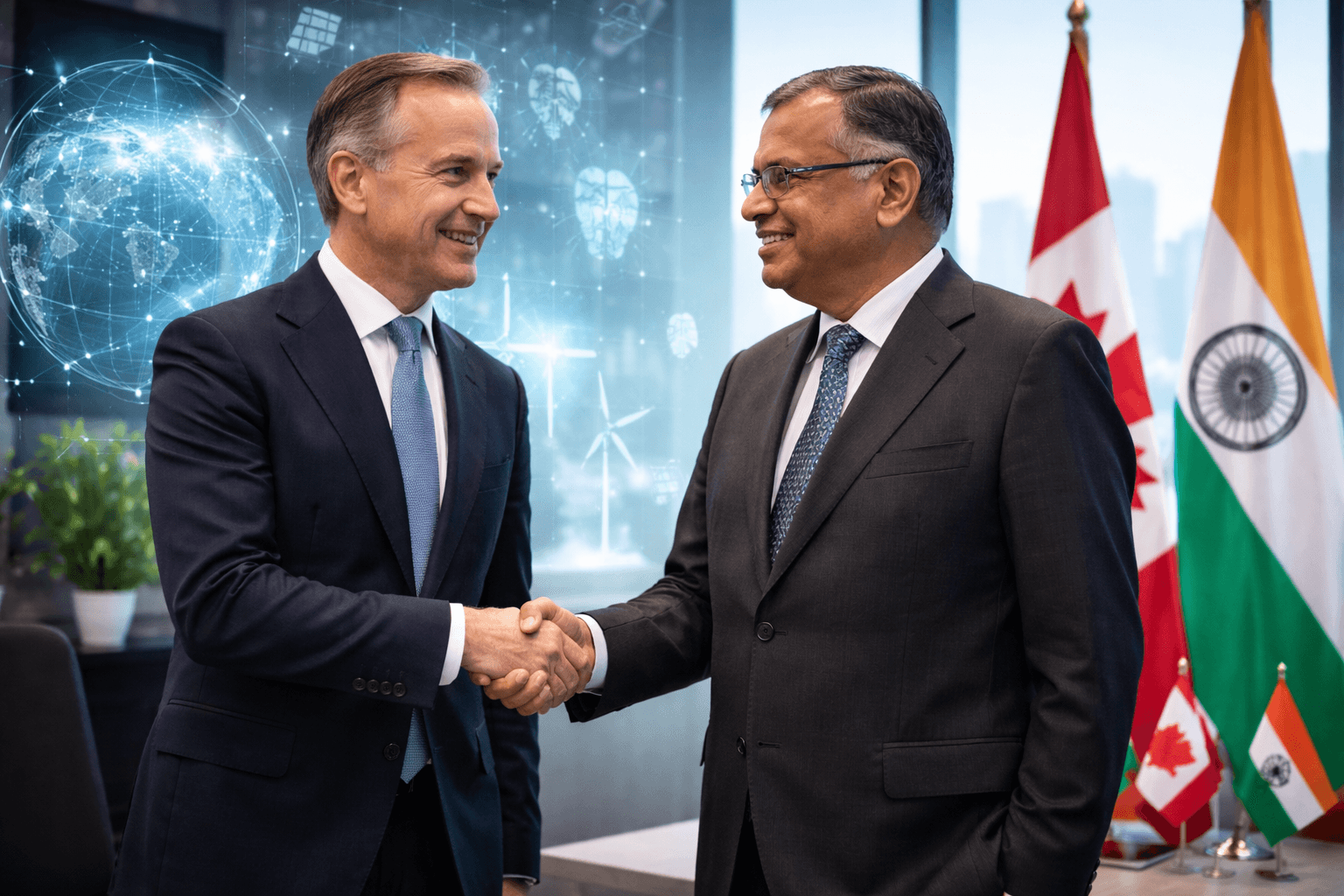
Canada is recalibrating its global technology strategy at a time when artificial intelligence and clean energy are reshaping economic power. India’s Tata Group, one of the world’s largest and most diversified conglomerates, is simultaneously expanding its international technology footprint. Against this backdrop, the recent meeting between Mark Carney and Natarajan Chandrasekaran carries strategic significance that extends well beyond symbolism.
The discussion focused on potential collaboration across artificial intelligence, advanced technology, and clean energy. While no formal agreement was announced, the engagement reflects a deliberate effort to align national policy priorities with industrial scale execution. It also signals a renewed momentum in India Canada economic relations, anchored in future facing sectors.
Why the Timing of This Engagement Is Important
Global competition in technology has intensified. Governments are now prioritizing trusted partnerships that balance innovation, security, and long term value creation. Canada is strengthening its position as a hub for responsible AI and sustainable technology, while India’s technology driven conglomerates are increasingly shaping global digital infrastructure.
Tata Group operates in more than one hundred countries and reports annual revenues exceeding one hundred fifty billion dollars. Its presence across technology services, manufacturing, renewable energy, and advanced engineering makes it a natural partner for countries seeking integrated and reliable technology collaboration. This scale and diversity explain why the Canadian leadership views Tata as a credible long term collaborator rather than a transactional investor.
you might like this :- Reliance Holds 70%, Meta Secures 30% stake in Reliance Enterprise Intelligence
Canada’s Strategic Push in Artificial Intelligence and Innovation
Canada has spent over a decade building its artificial intelligence ecosystem, with globally recognized research clusters in Toronto, Montreal, and Edmonton. Under Prime Minister Carney, the focus has shifted from research leadership to economic deployment. The government’s strategy emphasizes responsible AI adoption, secure technology supply chains, and innovation that delivers measurable industrial outcomes.
This approach reflects a broader policy shift. Canada is no longer seeking innovation in isolation. Instead, it aims to pair domestic research excellence with global enterprises capable of deploying technology at scale. That objective framed the discussions with Tata Group.
Why Tata Group Aligns With Canada’s Vision
Tata Group brings a rare combination of technological depth and operational reach. The group’s businesses span information technology, electric mobility, clean energy, aerospace, and advanced manufacturing. Collectively, Tata companies employ more than one million people worldwide, underscoring their ability to deliver complex, cross sector projects.
In artificial intelligence, Tata’s technology arms work extensively on enterprise automation, cloud platforms, data driven decision systems, and cybersecurity solutions. These capabilities directly align with Canada’s ambition to move AI from laboratories into real world economic use. At the same time, Tata’s long standing investments in renewable energy and sustainability complement Canada’s clean energy transition goals.
Key Themes Emerging From the Discussions
Artificial intelligence emerged as a central theme, with both sides exploring collaboration focused on applied and industrial AI rather than purely academic research. The emphasis remains on practical deployment, ethical governance, and scalable enterprise solutions. Canada’s research ecosystem and Tata’s implementation capacity create a complementary dynamic that few partnerships can replicate.
Clean energy also featured prominently in the discussions. Canada is accelerating its shift toward renewable power, low carbon manufacturing, and energy storage technologies. Tata’s expanding renewable portfolio and experience in sustainable infrastructure position it as a relevant partner in this transition.
Advanced manufacturing and resilient supply chains formed another important dimension of the talks. Areas such as electric vehicle ecosystems, battery production, and high value industrial components are increasingly viewed as strategic assets. Canada’s policy framework seeks stable, long term partners in these sectors, and Tata’s global manufacturing experience supports that objective.
Implications for Industry and Markets
The meeting sends a clear signal to global markets that India Canada engagement is evolving beyond traditional trade relationships. The focus is shifting toward strategic technology collaboration, where governments and corporations align their long term interests. This shift is likely to encourage further dialogue between Canadian policymakers and Indian technology leaders.
For Canada, deeper engagement with Tata Group enhances its competitiveness in emerging technologies while strengthening supply chain resilience. For Tata, collaboration with Canada offers access to advanced research ecosystems, stable regulatory environments, and new innovation opportunities in North America.
Strategic Meaning Beyond the Headlines
This engagement reflects a broader global trend. Governments increasingly prefer partnerships with enterprises that demonstrate governance credibility, technological capability, and long term commitment. Tata Group fits this profile, while Canada is positioning itself as a trusted innovation partner rather than a passive market.
If translated into concrete initiatives, the discussions could influence artificial intelligence governance frameworks, cross border research investment, and clean technology supply chains. The long term value lies not in announcements, but in execution discipline.
What to Expect Going Forward
No formal agreements were announced, and that restraint is notable. It suggests that both sides are laying groundwork rather than pursuing quick headlines. The next phase is likely to involve sector specific evaluations, pilot collaborations, and policy alignment discussions before any large scale commitments.
Such a measured approach increases the likelihood of sustainable outcomes rather than symbolic partnerships.
The meeting between Prime Minister Mark Carney and Tata Group Chairman N Chandrasekaran reflects a strategic convergence of national priorities and corporate capability. Artificial intelligence and clean energy sit at the center of this alignment, supported by advanced manufacturing and technology driven supply chains.
While still at an exploratory stage, the engagement signals a deeper, more structured phase of India Canada cooperation. If followed by disciplined execution, it could shape bilateral technology collaboration for years to come.
Topics
Covering startup news, AI, technology, and business at ThePrimely. Delivering accurate, in-depth reporting on the stories that shape the future.