
Will India Get More Concessions From the US After the 30-Day Russian Oil Waiver?
A Strategic Energy Decision
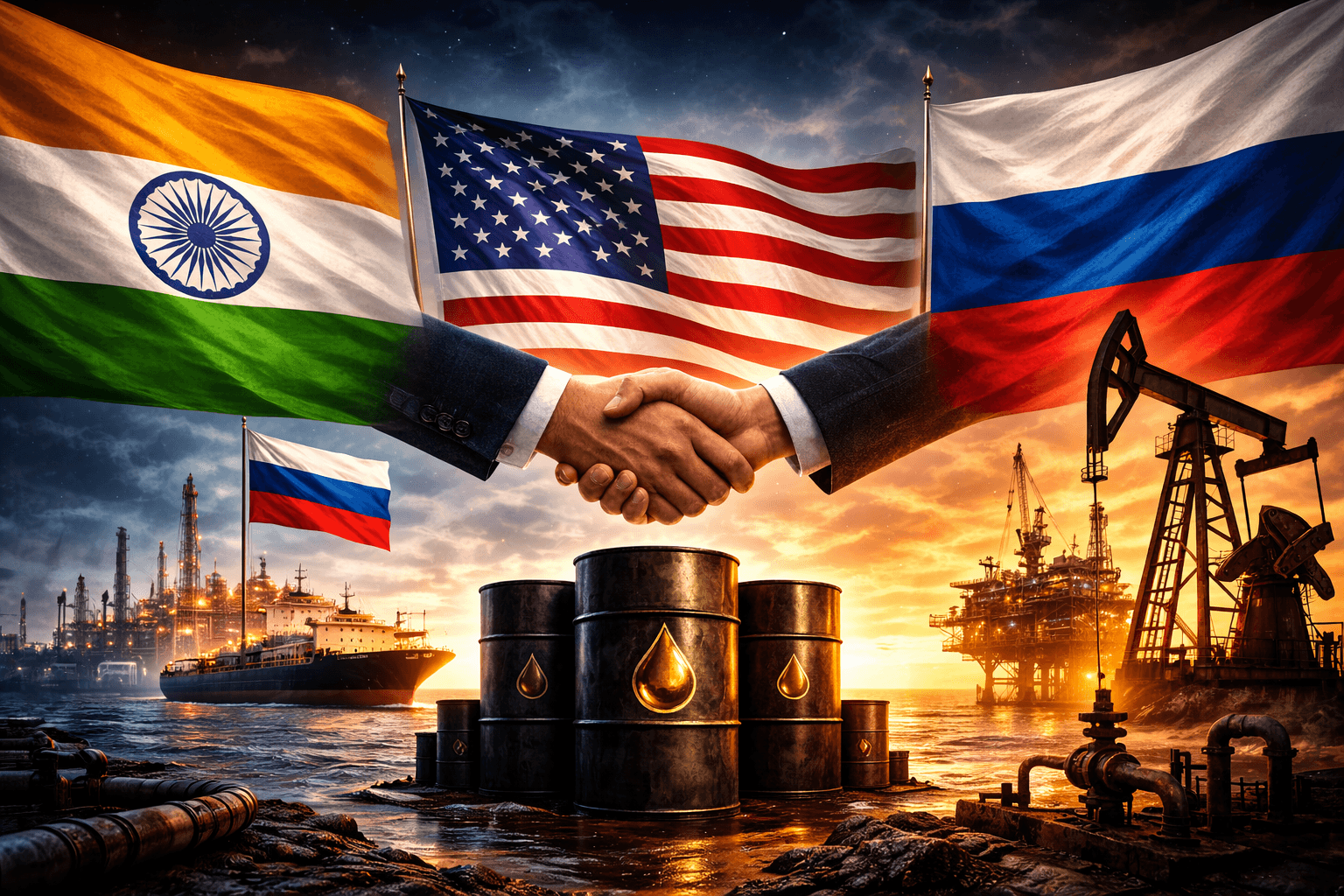
The United States has issued a temporary policy shift that allows India to purchase Russian oil despite ongoing sanctions. The decision arrives during a period of escalating geopolitical tension in the Middle East.
Washington approved a 30 day waiver permitting Indian refiners to buy Russian crude that is already loaded on ships. The move aims to stabilize oil markets and prevent supply disruptions as regional conflict threatens global energy routes.
At first glance, the decision appears to contradict earlier pressure from the US to limit Russian energy purchases. However, the context reveals a more complex strategic calculation involving energy security, market stability, and diplomatic balance.
Understanding the US Waiver for India to Buy Russian Oil
The US Treasury authorized a temporary license lasting until April 4, 2026. The waiver allows Indian refiners to purchase Russian crude oil that was loaded onto vessels before March 5.
Importantly, the permission applies only to oil already in transit. It does not reopen unrestricted trade with Russia.
US officials explained that the purpose is to keep oil flowing into global markets during a period of disruption. The waiver is designed to avoid sudden supply shortages and prevent sharp price spikes.
President Donald Trump stated the decision was meant to “take a little pressure off” global markets during the crisis.
Therefore, the policy is not a long term change. Instead, it functions as a short term stabilizing mechanism.
Why the Middle East Crisis Triggered the Decision
The policy shift is closely linked to rising instability in the Middle East.
Energy markets are particularly sensitive to disruptions around the Strait of Hormuz, a critical maritime route for global oil transport. Nearly 40 to 50 percent of India’s crude imports pass through this corridor.
Any disruption in the region can create immediate supply pressure.
India is especially vulnerable because it imports almost 90 percent of its crude oil requirements from international markets.
In this environment, allowing India to access Russian cargoes already at sea helps ease immediate supply constraints. It also reduces competition for Middle Eastern barrels among global buyers.
India’s Oil Strategy and Energy Dependence
India’s energy strategy has consistently focused on supply diversification and price efficiency.
After the Ukraine conflict began in 2022, India became one of the largest buyers of Russian oil. Discounted prices made Russian crude economically attractive.
However, imports fluctuated under international pressure. At one point, Russia accounted for around 40 percent of India’s crude imports.
Later, the share fell to about 21 percent in early 2026 before recovering again.
Despite geopolitical pressure, Indian officials maintain that energy purchases are guided by national interest.
Government representatives have stated that India does not require permission from any country to purchase oil.
This stance highlights India's broader strategy of maintaining strategic autonomy in energy procurement.
Immediate Market Impact
The waiver has already influenced oil trade dynamics.
Industry sources report that Indian refiners have begun securing Russian cargoes available in international waters. In some cases, around 20 million barrels of crude have been purchased following the announcement.
Analysts estimate that Russian oil shipments to India could rise from about 1 million barrels per day to as high as 1.6 to 2 million barrels per day in the near term.
However, the benefit is temporary. The waiver primarily unlocks oil that is already in transit rather than expanding long term supply contracts.
Competition from other buyers, particularly China, could also limit the extent of additional purchases.
Strategic Implications for US India Relations
The decision also reflects the evolving nature of US India strategic cooperation.
India remains a key partner in the Indo Pacific region. Maintaining energy stability in the country supports broader geopolitical goals.
The US also expects India to increase imports of American oil in the future. The waiver therefore acts as a short term flexibility measure rather than a shift in sanctions policy.
At the same time, the move signals Washington’s willingness to adapt policy during global market disruptions.
In practical terms, it prioritizes energy market stability over strict enforcement during a temporary crisis.
Future Outlook for Global Oil Markets
The next few weeks will determine whether the waiver has a lasting impact.
If tensions in the Middle East escalate further, global oil prices could rise sharply. Some analysts warn that severe disruptions could push prices toward $150 per barrel.
For India, the priority remains ensuring uninterrupted fuel supplies and maintaining refinery operations.
In the longer term, the crisis reinforces the importance of diversified energy sources. Countries are likely to accelerate investments in alternative supply routes, strategic reserves, and renewable energy.
The US waiver for India to buy Russian oil represents a pragmatic response to a volatile global energy environment.
Rather than a shift in sanctions policy, it serves as a targeted measure to stabilize oil markets during geopolitical disruption.
For India, the waiver provides short term supply flexibility. For the United States, it helps maintain market balance while preserving strategic relations.
The broader lesson is clear. In global energy politics, economic stability often demands strategic flexibility.
Topics
Covering startup news, AI, technology, and business at ThePrimely. Delivering accurate, in-depth reporting on the stories that shape the future.