
Why Trump Mobile T1 Is Not Fully Made in the US and What That Really Means
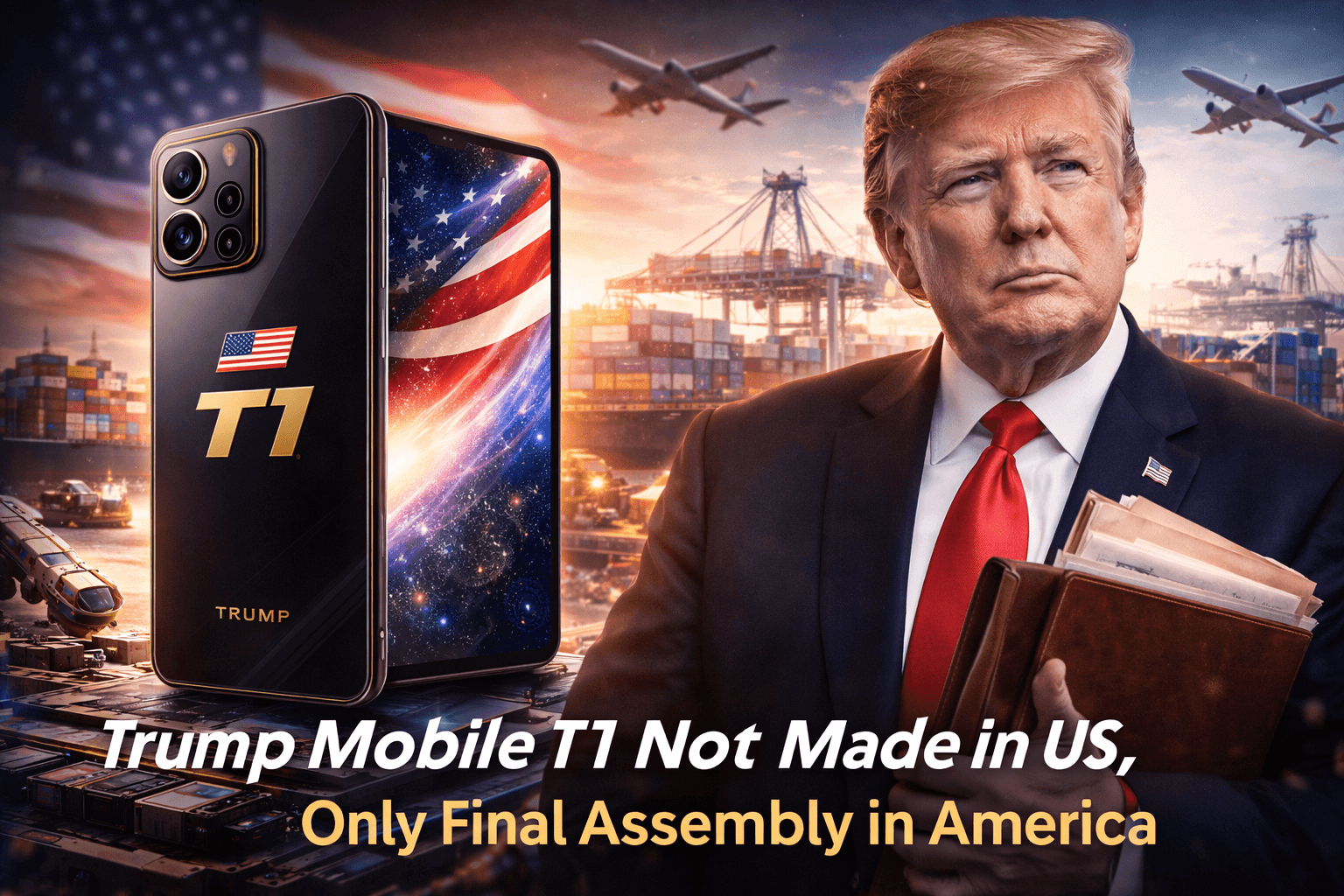
The buzz around Trump Mobile’s T1 smartphone promised a bold new entrant in the U.S. tech market a phone that would be proudly made in America to compete with Apple and Samsung. But recent reports show that reality has shifted.
Contrary to early messaging and promotional claims, the T1 will not be fully manufactured in the United States. Instead, most of its production will take place overseas, and only limited final assembly will happen in the U.S., specifically in Miami, Florida.
This marks a significant change from the original narrative, which positioned the device as a genuinely domestic alternative in a sector dominated by foreign manufacturing.
How the “Made in America” Narrative Changed
When Trump Mobile was unveiled in mid-2025, company marketing materials highlighted that the T1 was “designed and built in the United States,” tapping into patriotic sentiment and reshoring rhetoric.
However, technology reporting and executive comments since then have confirmed that the bulk of production and component sourcing occurs overseas, where most modern smartphone manufacturing happens due to established global supply chains.
Rather than a fully domestic handset, the T1 phone’s overseas production will be followed by limited final assembly work in the United States a shift that has prompted skepticism from experts and potential buyers alike.
Why Full US Manufacturing Was Hard to Deliver
Smartphone production on a large scale is a complex, highly specialised process. Most global devices including those from major brands like Apple, Samsung, and Google rely on parts and assembly from China, Vietnam, South Korea, and increasingly India.
To qualify as “Made in USA” under U.S. federal standards, nearly all components and final assembly must be domestic a requirement that is extremely difficult to meet at a competitive price point. Industry experts point out that building consumer smartphones entirely in the U.S. would significantly raise costs and require facilities and supplier networks that do not currently exist.
Even specialty phones that are genuinely American-made, such as small boutique models costing well over $2,000, rely on global components for parts like crystals, cameras, or modem chips.
Updated Marketing and Messaging
In response to these challenges, Trump Mobile has updated how it talks about the T1’s origins. Instead of stating it is “Made in the USA,” the company now uses phrases like “proudly designed with American values” or notes that final assembly occurs in the United States.
This shift is reflected on official sites where earlier statements about full U.S. manufacture have been removed or softened. However, critics say the language still falls short of genuine domestic production.
Launch Delays and Spec Changes
The T1 smartphone has already faced repeated delays. Originally expected in 2025, its launch has been pushed to early 2026 as the company works through design refinements, certification processes, and supply chain adjustments.
Reports also suggest changes in design details and pricing strategy, with executives hinting that models beyond the initial batch could cost more than the original $499 introductory price.
The decision to only assemble the T1 domestically aligns with these shifts, as full U.S. production proved less feasible than initially implied.
Consumer Reaction and Political Implications
For customers who pre-ordered the device based on the “Made in America” label, the reversal has stirred disappointment. Some say it feels like a marketing pivot rather than a fulfillment of patriotic manufacturing pledges.
Observers also note the political dimension: the original messaging fit a narrative of reshoring and domestic production that resonates with certain voter segments. The change to limited assembly highlights how globalisation and manufacturing realities can challenge even high-profile branding claims.
What This Means for the Trump Mobile Brand
Trump Mobile is an ambitious entry into the smartphone and telecom market, backed by licensing of the Trump name and aimed at capturing patriotic sentiment and value-oriented consumers. The T1 phone, along with its $47 per month service offering, represents this strategy.
Yet the manufacturing shift raises questions about how effectively the product can deliver on its core promise competing on both price and patriotic appeal while navigating complex global production networks.
Even with limited U.S. assembly, the broader picture shows that most of the high-value manufacturing steps remain outside the United States, reflecting industry norms that have been entrenched for decades.
Topics
Covering startup news, AI, technology, and business at ThePrimely. Delivering accurate, in-depth reporting on the stories that shape the future.