
Strait of Hormuz Crisis: What Happens if Iran Closes Global Oil Route
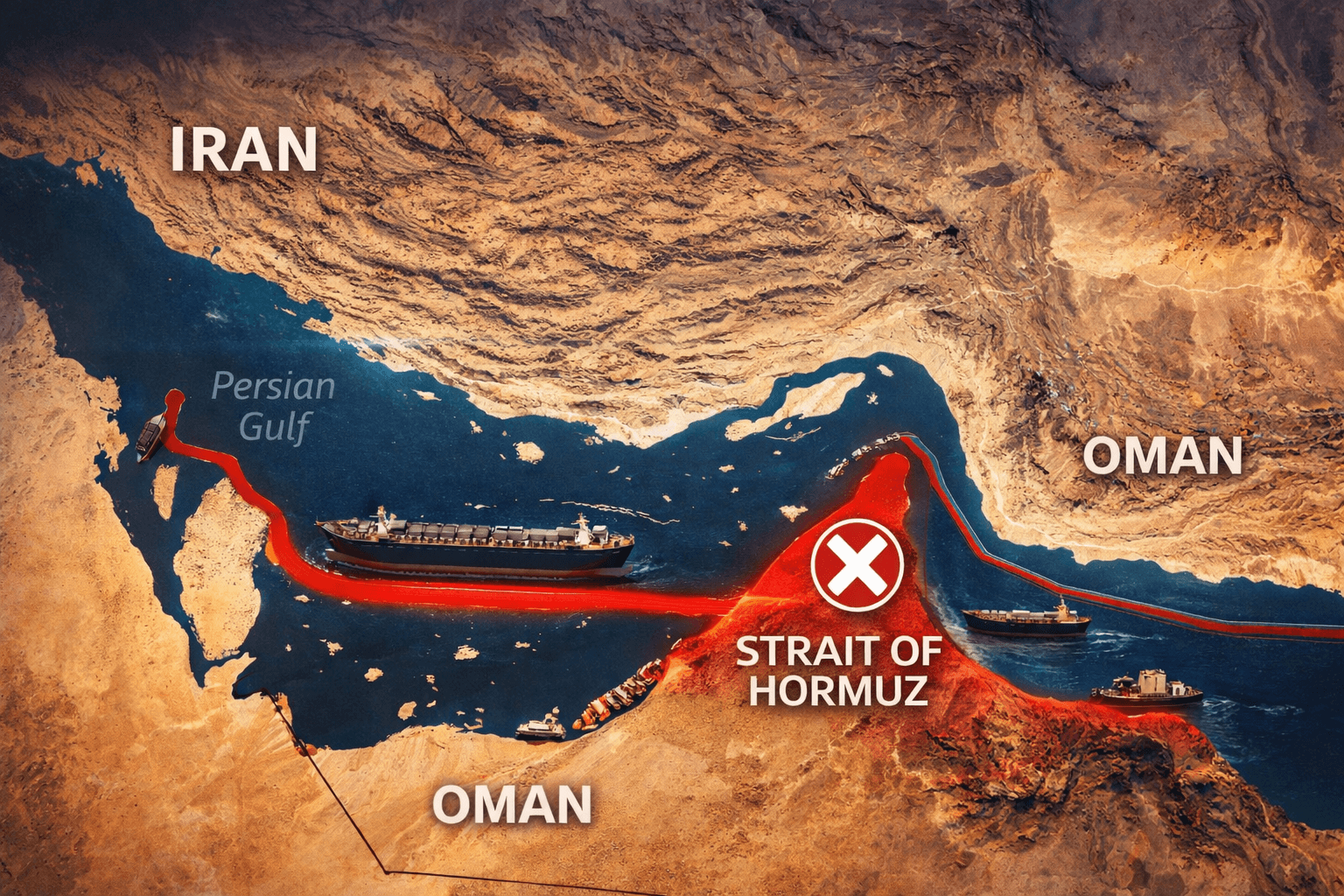
Global energy markets now focus on a narrow stretch of water between Iran and Oman.
The Strait of Hormuz has become the center of tension as the conflict involving Iran intensifies. US President Donald Trump recently warned Iran against disrupting shipping through the corridor.
“If Iran does anything that stops the flow of oil within the Strait of Hormuz, the United States will respond twenty times harder,” Trump wrote on social media.
His warning highlights how vital the strait is to the global economy.
About one-fifth of the world’s oil supply normally travels through this narrow passage. That makes it the busiest oil shipping route on Earth.
Why the Strait of Hormuz Matters
The Strait of Hormuz connects the Persian Gulf with the Gulf of Oman and the Arabian Sea.
Although the waterway looks small on a map, it carries enormous volumes of global energy trade.
At the entrance, the strait measures about 50 kilometres wide. At its narrowest point, it shrinks to roughly 33 kilometres.
Despite its size, the route handles around 20 million barrels of oil every day.
According to the US Energy Information Administration, the value of this trade approaches $600 billion each year.
Tankers carry crude oil through the corridor from several Gulf producers. These include Saudi Arabia, Iraq, Kuwait, Qatar, the United Arab Emirates and Iran.
From there, ships deliver the oil to markets across the world.
Asia Depends Heavily on the Route
A blockade of the Strait of Hormuz would hit Asian economies particularly hard.
Countries such as China, India, Japan and South Korea import large volumes of Gulf oil.
Data shows that about 82% of crude oil leaving the strait travels to Asian markets.
China alone buys most of Iran’s oil exports.
Chinese factories then use that oil to produce goods sold worldwide. Higher oil prices could therefore raise costs for consumers in many countries.
Shipping Through the Strait Has Slowed
Even without a full blockade, shipping traffic has already fallen sharply.
Security threats, missile attacks and warnings from Iran have discouraged many shipping companies.
Some insurers have also raised the cost of covering vessels that pass through the strait.
Energy analyst Arne Lohmann Rasmussen said the route has effectively closed for many companies.
“You risk attack, and insurance becomes extremely expensive,” he said.
Because of those risks, many tankers now wait outside the strait until the security situation improves.
Oil Prices React Quickly
Energy markets respond quickly to events in the Middle East.
When traders fear supply disruption, they often push oil prices higher.
Crude oil recently surged above $100 per barrel as the conflict intensified.
Prices later fell toward $90 per barrel after comments suggested the war might end sooner than expected.
Even after the decline, oil prices remain far higher than before the conflict began.
Shipping costs have also risen sharply.
Data from the London Stock Exchange Group shows that hiring a supertanker from the Gulf to China now costs more than $400,000 per voyage.
How Iran Could Close the Strait
Iran has several options if it attempts to disrupt shipping.
Military analysts say the country could deploy naval mines in the narrow waterway.
Iran could also launch anti-ship missiles or attack tankers using fast naval boats.
The Iranian navy and the Islamic Revolutionary Guard Corps operate fleets designed for such operations.
However, any attempt to close the strait would likely trigger a strong international response.
The United States and its allies have previously used naval forces to protect shipping routes in the Gulf.
During the Iran-Iraq war in the 1980s, US warships escorted oil tankers through the region.
Alternative Routes Cannot Fully Replace Hormuz
Some Gulf producers have built pipelines to bypass the Strait of Hormuz.
Saudi Arabia operates a 1,200-kilometre pipeline that transports crude oil to the Red Sea.
The United Arab Emirates also runs a pipeline from inland oil fields to the port of Fujairah.
These routes allow some exports to avoid the strait.
However, analysts say they cannot replace the massive volume of oil normally shipped through Hormuz.
Even with these pipelines, a blockade could remove eight to ten million barrels of oil per day from global markets.
A Narrow Waterway with Global Impact
For now, the Strait of Hormuz remains open, though traffic has slowed significantly.
But the crisis shows how a single maritime corridor can shape the global economy.
Energy markets, governments and shipping companies continue to watch the situation closely.
Because if the strait closes completely, the consequences would reach far beyond the Middle East.
Fuel prices, supply chains and household bills across the world could all feel the impact.
Topics
Covering startup news, AI, technology, and business at ThePrimely. Delivering accurate, in-depth reporting on the stories that shape the future.