
Why Has the Rupee Hit ₹95 Against the Dollar, and What Should Investors Do Now?
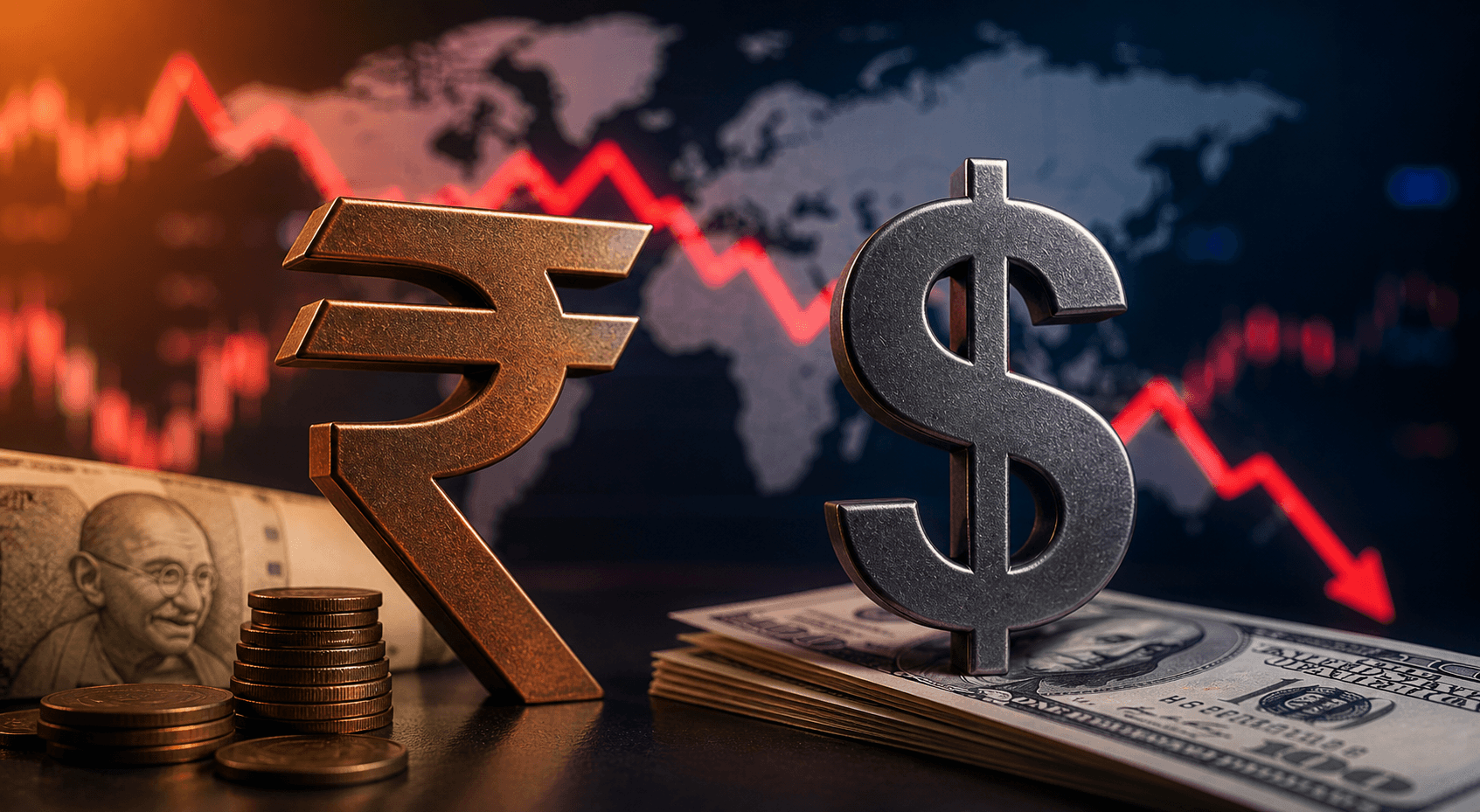
The Indian rupee has crossed a historic threshold.
It touched a record low near ₹95.35 against the US dollar, raising fresh concerns across financial markets and households alike. For many, this may appear to be another currency fluctuation. However, the current fall signals deeper macroeconomic pressure. It reflects global energy shocks, foreign investor exits, and tighter global monetary conditions.
The key question now is simple. What does Rupee at ₹95 mean for investors, and how should they respond? The answer demands perspective, not panic.
Why Is the Rupee at ₹95? Understanding the Core Drivers
The rupee’s weakness is not the result of a single event. Several structural pressures have aligned at the same time.
The biggest trigger is crude oil. Brent crude has surged above $124 to $126 per barrel, sharply increasing India’s import bill. Since India imports most of its energy needs, every rise in oil prices directly increases dollar demand. That weakens the rupee further.
At the same time, foreign portfolio investors have pulled over $20 billion from Indian markets in recent weeks. These outflows have intensified dollar demand while reducing rupee liquidity. Another major factor is the US Federal Reserve.
Its firm stance on interest rates has strengthened the dollar globally. Emerging market currencies, including the rupee, have naturally faced added pressure. Together, these forces have pushed the rupee into historic territory.
What Does Rupee at ₹95 Mean for India’s Economy?
A weaker rupee has both costs and opportunities. The immediate downside is inflation. Imported products become more expensive. Fuel prices rise first. Then transportation costs increase. Eventually, this affects food prices, electronics, consumer goods, and manufacturing costs.
For households, this translates into a gradual rise in daily expenses. For businesses, imported raw materials become costlier. This compresses profit margins in sectors such as aviation, electronics, chemicals, and oil marketing.
However, not every sector suffers. Export oriented industries gain from rupee weakness because their dollar revenues translate into higher rupee earnings. This often benefits IT services, pharmaceuticals, textiles, and select manufacturing exporters.
That creates a split market. Some sectors face pressure, while others strengthen.
How Is the RBI Responding to the Rupee Slide?
The Reserve Bank of India has stepped in aggressively. Market data shows the RBI’s forward dollar position has crossed $104 billion, a record level. This reflects large scale intervention to reduce excessive volatility.
The central bank has also been supplying dollars through state owned banks to smooth sharp market moves. Yet intervention has limits.
The RBI can slow volatility, but it cannot fully offset sustained global pressures such as oil shocks or large capital outflows. This means investors should not expect quick currency stabilization unless external conditions improve.
What Should Investors Do Now? Strategic Moves That Matter
This is not the time for impulsive portfolio changes. It is the time for disciplined allocation. A falling rupee often increases short term volatility. Reacting emotionally usually destroys long term returns. Instead, investors should focus on resilience. Diversification becomes critical. A balanced portfolio across equities, debt, and gold offers stronger protection during currency stress. Gold deserves particular attention.
Historically, gold performs well when currencies weaken and geopolitical risks rise. It acts as a natural hedge against inflation and uncertainty. Within equities, investors should tilt toward export driven sectors. IT services and pharmaceutical companies often benefit from dollar strength. At the same time, caution is warranted in sectors heavily dependent on imports.
Aviation, consumer electronics, and fuel intensive businesses may face margin pressure if crude prices remain elevated. Debt investors should also remain selective. If inflation rises further, bond yields may move higher, which can hurt long duration debt funds. Short duration debt instruments may offer greater stability.
Is This a Temporary Fall or a Structural Shift?
The answer depends on three variables. First, global crude oil prices. If oil remains above $120 per barrel, pressure on India’s current account will persist. Second, foreign capital flows. Sustained institutional selling would continue to weaken sentiment. Third, US monetary policy.
A stronger dollar environment will keep emerging market currencies under pressure. Most analysts expect volatility to continue in the near term, with some forecasting levels near ₹96.80 if external risks remain elevated. That said, India’s long term economic fundamentals remain intact. The present challenge is cyclical, not existential.
Why Calm Strategy Beats Panic
Rupee at ₹95 is a warning signal. It highlights external vulnerabilities. It does not signal economic collapse. Currency weakness often creates short term discomfort, but it also reveals opportunities for disciplined investors.
The smartest response is not to chase headlines. It is to strengthen portfolio quality, increase diversification, and focus on sectors positioned to benefit from current macro trends. Periods like this test conviction. They also reward strategic patience.
FAQ'S
Why has the rupee fallen to ₹95?
The rupee has weakened due to rising crude oil prices, foreign investor outflows, and a stronger US dollar driven by higher US interest rates.
Will the rupee fall further?
It could weaken further if oil prices stay elevated and foreign capital outflows continue.
Should investors sell their equity investments now?
No. Panic selling during currency volatility often locks in losses. Strategic portfolio rebalancing is a better approach.
Which sectors benefit from a weaker rupee?
IT services, pharmaceuticals, and export focused manufacturing sectors often benefit.
Is gold a good investment during rupee weakness?
Yes. Gold typically acts as a hedge against inflation, currency depreciation, and global uncertainty.
Topics
Covering startup news, AI, technology, and business at ThePrimely. Delivering accurate, in-depth reporting on the stories that shape the future.