
Samsung Unveils Glasses-Free 3D Screen With 2D/3D Switch
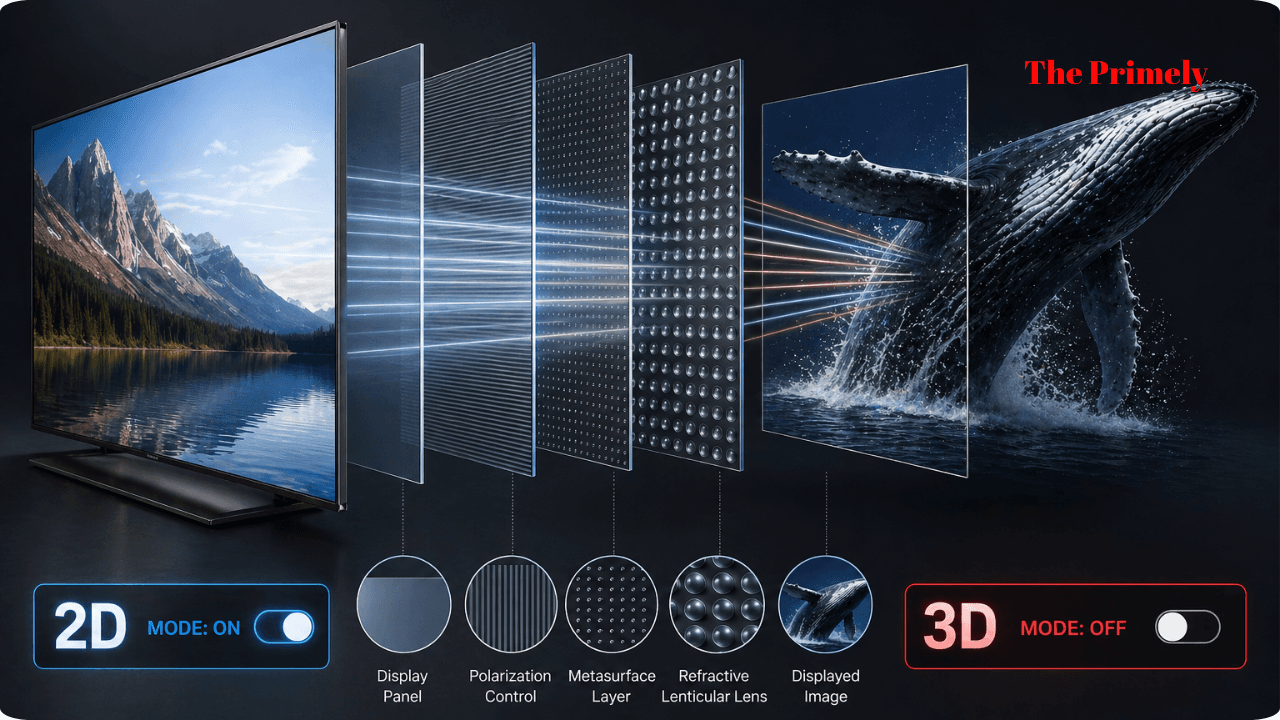
Samsung 2D 3D display technology is pushing screens into a new era, where users may no longer need special glasses to experience depth. The company, in collaboration with POSTECH, has developed a switchable display that can seamlessly toggle between standard 2D viewing and immersive 3D visuals.
This is not just another experimental feature. It represents a major shift in how displays could function across smartphones, tablets, and future devices.
How the Technology Works
At the core of this innovation is a metasurface lenticular lens, an ultra-thin optical layer built using nanoscale structures. This layer precisely controls how light is directed toward the viewer, enabling both flat and depth-based visuals on the same screen.
Unlike traditional 3D displays that rely on bulky lenses or external glasses, this system uses a metalens just around 1.2 mm thick, making it compact enough to fit into modern devices.
The display can switch modes using voltage control. When active, the lens changes how light bends, allowing the screen to produce either a clear 2D image or a multi-view 3D effect.
What Makes It Different
Older glasses-free 3D systems often suffered from poor viewing angles and reduced image quality. Samsung’s approach aims to solve these problems.
The new system can achieve viewing angles of up to 100 degrees, significantly wider than earlier technologies that were limited to narrow viewing zones.
It also maintains high-resolution clarity in 2D mode while delivering depth in 3D, removing the trade-off that typically exists between the two formats.
Why This Matters Now
The idea of glasses-free 3D has been around for years, but it never reached mainstream adoption due to technical limitations. Samsung’s solution addresses those limitations by combining thin design, better light control, and seamless switching.
This could open new possibilities across industries. Entertainment, gaming, augmented reality, and even medical imaging could benefit from displays that naturally create depth without extra hardware.
From Research to Real Devices
The technology is still in the research phase, but Samsung has already demonstrated working prototypes using OLED panels.
Reports suggest that future devices, possibly flagship smartphones, could integrate this display system within the next few years.
If commercialised successfully, it could redefine how users interact with screens, turning flat displays into dynamic, depth-aware interfaces.
Strategic Implications
Samsung’s move highlights a broader trend in display innovation. The focus is shifting from resolution and refresh rates toward immersive experiences.
By investing in metasurface optics, Samsung is positioning itself at the forefront of next-generation display technology. This could give it a competitive edge in both consumer electronics and emerging tech sectors.
Topics
Covering startup news, AI, technology, and business at ThePrimely. Delivering accurate, in-depth reporting on the stories that shape the future.