
China Blocks Nvidia H200 Chips as Tech Tensions Deepen
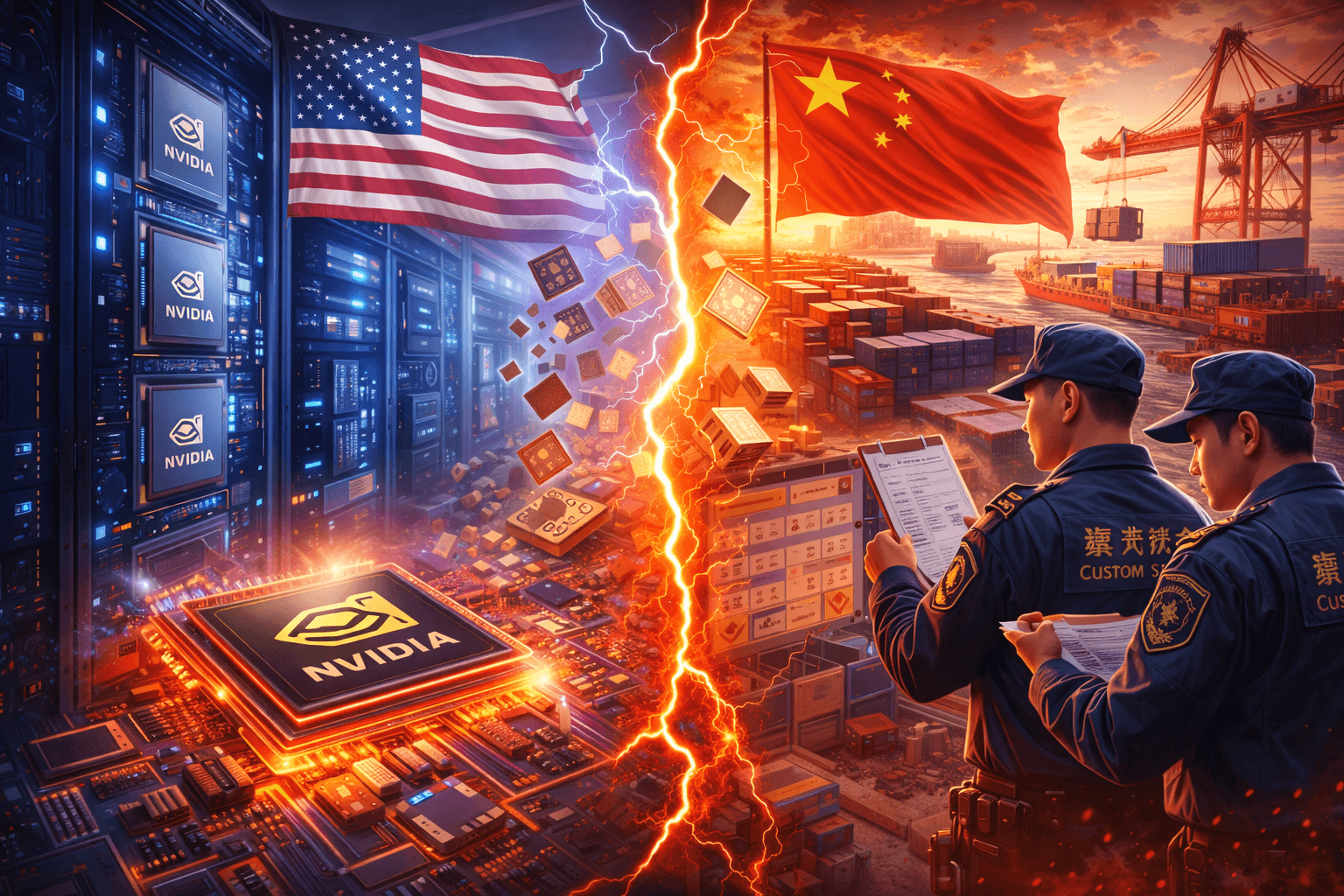
China Blocks Nvidia H200 Chips, Complicating Global AI Supply Chains
China has reportedly instructed customs authorities to prevent Nvidia H200 chips China shipments from entering the country, a move that adds a new layer of complexity to global semiconductor trade and underscores deepening US China technology tensions.
The guidance, described as administrative rather than publicly legislated, places enforcement power directly at the border. Even where U.S. export rules allow limited sales, China’s customs-level intervention effectively determines whether advanced Nvidia AI hardware reaches one of the world’s largest AI markets. The result is growing uncertainty for chipmakers, cloud providers, and AI developers operating across borders.
A Quiet Restriction With Major Impact
Unlike formal policy announcements, China customs restrictions often operate through guidance to port authorities. In this case, shipments of Nvidia’s H200 one of the company’s most advanced AI accelerators are reportedly being stopped during inspection.
That matters because export controls traditionally work in one direction: producer nations restrict sales. Here, the importing country is exercising its own gatekeeping power, illustrating how semiconductor export controls have evolved into a two-sided regulatory environment.
This approach gives Beijing leverage over technology flows even when foreign governments relax or reinterpret their own rules.
Why the H200 Chip Is Strategically Important
The H200 is designed for memory-intensive AI workloads such as large language model training, generative AI systems, and scientific computing. It plays a central role in modern AI data center chips infrastructure, where performance is increasingly defined by bandwidth and energy efficiency.
For Chinese technology firms, access to such hardware is tied directly to competitiveness in artificial intelligence. Limiting imports of this chip affects research institutions, cloud providers, and AI startups scaling advanced models.
In short, the issue is not just about one product. It sits at the intersection of computing power, industrial policy, and national strategy.
Beijing’s Push for Semiconductor Self-Reliance
The move aligns with a broader goal: accelerating China semiconductor self reliance. Over the past several years, Beijing has invested heavily in domestic chip design, manufacturing tools, and AI hardware ecosystems.
By creating regulatory uncertainty around foreign high-end chips, authorities may be encouraging companies to prioritize local alternatives, even if those lag global performance leaders. Dependence on imported advanced semiconductors now carries not only commercial risk but also regulatory exposure.
This shift reframes technology procurement as a strategic decision rather than a purely technical one.
A New Phase in US–China Technology Competition
The episode illustrates how China AI chip restrictions are no longer simply reactive to U.S. actions. Instead, both countries are shaping technology flows to align with national priorities.
Washington’s focus has been to prevent advanced chips from supporting sensitive applications. Beijing’s strategy increasingly centers on controlling domestic demand, guiding industry behavior, and reducing reliance on foreign suppliers.
This dynamic creates a layered system of controls where approval from one side does not guarantee market access on the other.
Implications for Nvidia and the Industry
For Nvidia, China has historically been an important though politically sensitive market. The H200 represents a high-performance tier within its product lineup, and restrictions on entry could limit near-term sales while accelerating customer migration toward alternative suppliers.
Over time, that shift could reshape competitive dynamics in the global AI hardware sector. Once enterprises adapt software and infrastructure around different chips, switching back becomes costly.
For the broader industry, the situation adds friction to global chip supply chains already navigating sanctions, licensing rules, and industrial policy incentives. Companies designing AI systems must now plan not only for export compliance, but also for import enforcement and regulatory unpredictability.
Market and Career Relevance
Investors increasingly treat AI semiconductors as geopolitical assets, not just technology products. Sudden restrictions can affect revenue forecasts, regional demand patterns, and long-term growth assumptions.
For professionals in hardware engineering, data center operations, and semiconductor manufacturing, the message is clear: technical decisions are now closely tied to policy environments. Skills in compliance, supply chain strategy, and cross-border operations are becoming as important as engineering expertise.
What Happens Next
It remains uncertain whether China’s reported practice will formalize into written regulation or remain an enforcement norm. Outcomes may hinge on broader diplomatic and trade developments.
What is clear is that access to advanced AI chips is increasingly shaped by national strategy. The Nvidia H200 chips China situation reflects a broader shift in which AI infrastructure is treated as a strategic resource governed by borders, controls, and geopolitical rivalry rather than open market logic.
Frequently Asked Questions
Why is China blocking Nvidia H200 chips?
The move appears tied to technology control, supply chain strategy, and efforts to reduce dependence on foreign AI hardware.
Are U.S. export approvals enough to sell chips in China?
Not necessarily. Import-side enforcement can still limit access.
How does this affect AI development?
It may slow access to top-tier hardware while accelerating domestic alternatives.
What does this mean for global supply chains?
Planning complexity increases as companies manage both export and import restrictions.
Topics
Covering startup news, AI, technology, and business at ThePrimely. Delivering accurate, in-depth reporting on the stories that shape the future.