
NASA DART Mission Changed an Asteroid’s Orbit Around the Sun
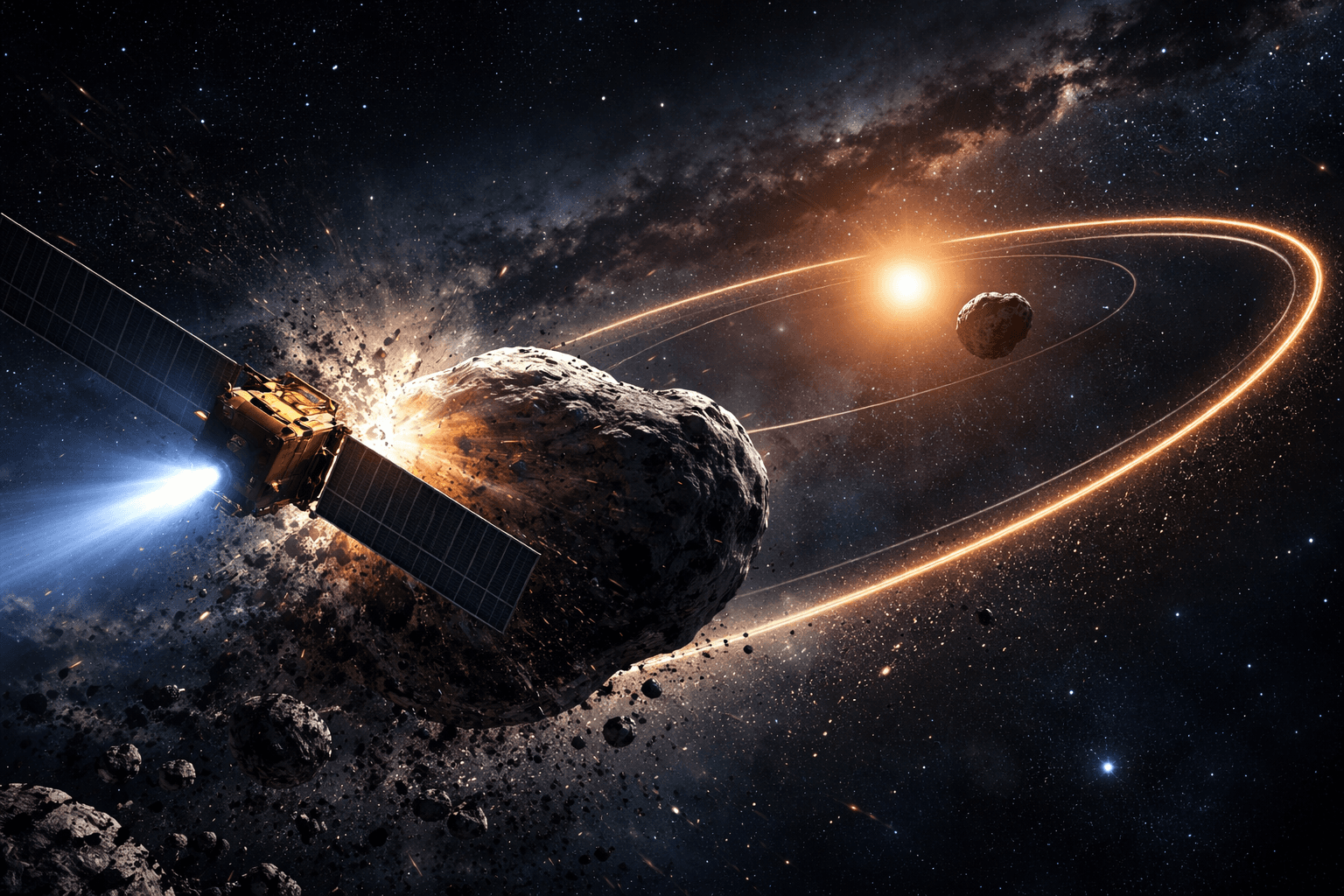
A Space Experiment That Moved an Entire Asteroid System
The NASA DART mission was designed to test a simple idea. Could humanity deflect an asteroid using a spacecraft impact?
New scientific analysis now shows the mission achieved something far more significant. The impact not only shifted a small asteroid’s orbit around its partner. It also slightly altered the entire asteroid system’s orbit around the Sun.
This discovery marks a historic milestone in planetary defense research. For the first time, a human made spacecraft measurably changed the motion of a celestial system in solar orbit.
Scientists say the result demonstrates the real potential of asteroid deflection technology. It also provides critical insights into how Earth might defend itself from future asteroid threats.
Understanding the Asteroid System Targeted by NASA
The experiment focused on a binary asteroid system known as Didymos and Dimorphos.
Didymos is the larger asteroid. Dimorphos is a smaller moonlet that orbits it. Before the experiment, Dimorphos completed one orbit around Didymos roughly every 11 hours and 55 minutes.
This system offered an ideal test case. It allowed scientists to measure orbital changes precisely without threatening Earth.
NASA launched the Double Asteroid Redirection Test spacecraft, commonly called DART, in November 2021. The spacecraft traveled nearly 11 million kilometers before reaching the asteroid system.
On September 26, 2022, the spacecraft intentionally crashed into Dimorphos at about 22,500 kilometers per hour.
The goal was clear. Measure whether the impact could alter the asteroid’s motion.
The Impact That Exceeded Expectations
The collision delivered a dramatic result.
Initial observations showed Dimorphos’ orbital period changed significantly. Instead of circling Didymos every 11 hours and 55 minutes, the new orbit shortened by about 33 minutes.
Scientists originally hoped for a change of at least 73 seconds. The actual result was far greater.
However, deeper analysis revealed something even more remarkable.
The impact generated a massive plume of debris. This ejecta acted like a propulsion system. As material blasted away from the asteroid, it created additional momentum.
As a result, the asteroid received a stronger push than the spacecraft alone could provide.
This effect amplified the impact and produced a measurable shift in the system’s motion.
A Subtle but Historic Shift in Solar Orbit
New studies show the DART collision did more than adjust Dimorphos’ orbit around Didymos.
The event slightly changed how the Didymos Dimorphos system travels around the Sun.
The shift is extremely small in cosmic terms. Yet its importance is enormous.
Until now, no human made object had altered the solar orbit of a celestial body. The DART impact represents the first confirmed instance of such a change.
Scientists measured the alteration using detailed observations and long term tracking data.
The results show that kinetic impact techniques can influence asteroid motion beyond local orbital changes.
This finding significantly strengthens the case for asteroid deflection missions.
Why This Matters for Planetary Defense
Asteroid impacts have shaped Earth’s history. Large collisions caused mass extinctions in the past.
Today, space agencies track thousands of near Earth objects. Most pose no threat. However, some asteroids could potentially collide with Earth in the future.
The DART experiment offers a proven method to address that risk.
The concept is straightforward.
A spacecraft strikes an asteroid years before a predicted impact. Even a tiny change in velocity can shift the asteroid’s future path enough to avoid Earth.
The latest findings confirm that such impacts can generate additional force through debris ejection. This effect increases the effectiveness of the deflection strategy.
Therefore, planetary defense planners now have real world data rather than theoretical models.
Scientific Insights from the DART Experiment
Beyond planetary defense, the mission provided valuable scientific discoveries.
First, the structure of Dimorphos turned out to be weaker than expected. The asteroid appears to consist of loosely bound rubble rather than solid rock.
This structure allowed the impact to eject large amounts of material. That debris enhanced the momentum transfer dramatically.
Second, the mission revealed how asteroid systems respond dynamically to external forces. Even small impacts can produce measurable long term changes.
Third, the experiment improved observation techniques for tracking asteroid motion. Scientists combined ground telescopes, space telescopes, and radar data to measure the orbital shifts precisely.
These methods will help future missions study similar systems.
The Role of International Collaboration
The DART mission also demonstrates the growing global cooperation in planetary defense.
Several observatories across the world monitored the impact and its aftermath. Their data helped confirm the orbital changes.
The next phase will involve closer inspection of the asteroid system.
The European Space Agency’s Hera mission is scheduled to arrive at Didymos and Dimorphos later in the decade. Hera will map the impact crater, measure asteroid mass, and analyze the debris field.
These measurements will refine models of asteroid deflection and improve future mission designs.
Strategic Implications for Future Space Missions
The success of the NASA DART mission opens new strategic possibilities.
Space agencies now have practical evidence that kinetic impactors can redirect asteroids. This method requires relatively simple spacecraft technology compared to nuclear or complex propulsion systems.
Moreover, the experiment shows that asteroid deflection benefits from secondary effects such as debris ejection.
Future missions may intentionally design impacts to maximize this momentum boost.
Researchers also plan to test different asteroid types. Each may respond differently depending on composition and internal structure.
Understanding those differences will be essential for reliable planetary defense strategies.
What Comes Next for Asteroid Defense
Planetary defense is now moving from theory to operational planning.
Space agencies are expanding asteroid detection programs. Early discovery remains the most important factor in preventing collisions.
At the same time, mission planners are developing rapid response deflection technologies.
The DART experiment serves as a foundational proof of concept. It confirms that human intervention can alter asteroid trajectories in space.
While the solar orbit change is small, the implication is powerful. Humanity has demonstrated its ability to influence the motion of objects within the solar system.
This capability may become essential as asteroid monitoring improves.
The NASA DART mission has delivered one of the most significant achievements in modern space science.
The spacecraft impact successfully altered Dimorphos’ orbit around Didymos. More importantly, new research shows the event slightly shifted the asteroid system’s orbit around the Sun.
This marks the first time a human made object measurably changed the motion of a celestial body in solar orbit.
The result strengthens planetary defense strategies and provides valuable scientific insights into asteroid dynamics.
As future missions build on these findings, humanity moves closer to a reliable system for protecting Earth from asteroid threats.
The DART experiment proves that proactive defense is no longer theoretical. It is now scientifically demonstrated.
Topics
Covering startup news, AI, technology, and business at ThePrimely. Delivering accurate, in-depth reporting on the stories that shape the future.