
Japan’s Northeast India–Bay of Bengal Connectivity Plan Signals Strategic Shift in Indo-Pacific
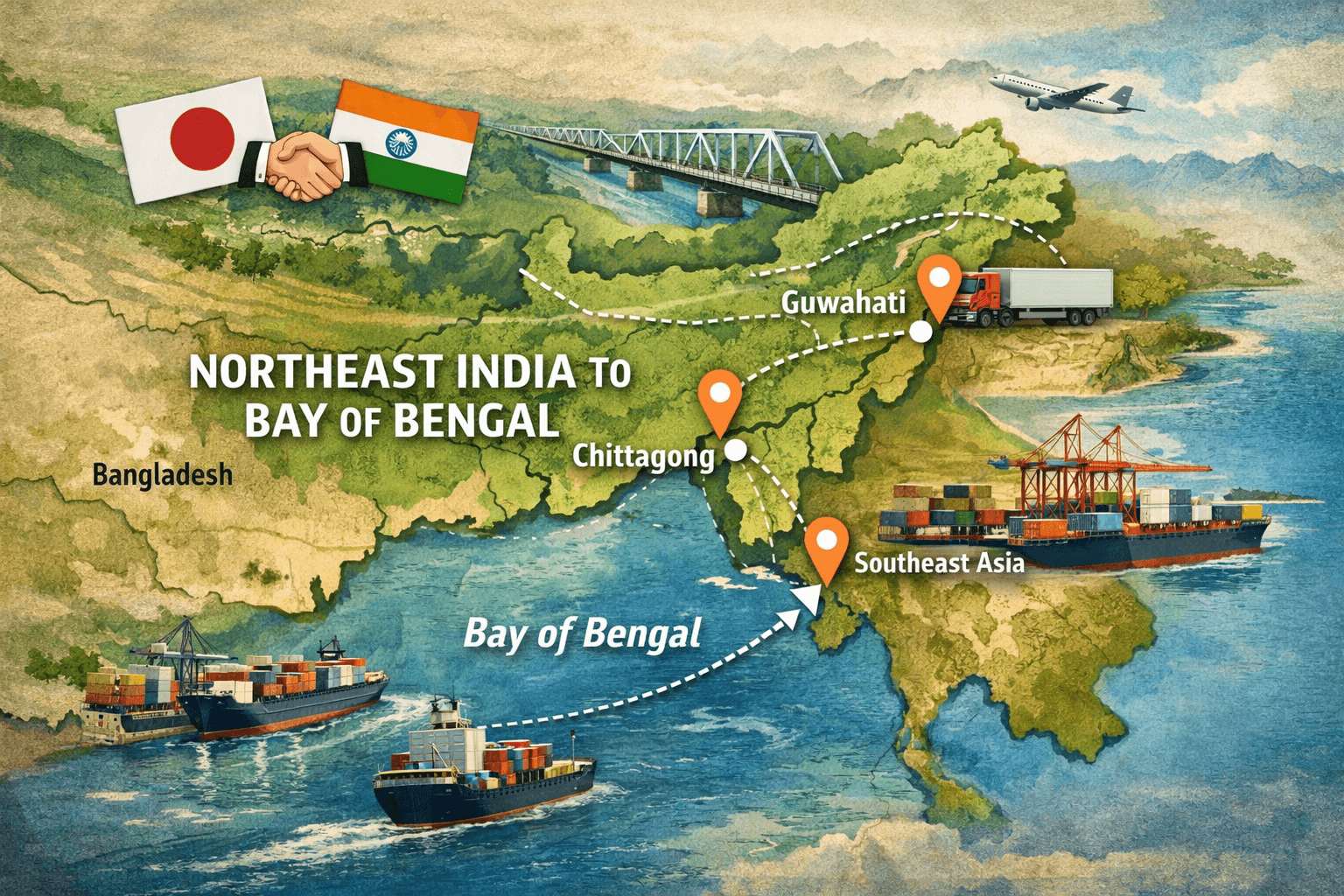
The push for Northeast India Bay of Bengal connectivity marks a significant shift in regional geopolitics and economic strategy. Japan has reaffirmed its commitment to support infrastructure and connectivity projects linking India’s Northeast to the Bay of Bengal and the wider Indian Ocean.
The announcement, made by Japan’s Deputy Foreign Minister Horii Iwao, reflects a deeper strategic alignment between India and Japan. It also positions Northeast India as a critical gateway to Southeast Asia.
A Strategic Vision for Northeast India Bay of Bengal Connectivity
Japan’s commitment is not limited to infrastructure. It is part of a broader regional vision.
Speaking at the India–Japan Intellectual Conclave in Shillong, Horii emphasized that Japan will support projects connecting Northeast India to maritime routes in the Bay of Bengal and beyond.
This includes enhancing trade corridors, transport networks, and economic integration.
The goal is clear. Transform Northeast India from a landlocked region into a connected economic hub.
Why Northeast India Matters in the Indo-Pacific Strategy
A Gateway to Southeast Asia
Northeast India holds unique geographical importance.
It shares borders with:
- Bangladesh
- Myanmar
- Bhutan
- Nepal
This location makes it a natural bridge between India and Southeast Asia.
Japan views the region as a “gateway” capable of driving economic growth when integrated into regional supply chains.
Aligning with the Free and Open Indo-Pacific Vision
The initiative aligns with Japan’s Free and Open Indo-Pacific (FOIP) policy.
Under this framework, Japan aims to create secure and efficient trade routes across the region.
A key component is building an “industrial value chain” that connects Northeast India to maritime networks in the Bay of Bengal.
This would strengthen supply chains and reduce dependency on narrow trade corridors.
Key Developments Driving the Initiative
Infrastructure and Trade Connectivity
Japan plans to support projects that improve:
- Road and rail connectivity
- Port access through the Bay of Bengal
- Cross-border trade routes
These developments will help integrate Northeast India with global markets.
Private Sector Collaboration
The initiative extends beyond public infrastructure.
Japan is encouraging private-sector cooperation in key sectors such as:
- Semiconductors
- Clean energy
- Economic security
This signals a shift toward industrial collaboration, not just connectivity.
Strengthening Regional Partnerships
The initiative also involves neighboring countries.
Discussions at the conclave highlighted cooperation with Bangladesh, Bhutan, Nepal, and Southeast Asian nations.
These partnerships are critical to building a functional regional network.
Economic and Strategic Impact
Boosting Trade and Investment
Improved connectivity can significantly reduce logistics costs.
It can also open new export routes for industries in Northeast India.
Access to the Bay of Bengal allows direct linkage to global shipping lanes.
This can transform regional economies and attract investment.
Enhancing Regional Stability
The initiative supports broader geopolitical goals.
Stronger economic integration can enhance stability across the Indo-Pacific.
It also aligns with India’s “Act East” policy, which aims to deepen engagement with Southeast Asia.
Creating a Multi-National Economic Corridor
By linking multiple countries, the project can create a regional economic corridor.
This includes:
- Supply chain integration
- Energy cooperation
- Cross-border mobility
Such a corridor can act as a growth engine for the region.
Strategic Implications for India–Japan Relations
Deepening Bilateral Cooperation
The initiative reflects a maturing India–Japan partnership.
Recent high-level meetings, including engagements between Prime Minister Narendra Modi and Japanese leadership, have reinforced this alignment.
The focus has shifted from infrastructure aid to strategic collaboration.
Expanding Beyond Infrastructure
Japan’s approach now includes:
- Technology partnerships
- Industrial development
- Talent and skill exchange
This broadens the scope of bilateral ties.
Positioning Against Global Uncertainty
In a fragmented global environment, regional partnerships are gaining importance.
India and Japan are positioning themselves as key players in shaping Indo-Pacific stability.
Challenges and Execution Risks
While the vision is ambitious, execution remains complex.
Key challenges include:
- Cross-border coordination
- Infrastructure financing
- Regulatory alignment
- Political sensitivities in the region
Connectivity projects often face delays due to logistical and administrative hurdles.
Sustained coordination among multiple stakeholders will be essential.
Future Outlook for Northeast India Bay of Bengal Connectivity
The initiative has long-term implications.
If executed effectively, it can:
- Transform Northeast India into a trade hub
- Strengthen India’s position in the Indo-Pacific
- Enhance regional economic integration
The focus will now shift to implementation.
This includes project timelines, investment flows, and measurable outcomes.
The success of the initiative will depend on sustained political and economic commitment.
Topics
Covering startup news, AI, technology, and business at ThePrimely. Delivering accurate, in-depth reporting on the stories that shape the future.