
Interstellar Comet 3I/ATLAS: ALMA Uncovers Its Birth Conditions
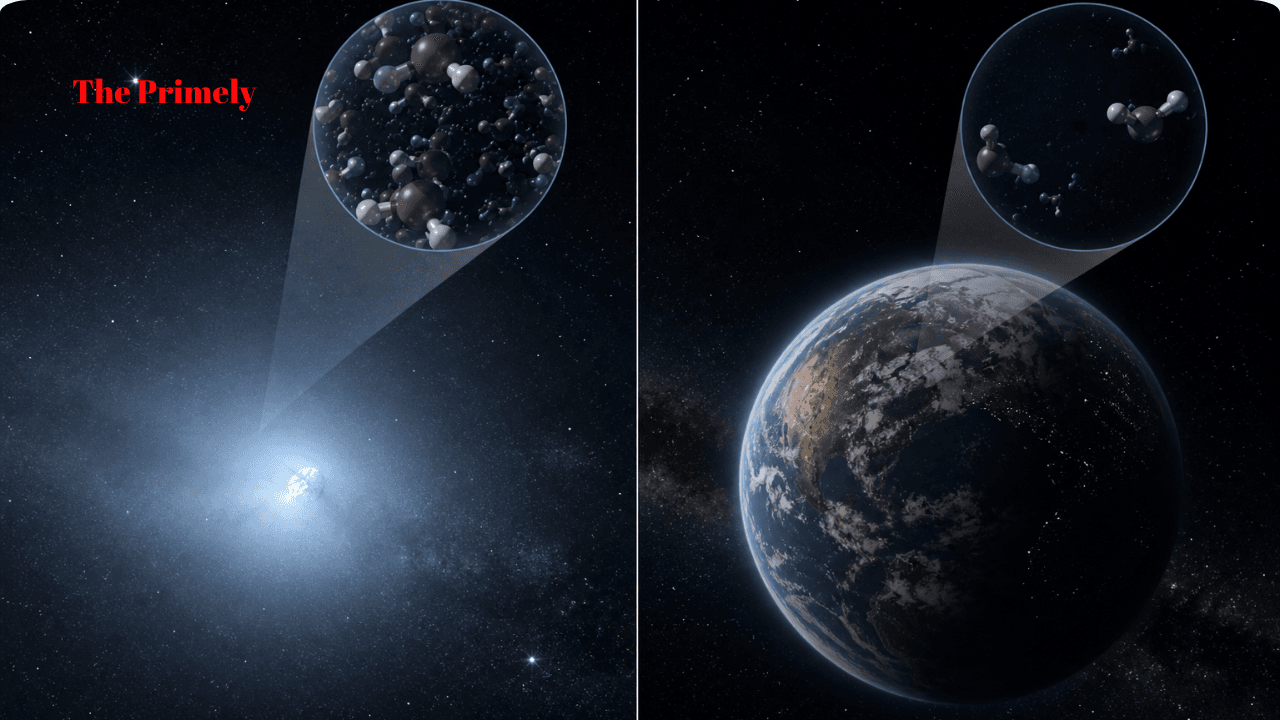
The interstellar comet 3I/ATLAS is offering scientists a rare glimpse into distant planetary systems, as new observations reveal it formed in an environment far colder than our solar system, based on chemical signatures preserved for billions of years.
Using advanced radio observations, researchers identified unusual molecular patterns that indicate extreme formation conditions, making this comet a valuable record of early cosmic chemistry.
ALMA Unlocks Chemical Clues
The interstellar comet 3I/ATLAS contains significantly higher levels of deuterated water compared to typical solar system comets, pointing to a formation environment with extremely low temperatures.
This chemical signature acts like a fingerprint, allowing scientists to trace the physical conditions of its origin with remarkable precision.
Such elevated levels of heavy water usually form in regions below 30 Kelvin, suggesting the comet was born in a deeply frozen and distant part of space.
This makes it one of the clearest pieces of evidence showing how different planetary systems can be from our own.
A Visitor From Another Star System
The interstellar comet 3I/ATLAS is only the third confirmed object from outside our solar system, following earlier discoveries that sparked global scientific interest.
Its trajectory confirms that it is not bound to the Sun and is simply passing through before continuing its journey across interstellar space.
Scientists believe the comet may be billions of years old, potentially older than our solar system itself.
This makes it a cosmic time capsule, preserving materials from an era and environment that shaped distant stars and planets.
What This Means for Planetary Science
The interstellar comet 3I/ATLAS is reshaping our understanding of planetary formation by showing that not all systems evolve under similar conditions.
Its composition suggests that temperature, radiation, and chemistry can vary significantly across different regions of the galaxy.
This challenges long-standing assumptions that planetary systems follow a uniform model like our own.
Instead, it opens the possibility that each system has a unique evolutionary path influenced by its environment.
Strategic Implications
The findings from the interstellar comet 3I/ATLAS highlight the importance of advanced observatories in studying objects beyond our solar system.
Facilities like ALMA allow scientists to analyze molecular compositions with unprecedented detail and accuracy.
At a broader level, this research expands our understanding of the Milky Way’s diversity and complexity.
It reinforces the idea that our solar system may be just one of many distinct cosmic outcomes.
Topics
Covering startup news, AI, technology, and business at ThePrimely. Delivering accurate, in-depth reporting on the stories that shape the future.