
IndiGo Delhi–Manchester Flight Turns Back Mid Air After West Asia Airspace Curbs
Global aviation depends heavily on stable airspace corridors. When geopolitical tensions rise, those corridors can close within hours.
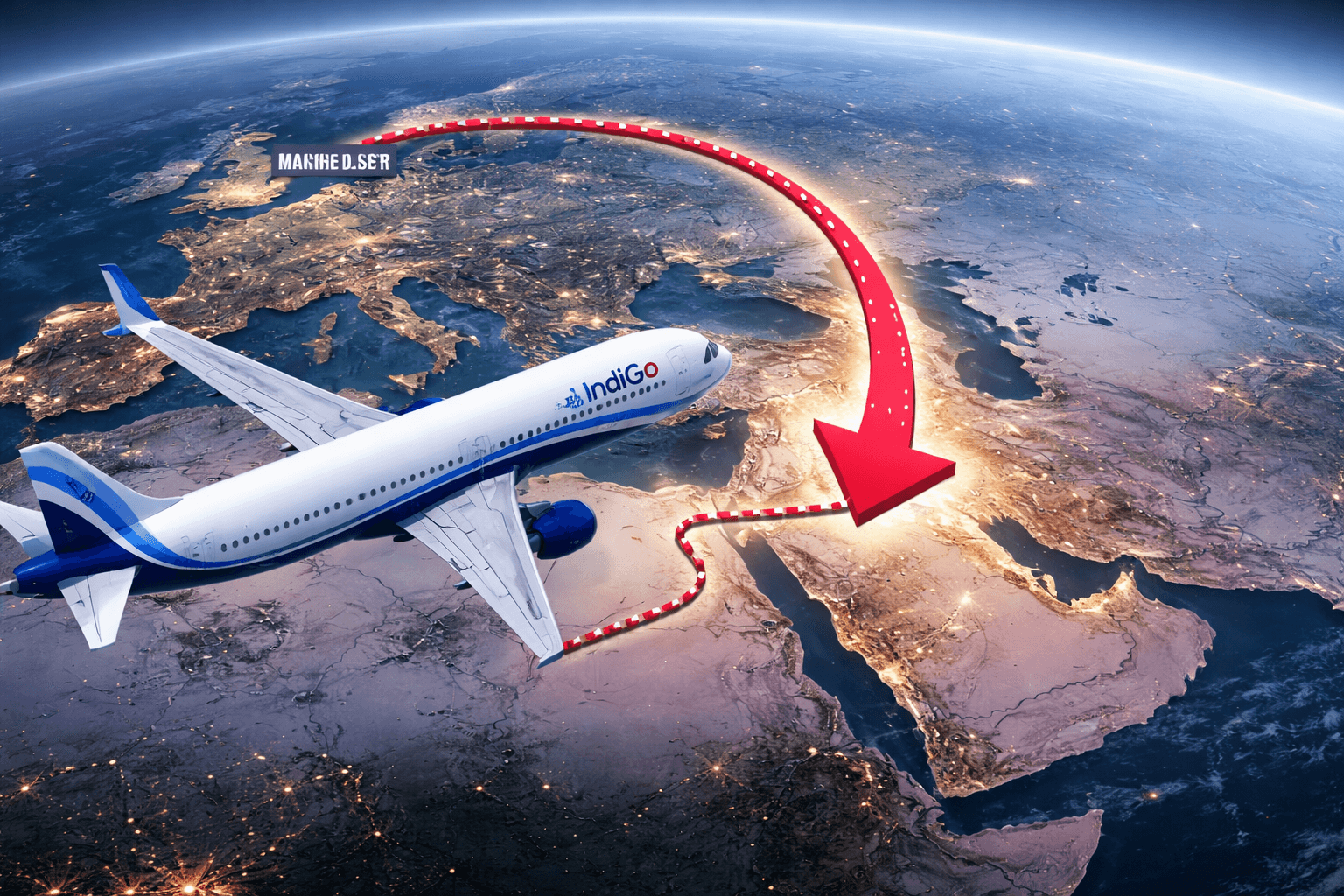
That is exactly what happened to the IndiGo Delhi Manchester flight this week. The aircraft flew for nearly seven hours before abruptly turning back to India. The reason was not a technical failure. Instead, it was a sudden restriction in West Asia airspace linked to escalating regional tensions.
The incident highlights how geopolitical conflicts increasingly disrupt international aviation networks.
What Happened to the IndiGo Delhi Manchester Flight
The IndiGo Delhi Manchester flight (6E 033) departed from New Delhi for Manchester in the United Kingdom. The aircraft had already traveled deep into international airspace.
Flight tracking data showed the aircraft approaching the Ethiopia Eritrea region after about seven hours of flying. At that point the aircraft performed a mid air turnaround and returned to Delhi.
The airline confirmed the decision shortly after the aircraft began its return journey.
According to IndiGo, authorities imposed last minute airspace restrictions across parts of West Asia. These restrictions prevented the aircraft from continuing safely toward Europe.
Therefore, the airline chose to return the flight to its origin.
IndiGo emphasized that passenger safety, crew security, and aircraft safety remain the highest priority.
Why West Asia Airspace Suddenly Closed
Escalating Regional Tensions
The airspace restrictions are tied to the rapidly evolving security situation in West Asia.
Recent military developments involving the United States, Israel, and Iran have heightened regional tensions. Aviation authorities in multiple countries responded by limiting or restricting aircraft movement across sensitive airspace corridors.
As a result, airlines must constantly reroute aircraft to avoid conflict zones.
These restrictions can appear with little warning. When that happens, flights already in the air may need to divert or return.
Strategic Importance of Middle East Airspace
West Asia sits at the center of global aviation routes. Flights traveling between:
- India and Europe
- Asia and North America
- Gulf hubs and Western markets
often cross this region.
When airspace restrictions occur, airlines face limited alternatives. They may need to:
- reroute flights through Africa
- extend flight times by several hours
- make refueling stops
- cancel services entirely
In the case of the IndiGo Delhi Manchester flight, available routing options were insufficient for the aircraft to continue safely.
Wider Impact on Airlines and Global Aviation
Rising Flight Disruptions
The mid air turnaround is part of a broader aviation disruption. Several airlines have already adjusted their operations due to regional instability.
Indian carriers in particular face operational pressure because many long haul routes pass near or through Middle Eastern airspace.
Recent disruptions include:
- suspension of certain international routes
- cancellations across Europe and West Asia
- longer flight times due to rerouting
- rescheduling and passenger rebooking operations
In some cases, rerouted flights add two to three hours of travel time.
Operational Pressure on IndiGo
IndiGo has recently expanded its long haul operations to Europe using leased widebody aircraft.
Routes such as:
- Delhi to Manchester
- Mumbai to London
- Mumbai to Amsterdam
depend heavily on stable airspace corridors.
However, ongoing airspace restrictions have already forced the airline to reduce frequencies on several European routes.
This makes operational planning more complex.
Every long haul flight must now be evaluated against real time geopolitical risk.
Strategic Implications for Global Aviation
Aviation and Geopolitics Are Now Closely Linked
The IndiGo Delhi Manchester flight incident shows how aviation is increasingly tied to geopolitical developments.
Airlines must constantly monitor:
- conflict zones
- military activity
- airspace advisories
- international aviation warnings
Even a small shift in regional security can affect dozens of international routes.
Route Planning Is Becoming More Complex
Modern airlines rely on optimized flight paths to control fuel costs and maintain schedules.
However, geopolitical instability forces airlines to adapt quickly.
Airlines now require:
- dynamic route planning systems
- real time satellite monitoring
- coordination with international aviation authorities
Without these tools, disruptions would be far more severe.
What Happens Next for Affected Passengers
IndiGo stated that it is working with authorities to determine whether the journey can resume safely.
Passengers on the affected flight are expected to receive updates regarding:
- rebooking options
- revised travel schedules
- possible alternate routes
Airlines typically provide either alternative flights or refunds during such disruptions.
Future Outlook for International Flights
The broader outlook depends largely on geopolitical developments in West Asia.
If tensions continue, airlines may need to operate longer routes across Africa or Central Asia. This would increase:
- fuel costs
- travel time
- operational complexity
However, aviation authorities constantly review airspace advisories. If stability improves, normal flight corridors could reopen quickly.
Until then, airlines will continue prioritizing safety over schedule reliability.
The IndiGo Delhi Manchester flight turning back mid air reflects the growing intersection between aviation and geopolitics.
A flight that had already traveled seven hours suddenly became operationally unviable due to airspace restrictions. The airline made the safest decision by returning to Delhi.
More importantly, the incident demonstrates a broader trend. Global aviation now operates within a rapidly shifting geopolitical landscape.
For airlines, adaptability and real time decision making are becoming just as important as aircraft technology or route networks.
Safety remains the ultimate priority.
Topics
Covering startup news, AI, technology, and business at ThePrimely. Delivering accurate, in-depth reporting on the stories that shape the future.