
India's National Quantum Mission Adds 9 Startups, Hits 1,000km Milestone
India's Quantum Ambition Just Got Bigger and It Is Ahead of Schedule
India's National Quantum Mission is moving faster than its own targets.
The Union government has expanded the startup base under its flagship National Quantum Mission, adding nine new ventures to accelerate indigenous capabilities across quantum technologies. The latest inclusion takes the total number of supported startups under the mission to 17.
The expansion arrives alongside a landmark technical achievement one that arrived years ahead of plan. For a mission that only launched in 2023, that combination of speed and scale signals serious intent.
The 1,000 km Quantum Network A World Class Breakthrough
Before examining the new startups, the headline milestone demands attention.
The milestone was achieved using indigenous technology developed by QNu Labs, a Bengaluru based startup supported under the mission that specialises in quantum safe cybersecurity solutions. This is among the longest quantum key distribution deployments globally since the mission's launch in October 2024.
The National Quantum Mission was approved in 2023 with a budget of over ₹6,000 crore, with one of its key goals being to develop a 2,000 km quantum communication network within eight years.
The mission has achieved the 1,000 km secure communication milestone in less than three years, even though its target was to achieve 2,000 km capability in eight years.
Half the distance. A fraction of the time. That is what ahead of schedule looks like.
DST Secretary Dr. Abhay Karandikar described the development as a landmark advancement in secure quantum communication, noting that it reflects progress ahead of envisaged timelines.
Why This Technology Matters Beyond the Lab
Quantum communication is not an academic exercise. It has direct, deployable strategic value.
The technology is expected to play a key role in strengthening secure communications in sectors such as defence, banking and critical infrastructure. Officials added that it can work even in difficult environments, including underwater and underground networks, widening its scope for both civilian and strategic use.
The achievement is expected to strengthen secure communication capabilities across defence, financial systems and critical infrastructure, while advancing India's broader push towards a secure digital ecosystem.
Any nation that can transmit data that is physically impossible to intercept without detection has a strategic advantage in every sensitive sector simultaneously. India just demonstrated that capability at 1,000 km scale.
The Nine New Startups What They Are Building
The newly onboarded startups Sense XT, ORVISSEMI, QuBeats, Quantum AI Global, bloq, GDQ Labs, Quantum Biosciences, Bumble Bee Instruments Pvt. Ltd., and SAS Qute Electronics Pvt. Ltd. are working on a range of applications, from quantum biosensors for disease detection and photon sensing technologies to quantum positioning systems, atomic memory and precision electronic systems.
Each of these areas represents a distinct sector of application. Quantum biosensors could transform early disease diagnosis. Quantum positioning systems could offer GPS independent navigation for defence and aerospace. Atomic memory and precision electronics sit at the core of next generation computing hardware.
Officials said the expansion reflects a broader strategy to build a pipeline of deeptech startups that can translate research into deployable technologies.
The RDI Funding Engine Powering the Pipeline
The startup expansion does not stand alone. It is backed by a rapidly scaling funding infrastructure.
The government has launched a first of its kind ₹1 lakh crore Research, Development and Innovation Fund to boost private sector R&D in areas like 6G and advanced manufacturing.
The Technology Development Board and the Biotechnology Industry Research Assistance Council are functioning as second level fund managers under the RDI framework. Officials emphasized the use of new financial instruments such as optionally convertible debt, designed to support startups without immediate equity dilution and to attract private investment alongside public funding.
The optionally convertible debt model is particularly noteworthy. It lets startups access government capital without surrendering equity at an early stage a structure that is more founder friendly and more likely to attract coinvestment from private venture capital.
The Technology Development Board has received over 100 proposals within two months of issuing a call, with six companies already being taken forward for investment. BIRAC has seen nearly 200 applications under recent calls, spanning areas such as cancer research, gene therapy and bio manufacturing.
That level of response 100 proposals in two months indicates genuine market demand for government backed deeptech funding, not just policy signaling.
Official Response Speed, Scale and Strategic Visibility
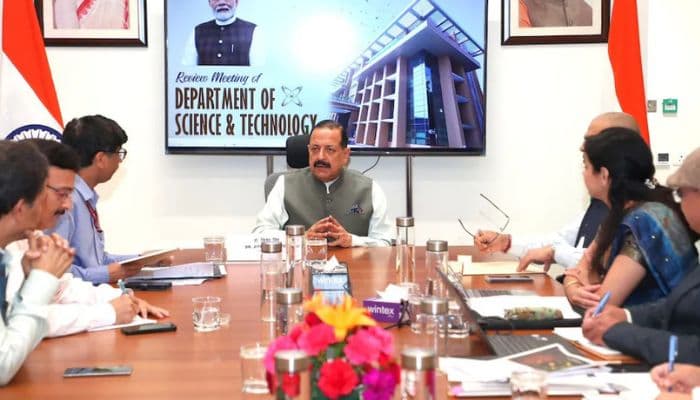
Reviewing the progress, Union Minister for Science and Technology Dr. Jitendra Singh stressed the need to scale participation and visibility of such initiatives. He underscored the need for transparency, structured evaluation and wider outreach to improve participation and awareness of government backed R&D funding.
Singh also called for coordinated communication strategies to amplify key scientific achievements, including the quantum milestone, and to position India's emerging technology ecosystem more prominently.
The minister's emphasis on visibility is significant. Breakthroughs mean little if the talent pipeline students, researchers, founders does not know about them. Outreach is not a soft priority. It directly affects the volume and quality of future applications.
India's Quantum Push in Global Context
India is not the only nation racing in quantum technology. The US, China, the EU, and the UK all have active national quantum programs with significant funding commitments.
What distinguishes India's approach is its deliberate integration of startups as primary technology translators not just academia or defence labs. The developments come amid a broader policy push to strengthen India's deep tech capabilities through mission mode programmes, blended financing models and startup support frameworks, with quantum technologies emerging as a key strategic frontier alongside biotechnology and advanced communications.
The blended finance model public capital structured to unlock private capital is the architecture that scales. India appears to have grasped that government cannot fund quantum at the required pace alone. It needs private risk appetite working alongside sovereign commitment.
FAQ India's National Quantum Mission
Q1. What is India's National Quantum Mission? The National Quantum Mission was approved in 2023 with a budget of over ₹6,000 crore. Its key goals include developing quantum computers and a 2,000 km quantum communication network within eight years.
Q2. How many startups are now supported under the mission? The latest inclusion takes the total number of supported startups under the mission to 17, following the addition of nine new ventures.
Q3. What did the 1,000 km quantum network achieve? The milestone represents one of the longest quantum key distribution deployments globally. It was achieved using indigenous technology developed by QNu Labs, a startup focused on quantum safe cybersecurity solutions.
Q4. Which nine new startups joined the National Quantum Mission? The nine newly supported startups are Sense XT, ORVISSEMI, QuBeats, Quantum AI Global, bloq, GDQ Labs, Quantum Biosciences, Bumble Bee Instruments Pvt. Ltd., and SAS Qute Electronics Pvt. Ltd.
Q5. What applications are the new quantum startups working on? The newly supported startups are working on areas ranging from quantum biosensors for disease detection and photon sensing technologies to quantum positioning systems, atomic memory and precision electronic systems.
Q6. What is the ₹1 lakh crore RDI Fund? The government has launched a first of its kind ₹1 lakh crore Research, Development and Innovation Fund to boost private sector R&D in strategic areas such as 6G and advanced manufacturing.
What Comes Next From Milestone to Market
The 1,000 km network is a proof of capability. The next phase is about translating that capability into deployable infrastructure at scale.
The mission's stated goal remains a 2,000 km network within eight years. At the current pace, India could hit that target well ahead of schedule as it already has with the 1,000 km milestone. If it does, India will have one of the largest quantum secured communication networks in the world, built substantially on indigenous technology and startup innovation.
The government is seeking to ensure both innovation and scalability in emerging sectors such as 6G, advanced manufacturing, space technologies and biotechnology.
The startup cohort expansion from 8 to 17 in a short span points toward a system that is working applications are flowing, funding is moving, and technologies are advancing. The risk now is execution: whether the RDI framework delivers investments at the pace the application volumes suggest, and whether quantum startups can move from lab proven tech to commercial deployments.
Topics
Covering startup news, AI, technology, and business at ThePrimely. Delivering accurate, in-depth reporting on the stories that shape the future.