
Haryana Budget 2026: Growth, Welfare and Structural Transformation Under Nayab Singh Saini
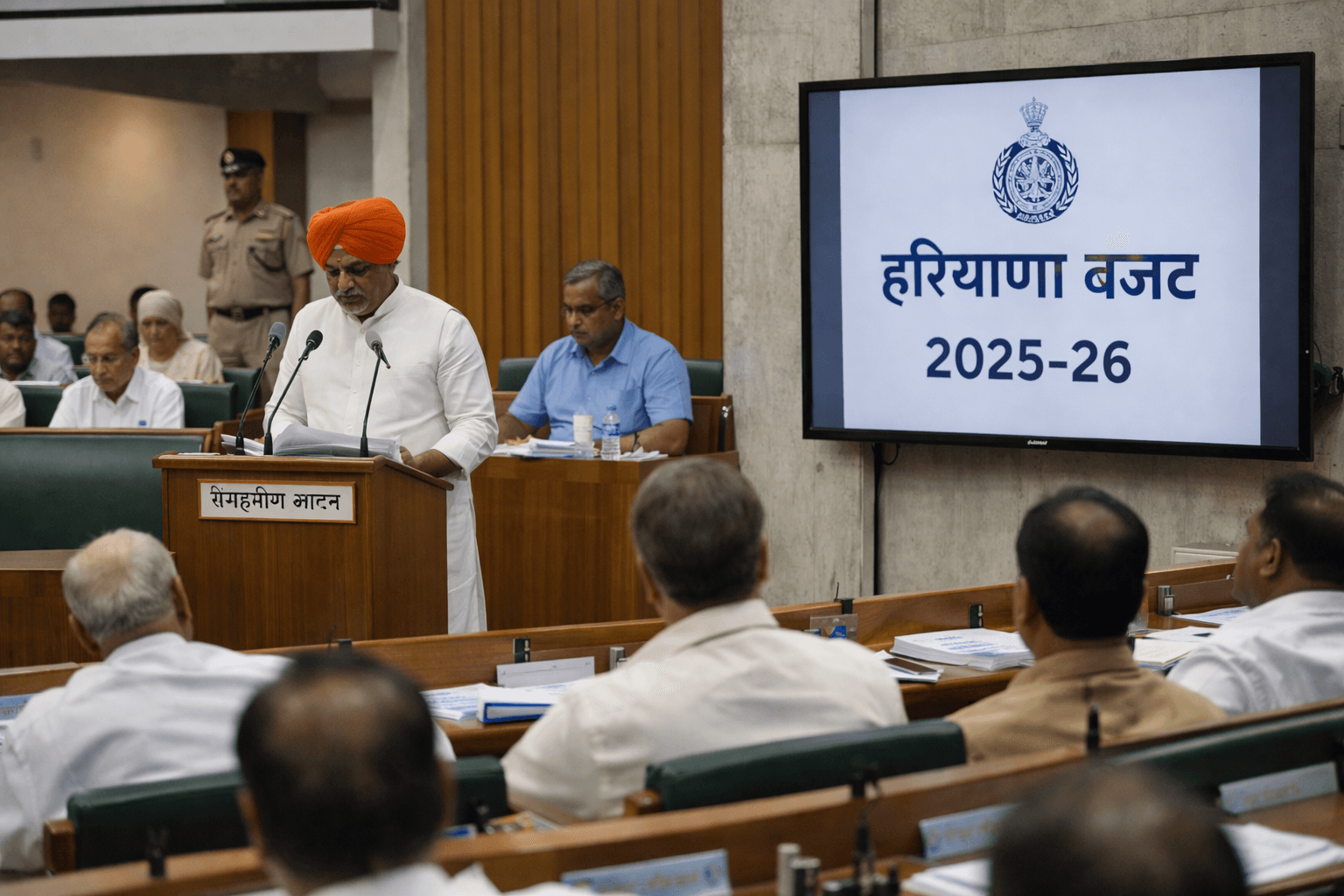
The Haryana Budget 2026 represents a strategic blueprint for economic expansion, social development, and administrative reform. Presented by Chief Minister Nayab Singh Saini, who also holds the finance portfolio, the budget outlines a comprehensive plan to strengthen the state’s economic foundations while addressing emerging challenges.
With a total outlay of approximately ₹2.23 lakh crore, marking a 10.28% increase over the previous fiscal, the budget signals a calibrated approach to growth, fiscal discipline, and sectoral investment.
This budget is not merely a financial document. It is positioned as a roadmap for long-term development, focusing on human capital, infrastructure, and economic resilience.
Budget Size and Fiscal Direction
The Haryana government has significantly expanded its spending plan for FY2026–27. The total allocation of ₹2.23 lakh crore reflects the state’s ambition to accelerate growth while maintaining fiscal stability.
A notable component is the capital expenditure of ₹28,205 crore, which accounts for a substantial share of the budget.
Capital expenditure plays a critical role in driving long-term growth. It supports infrastructure development, improves productivity, and creates employment opportunities.
The increase in spending also reflects confidence in revenue growth and economic recovery.
Core Focus Areas of Haryana Budget 2026
Human Development and Education
The budget places strong emphasis on human capital development. Education and skill development have been identified as key pillars of long-term growth.
The government has proposed initiatives aligned with modern education systems, including digital learning and skill-oriented training. Efforts are also being made to expand access to quality education and support students pursuing opportunities abroad.
This approach reflects a shift from traditional education models to future-ready skills.
Digital Expansion and AI Integration
A notable feature of the Haryana Budget 2026 is its focus on digital transformation. The government aims to integrate technology and artificial intelligence into governance, education, and public services.
The emphasis on AI signals recognition of emerging economic trends. It positions Haryana to participate in the evolving digital economy.
This strategy aligns with national priorities of building a technology-driven economy.
Infrastructure Development as a Growth Engine
Infrastructure remains a central component of the budget strategy.
The government has proposed significant investments in urban development, transportation, and connectivity. Major cities such as Gurugram and Faridabad are expected to receive enhanced funding for infrastructure projects.
Projects such as metro corridors and improved road networks aim to reduce congestion and support economic activity.
These investments are designed to:
Improve mobility
Attract investment
Enhance urban living standards
Infrastructure development also has a multiplier effect on the economy, creating jobs and boosting demand.
Agriculture and Rural Economy
Agriculture continues to be a priority in the Haryana Budget 2026.
The government has announced measures to strengthen the financial position of farmers, including enhanced support through existing schemes and increased funding allocations.
One of the key proposals includes the establishment of a Haryana Agri Discom, which aims to ensure uninterrupted power supply to agricultural feeders and over 7.12 lakh consumers.
Reliable power supply is critical for agricultural productivity. This initiative is expected to improve efficiency and reduce operational challenges for farmers.
Employment, Youth and Social Welfare
The budget includes several initiatives aimed at youth empowerment and employment generation.
Skill development programs and overseas employment support mechanisms are being strengthened. The government has also emphasized structured pathways for international job opportunities.
In addition, social welfare schemes targeting women and unemployed youth have been proposed, including financial support and education-focused programs.
These initiatives aim to address both economic and social dimensions of development.
Healthcare and Public Services
Healthcare infrastructure is another area of focus.
The government has announced plans to upgrade district hospitals with advanced medical facilities, including diagnostic equipment and improved patient services.
Improved healthcare access is essential for inclusive growth. It also enhances the quality of life and supports long-term economic productivity.
Law Enforcement and Security Measures
A notable policy announcement in the Haryana Budget 2026 is the decision to reserve 20% of police recruitment for Agniveers, reflecting an effort to integrate trained personnel into state services.
This move has both employment and security implications.
It provides career pathways for former military personnel while strengthening law enforcement capabilities.
Environmental and Sustainability Initiatives
The budget also includes provisions for environmental sustainability.
The Haryana Clean Air Project, supported by ₹2,716 crore in World Bank assistance, aims to address air quality challenges in the state.
Additionally, a Green Climate Resilience Fund has been proposed to support long-term environmental initiatives.
These measures reflect growing awareness of environmental challenges and their economic impact.
Strategic Implications of the Budget
The Haryana Budget 2026 reflects a multi-dimensional strategy.
First, it emphasizes human capital development, recognizing that long-term growth depends on education and skills.
Second, it focuses on infrastructure investment, which drives economic activity and improves connectivity.
Third, it integrates technology and sustainability, aligning with global trends.
The budget also attempts to balance growth with welfare, ensuring that development remains inclusive.
Challenges and Risks
Despite its comprehensive approach, the budget faces several challenges.
Execution remains a critical factor. Large-scale infrastructure and welfare programs require efficient implementation.
Fiscal discipline must also be maintained. Increased spending must be supported by sustainable revenue growth.
External factors such as economic slowdown or inflation could impact outcomes.
Addressing these challenges will be essential for achieving the budget’s objectives.
Future Outlook
The Haryana Budget 2026 sets the stage for medium-term growth.
If implemented effectively, the initiatives could:
Enhance economic productivity
Improve infrastructure
Strengthen human capital
Increase investment attractiveness
The integration of digital technologies and sustainability measures positions the state for future challenges.
However, outcomes will depend on policy execution and economic conditions.
Topics
Covering startup news, AI, technology, and business at ThePrimely. Delivering accurate, in-depth reporting on the stories that shape the future.