
Adobe Stock Shock: Why Apple’s New Creator Bundle Is Spooking Investors
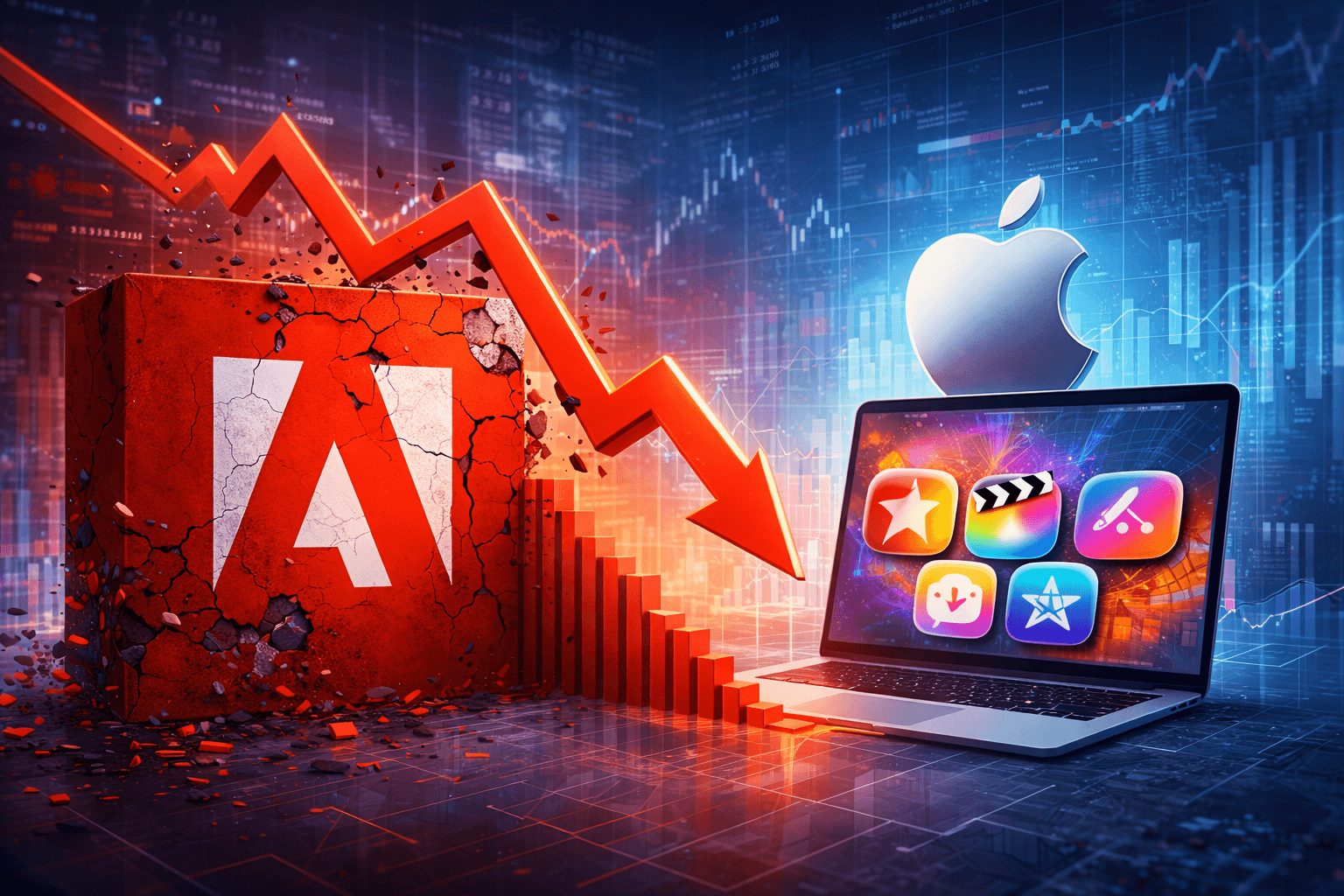
Adobe shares fall headlines dominated trading desks after Apple introduced a lower-priced creative software bundle that signals its most assertive push yet into Adobe’s core market. The announcement has intensified debate on Wall Street over whether Adobe’s long-standing pricing power is beginning to erode under mounting competitive and AI-driven pressure.
The selloff did not happen in isolation. Instead, it reflected a collision of new competitive risk, recent Wall Street analyst downgrades, and growing scrutiny of Adobe’s growth trajectory in a market where creative software competition is accelerating.
Apple’s Pricing Move Changes the Conversation
Apple’s newly announced Creator Studio bundle packages professional creative tools into a subscription priced well below typical Adobe Creative Cloud pricing tiers. The offering includes video, audio, and visual production software tightly integrated into Apple’s hardware and operating systems a strategic extension of the company’s broader Apple services strategy.
From a market perspective, pricing is the headline. Adobe’s full Creative Cloud suite sits at the premium end of the spectrum, reflecting its dominance in professional workflows across design, photography, and video production. Apple’s aggressive entry price reframes expectations, particularly for students, freelancers, and small creative teams.
This is less about feature parity and more about market anchoring. Lower subscription thresholds can influence early-career creators before they are locked into industry-standard ecosystems, creating long-term competitive implications.
Analyst Downgrades Add Fuel to the Slide
Even before Apple’s announcement, Wall Street analyst downgrades had begun weighing on sentiment. Several firms have recently flagged concerns around Adobe’s ability to reaccelerate growth while defending margins in an environment shaped by generative AI disruption and expanding alternatives.
An Adobe stock downgrade narrative has taken hold as analysts question whether new user growth can offset slower expansion among existing subscribers. Surveys showing rising adoption of lower-cost creative platforms have added to worries that Adobe’s future customer pipeline could look different from its past.
Apple’s move effectively validated fears already circulating in the market: that credible platform-level competition could chip away at Adobe’s pricing umbrella.
Apple vs Adobe Creative Software: Different Strengths
It is important to separate perception from operational reality. Apple vs Adobe creative software is not a clean one-to-one contest. Adobe remains deeply embedded in enterprise environments, agencies, and professional studios that rely on advanced capabilities, cross-platform workflows, and long-established file standards.
However, Apple’s edge lies in ecosystem control. Hardware optimization, seamless macOS integration, and bundled pricing create a frictionless entry point for creators who operate entirely within Apple devices. For budget-sensitive users, the cost differential alone can be decisive.
Over time, that dynamic could reshape entry-level adoption patterns, even if high-end professionals continue to depend on Adobe.
The Real Investor Concern: Pricing Power
The core issue behind the Adobe shares fall reaction is structural, not immediate. Investors are less worried about a sudden revenue collapse and more about long-term pricing pressure.
Adobe’s subscription model has historically commanded premium rates due to workflow lock-in and brand dominance. If credible alternatives normalize lower price expectations, the company may face tougher renewal conversations and slower average revenue growth per user.
This challenge intersects with AI pressure on Adobe. As generative tools automate design, editing, and production tasks, differentiation may shift from individual features to broader ecosystem value, integrations, and platform reach.
Short-Term Shock or Long-Term Threat?
Markets are still weighing whether this moment represents temporary volatility or a structural inflection point. Adobe retains significant advantages: entrenched professional usage, deep creative pipelines, and ongoing AI integration across its tools.
Yet the direction of travel is clear. Creative software is moving toward broader accessibility, tighter hardware-software ecosystems, and price competition at the entry level. Apple’s expansion accelerates that shift and forces investors to reexamine assumptions about Adobe’s moat.
What Happens Next
Adobe’s likely response will center on reinforcing its professional positioning, expanding AI-powered capabilities, and highlighting the value of its integrated creative workflow. The company’s challenge is to prove that premium pricing remains justified in a market where alternatives are improving and barriers to entry are falling.
For investors, the episode underscores how quickly sentiment can turn when a dominant SaaS model encounters credible platform competition. The latest move in creative software competition has not dethroned Adobe, but it has altered the risk conversation and that alone was enough to move the stock.
As Apple leans deeper into services and creative tooling, the battle lines in digital content creation are shifting. Whether Adobe adapts fast enough will shape not only future earnings, but the next era of creative software leadership.
Topics
Covering startup news, AI, technology, and business at ThePrimely. Delivering accurate, in-depth reporting on the stories that shape the future.