
Behavioral AI Compatibility Advantage: Redefining Hiring in the AI Era
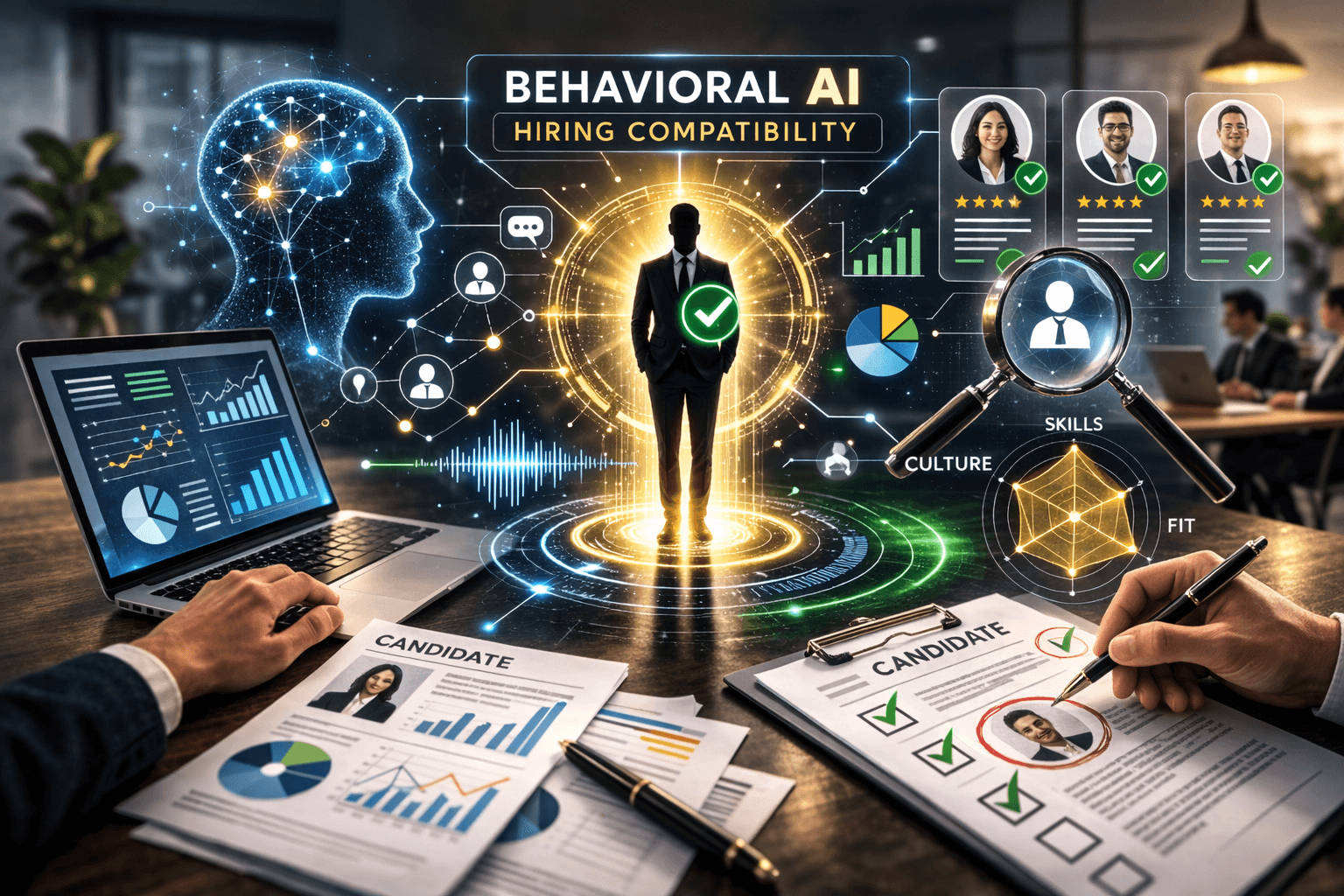
Behavioral AI compatibility is emerging as a solution. It shifts hiring from evaluating skills alone to understanding how individuals fit within a team or role.
A recent TechCrunch discussion highlights how this approach could redefine talent acquisition and organizational performance.
The Limits of Traditional Hiring Models
Most hiring processes focus on measurable achievements.
These include:
- Education
- Work experience
- Technical skills
While these factors matter, they often fail to predict real-world success.
Many candidates who look strong on paper struggle after joining a team. This disconnect creates high turnover and operational inefficiencies.
According to insights shared in the TechCrunch discussion, hiring decisions often remain “a gamble” despite structured processes.
This gap has opened the door for behavioral AI.
What Is Behavioral AI Compatibility?
Moving Beyond Skills to Behavior
Behavioral AI compatibility evaluates how individuals think, communicate, and operate within a team.
It focuses on alignment rather than qualifications.
The goal is not to identify the “best” candidate in isolation. Instead, it aims to identify the most suitable candidate for a specific environment.
As highlighted in the discussion, no trait is inherently good or bad. Its effectiveness depends on context and role alignment.
The Role of Voice Biomarkers
One of the most advanced approaches uses voice analysis.
Platforms like Mappa analyze thousands of voice biomarkers, including:
- Speech patterns
- Tone
- Linguistic signals
These data points help build behavioral profiles within seconds.
The result is a deeper understanding of personality traits, communication style, and cognitive tendencies.
How Behavioral AI Works in Practice
Rapid Behavioral Profiling
Modern AI systems can assess candidates in under a minute.
Candidates respond to prompts, and AI evaluates subtle indicators in their responses.
This process replaces subjective human judgment with data-driven insights.
Matching for Compatibility
The core value lies in matching individuals to roles and teams.
Instead of ranking candidates purely by credentials, AI identifies alignment based on:
- Work style
- Decision-making approach
- Communication patterns
This improves both performance and retention.
Reducing Hiring Bias
Behavioral AI also addresses unconscious bias.
Traditional hiring often favors familiar backgrounds or experiences.
By focusing on behavioral data, AI enables more equitable decisions.
This expands opportunities for underrepresented talent while maintaining performance standards.
Data-Driven Evidence: Why Compatibility Matters
The impact of compatibility-focused hiring is measurable.
For example, Mappa reports significantly lower turnover rates among hires selected through its platform.
While the industry average turnover rate is around 30%, Mappa claims its clients achieve rates as low as 2%.
This difference highlights the financial and operational benefits of better hiring decisions.
Reduced turnover leads to:
- Lower recruitment costs
- Higher team stability
- Improved productivity
Compatibility is not a soft metric. It is a business driver.
Industry Impact of Behavioral AI Compatibility
A Shift in Hiring Philosophy
Behavioral AI signals a broader shift in how companies define talent.
Skills remain important, but they are no longer sufficient.
Organizations are beginning to prioritize:
- Cultural alignment
- Team dynamics
- Role-specific behaviors
This represents a move from static evaluation to dynamic fit.
Implications for Startups and Enterprises
The impact is especially significant for startups.
Early hiring decisions shape company culture and long-term success.
Repeated hiring mistakes can slow growth and increase costs.
Behavioral AI offers a way to reduce this risk.
For larger enterprises, the focus shifts to scalability.
AI-driven compatibility models can standardize hiring across global teams while maintaining consistency.
Strategic Implications for Leaders
Hiring as a Data Problem
Behavioral AI reframes hiring as a data-driven process.
Leaders must rethink recruitment strategies to integrate behavioral insights.
Balancing Technology and Human Judgment
AI should augment, not replace, human decision-making.
Final hiring decisions still require context and leadership judgment.
Building Adaptive Teams
The ultimate goal is not just hiring individuals.
It is building teams that function effectively together.
Compatibility becomes a strategic advantage, not just a hiring metric.
Future Outlook: The Evolution of AI in Hiring
Behavioral AI is still evolving.
Future developments may include:
- Real-time behavioral analysis in meetings
- Continuous performance alignment tracking
- Integration with organizational design tools
As datasets improve, predictive accuracy will increase.
This could transform hiring into a more precise and measurable function.
However, ethical considerations will remain critical.
Transparency, data privacy, and fairness must guide adoption.
Topics
Covering startup news, AI, technology, and business at ThePrimely. Delivering accurate, in-depth reporting on the stories that shape the future.