
Tesla Terafab AI Chip Factory Signals Major Strategic Shift in AI Hardware
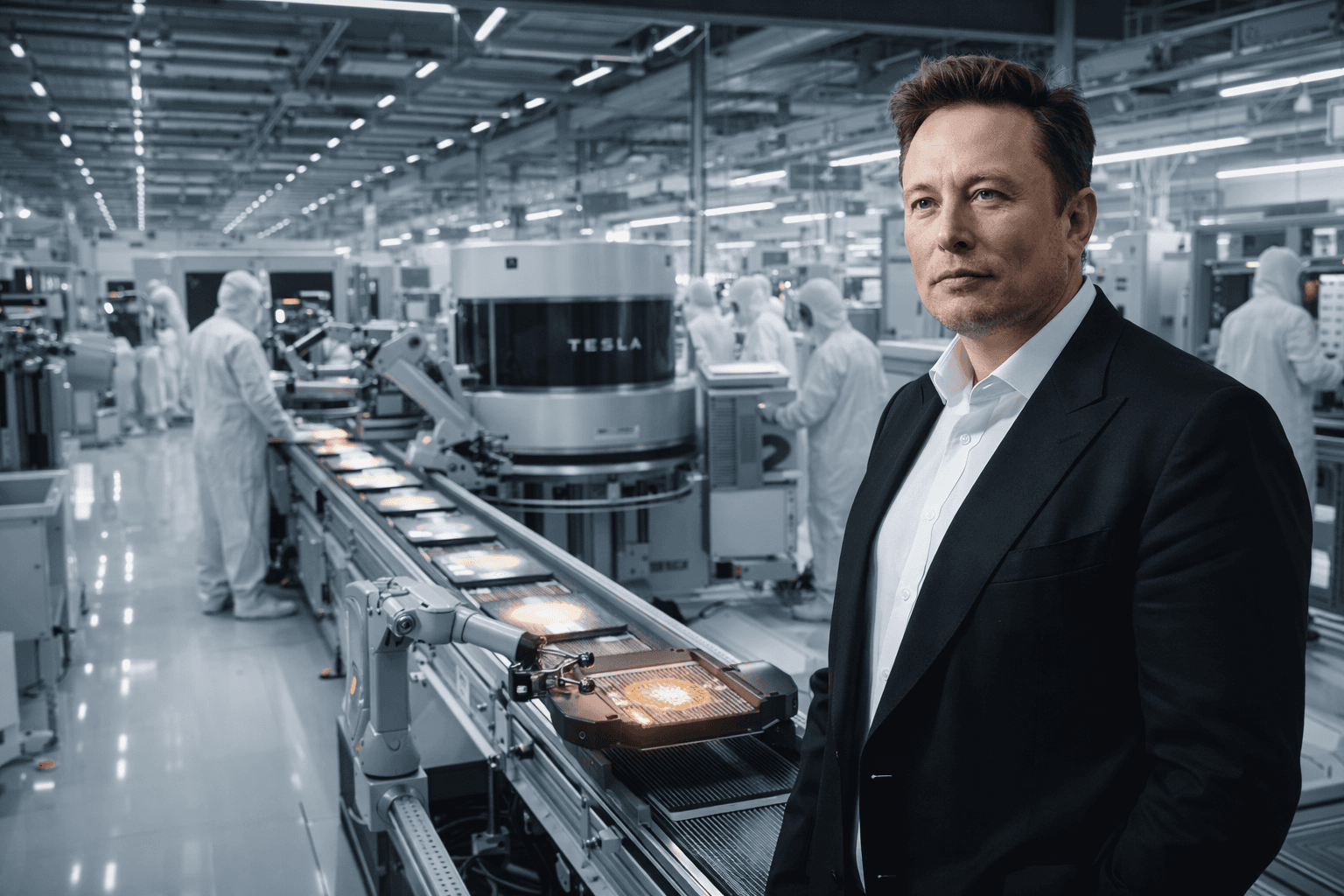
Artificial intelligence hardware has become the foundation of modern technology platforms.
Tesla now wants to control that foundation.
Elon Musk recently announced that the Tesla Terafab AI chip factory project will launch within seven days. The facility is designed to manufacture artificial intelligence chips that power Tesla’s autonomous driving systems.
The announcement highlights Tesla’s growing ambition to vertically integrate critical technologies that support its self-driving software and robotics initiatives.
Why Tesla Is Building the Terafab AI Chip Factory
Tesla currently relies on semiconductor partners to manufacture its AI chips.
However, demand for high-performance AI processors continues to accelerate across the technology industry.
Musk previously stated that existing suppliers may not be able to produce chips at the scale Tesla requires. As a result, the company concluded that building its own large manufacturing facility could be necessary.
The planned Tesla Terafab AI chip factory would significantly expand the company’s ability to produce advanced processors for autonomous driving.
The Role of Tesla’s Fifth-Generation AI Chips
Tesla is currently developing a fifth-generation AI chip architecture designed to power its next generation of autonomous systems.
These chips support complex neural networks that process large volumes of driving data from Tesla vehicles.
The processors are critical for systems such as Full Self-Driving (FSD), which rely on real-time video analysis and machine learning inference.
As Tesla expands its autonomous platform, demand for high-performance computing hardware continues to increase.
Potential Semiconductor Partnerships
Even with the Terafab initiative, Tesla may still collaborate with major semiconductor manufacturers.
Musk previously indicated that the company could explore discussions with Intel regarding potential chip manufacturing cooperation.
Tesla already works with global semiconductor leaders such as TSMC in Taiwan and Samsung in South Korea for chip production.
The Terafab project therefore represents a hybrid strategy that combines internal manufacturing with external supply chains.
Industry Context: The Global Race for AI Chips
The semiconductor industry has entered a period of intense competition.
Artificial intelligence models require enormous computing capacity, and companies are racing to secure reliable chip supply.
Technology giants including Nvidia, Apple, Google, and Amazon are increasingly designing their own custom processors.
Tesla’s move to build the Tesla Terafab AI chip factory reflects the same strategic trend. Companies want tighter control over the hardware powering their AI ecosystems.
Strategic Implications for Tesla’s Technology Ecosystem
Vertical integration has been a core element of Tesla’s strategy.
The company already designs key technologies internally, including battery systems, software architecture, and AI hardware.
Developing its own chip fabrication capability could deliver several advantages:
- Greater control over production volumes
- Faster chip design iteration cycles
- Reduced dependency on external suppliers
- Improved performance optimization for Tesla’s software stack
For autonomous vehicles, hardware and software integration plays a decisive role in system performance.
Market Impact on the Semiconductor and EV Industries
Tesla’s entry into chip manufacturing could influence both the semiconductor market and the electric vehicle sector.
First, it increases demand for specialized AI processors tailored to automotive applications.
Second, it could intensify competition among companies developing custom silicon for artificial intelligence workloads.
Finally, it highlights the growing overlap between the automotive industry and advanced computing infrastructure.
Vehicles are increasingly becoming high-performance computing platforms.
Topics
Covering startup news, AI, technology, and business at ThePrimely. Delivering accurate, in-depth reporting on the stories that shape the future.