
NavIC Atomic Clock Failure: ISRO’s Indigenous Navigation System Faces Technical Setback
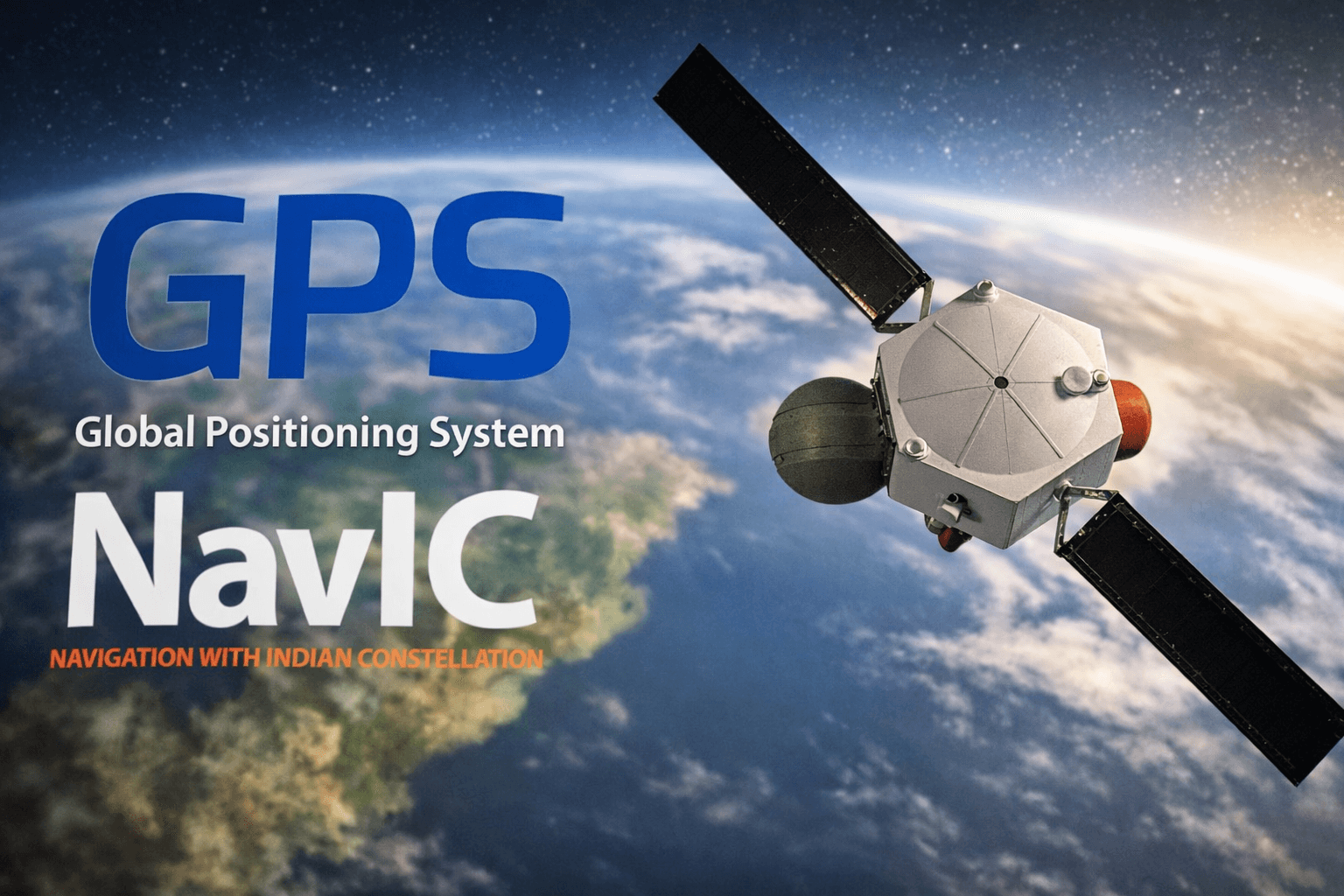
India’s indigenous satellite navigation system NavIC (Navigation with Indian Constellation) has encountered a significant technical challenge after the atomic clock onboard the IRNSS-1F satellite stopped functioning.
The malfunction has raised concerns about the operational strength of the navigation network that supports positioning services across India and nearby regions.
NavIC serves as India’s regional alternative to global navigation systems such as GPS, providing positioning, navigation, and timing services for civilian and strategic applications.
What Happened to the IRNSS-1F Satellite?
The issue emerged when the last functioning atomic clock on the IRNSS-1F satellite malfunctioned, effectively ending the satellite’s navigation service role.
The satellite, launched in March 2016, had been operating with only one active clock after the other two clocks had previously failed.
Atomic clocks are critical for navigation satellites because they provide extremely precise timing signals required to calculate location accurately.
Without a functioning atomic clock, a navigation satellite cannot contribute to position calculations.
Why Atomic Clocks Are Critical for Navigation Systems
Satellite navigation systems rely on highly accurate time measurements.
Each satellite transmits signals that include precise timestamps generated by onboard atomic clocks. Receivers on Earth use these signals from multiple satellites to calculate their position.
To determine an accurate location, signals from at least four operational satellites are required.
If the number of functioning satellites drops below this threshold, navigation services may become unreliable or degraded.
Impact on the NavIC Satellite Constellation
The NavIC system originally consisted of a constellation of navigation satellites placed in geostationary and geosynchronous orbits.
However, several satellites in the system have experienced technical problems over time, including failures of rubidium atomic clocks.
According to reports, six of the eleven satellites launched for the NavIC network have faced failures, highlighting the challenges involved in maintaining the constellation.
The IRNSS-1F malfunction further reduces the number of satellites capable of delivering full navigation services.
ISRO’s Plan to Strengthen NavIC
ISRO has been working to upgrade and expand the NavIC constellation through the NVS-series satellites, which incorporate improved navigation technology and enhanced signals.
These next-generation satellites are designed to provide:
- Better accuracy for civilian navigation
- Improved reliability
- Compatibility with mass-market devices such as smartphones
The space agency has also been developing indigenous atomic clock technology to reduce dependence on imported components.
Strategic Importance of NavIC for India
NavIC plays a vital role in India’s technological and strategic infrastructure.
The system supports multiple applications including:
- navigation for transportation and logistics
- disaster management
- maritime navigation
- military operations and national security
Unlike global systems such as GPS, NavIC is optimized for India and a region extending roughly 1,500 km around its borders.
This regional focus allows the system to provide high-precision positioning services within its coverage area.
Topics
Covering startup news, AI, technology, and business at ThePrimely. Delivering accurate, in-depth reporting on the stories that shape the future.