
Iran Targets Google, Microsoft and Nvidia as Middle East Conflict Expands into Tech Infrastructure
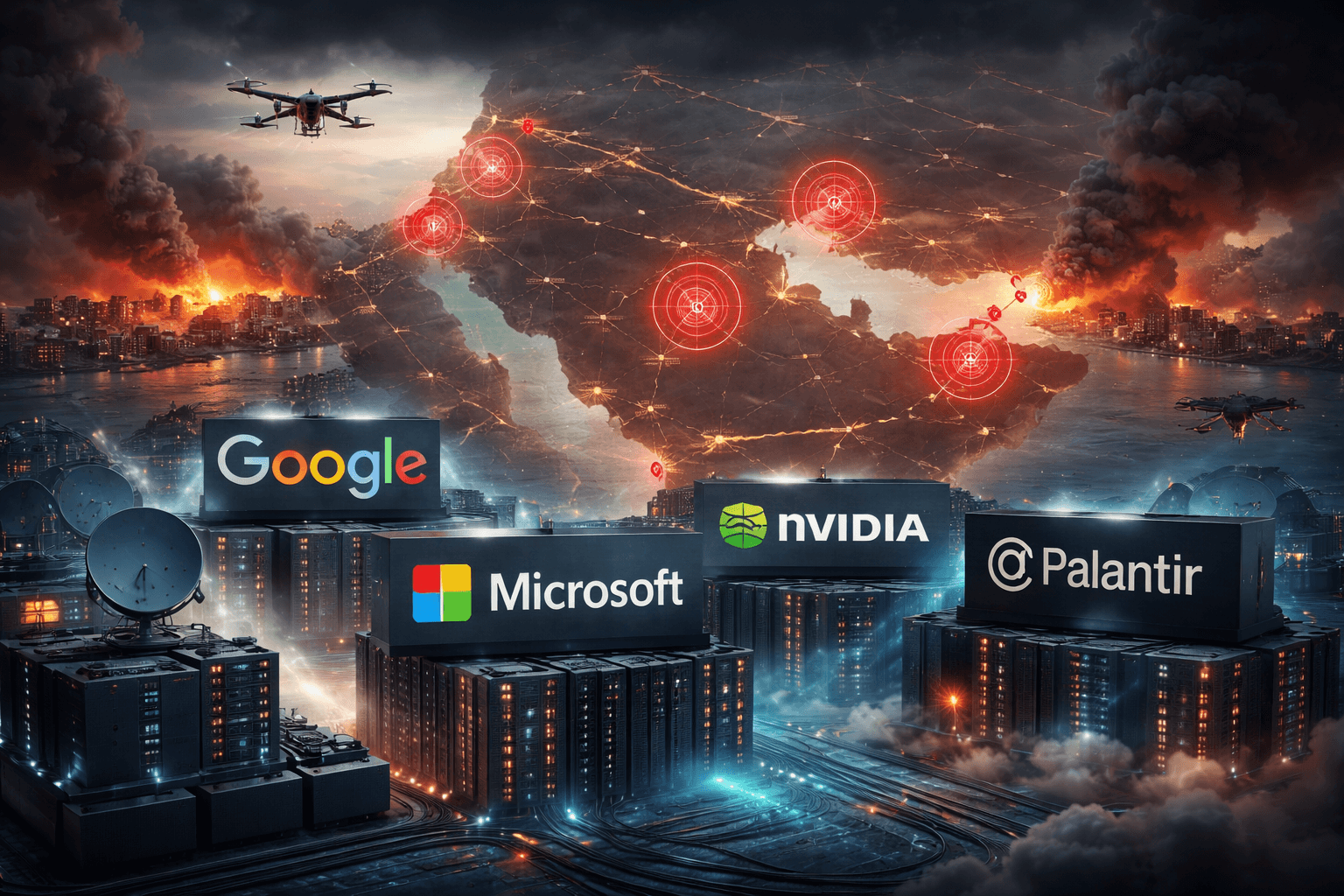
The Middle East conflict is entering a new phase. Military strikes are no longer the only concern. Iran Targets Google, Microsoft and Nvidia in Escalating Tech War
Digital infrastructure and technology companies are now part of the battlefield.
Iran has issued a warning that several major US technology companies could become legitimate targets. The list includes Google, Microsoft, Nvidia, IBM, Oracle, Amazon and Palantir.
This development signals a shift from traditional warfare toward infrastructure warfare. If the threat escalates, it could affect global cloud services, financial systems and enterprise technology networks across the region.
The Warning That Shifted the Conflict
Iranian state affiliated media published a list identifying offices and technology infrastructure operated by major US tech companies as potential targets.
The announcement reportedly came through the Tasnim News Agency, which is closely associated with the Islamic Revolutionary Guard Corps. The report described these facilities as “Iran’s new targets.”
The companies named include:
- Microsoft
- Nvidia
- IBM
- Oracle
- Palantir
- Amazon
According to the report, these companies were identified because their technologies allegedly support military or intelligence systems linked to the United States and Israel.
Iranian officials argued that as the regional conflict expands, the scope of legitimate targets also broadens to include economic and technological infrastructure.
What Infrastructure Could Be Targeted
The warning focuses on physical and digital infrastructure operated by technology firms across the Middle East.
Reports indicate that around 29 facilities were identified as possible targets. These include:
- Cloud data centers
- Research and development campuses
- AI and analytics facilities
- Corporate offices
- Technology hubs supporting regional cloud services
Locations reportedly span Israel, the United Arab Emirates, Qatar and Bahrain.
Examples mentioned in reports include:
- Nvidia’s research campus in Haifa
- Google technology hubs in Dubai
- IBM AI research facilities in Israel
These sites form part of the digital backbone supporting enterprise cloud services, artificial intelligence research and global software operations.
The Rise of Infrastructure Warfare
From Military Targets to Digital Systems
Historically, warfare focused on military installations and government infrastructure. That pattern is changing.
Iranian officials have described the conflict as evolving into infrastructure warfare. The concept expands the battlefield to include financial networks, technology platforms and cloud infrastructure.
This strategy reflects a broader shift in modern geopolitics. Technology companies now operate systems that power national security, logistics, communications and data analysis.
Consequently, their infrastructure can become strategic assets during geopolitical conflict.
The Economic Dimension
Iran has also warned that economic centers and banks linked to the United States or Israel could become targets.
Officials issued this warning after claiming that attacks had targeted Iranian financial institutions.
This signals a broader strategy that blends military retaliation with economic pressure.
Why Technology Companies Are Involved
Military Technology and AI Systems
Many of the companies listed are deeply involved in advanced technologies such as artificial intelligence, cloud computing and defense analytics.
Examples include:
- Cloud infrastructure used by government agencies
- AI systems supporting intelligence analysis
- Data platforms used for military logistics
- High performance computing used in defense research
Companies such as Palantir and Nvidia play major roles in data analytics and AI processing infrastructure. These technologies are increasingly embedded in modern defense operations.
Iranian officials claim this involvement justifies targeting related infrastructure.
Strategic Digital Dependence
The modern global economy runs on cloud infrastructure.
Major corporations, governments and financial systems rely on platforms provided by companies such as Google Cloud, Microsoft Azure and Amazon Web Services.
If regional infrastructure supporting these services becomes unstable, the effects could extend far beyond the Middle East.
A New Risk for Big Tech
Global Cloud Networks Under Geopolitical Pressure
The threat introduces a new layer of geopolitical risk for the global technology industry.
Tech companies increasingly operate physical infrastructure in politically sensitive regions. Data centers, AI research hubs and regional cloud networks now sit near geopolitical fault lines.
If these facilities become targets, companies may face several consequences:
- Increased cybersecurity and physical security spending
- Disruption to regional cloud services
- Insurance and operational risk escalation
- Government pressure to reassess infrastructure locations
Technology firms rarely operate as neutral actors anymore. Their platforms are embedded in national security systems and economic infrastructure.
Investor and Market Implications
Global investors may begin to price geopolitical exposure into technology infrastructure assets.
Cloud infrastructure in the Middle East could see heightened risk assessments. Multinational companies may also reconsider data localization strategies and redundancy planning.
For Big Tech, resilience and geographic diversification will become strategic priorities.
Strategic Implications for Global Technology
The situation highlights a deeper transformation in international conflict.
Three structural shifts are becoming clear:
First, technology infrastructure has become strategic infrastructure.
Cloud platforms and AI systems now support national power.
Second, private companies are increasingly part of geopolitical competition.
Technology firms now sit at the intersection of business, security and diplomacy.
Third, digital ecosystems can become indirect battlegrounds.
Disrupting cloud infrastructure can produce economic impact without traditional military escalation.
This dynamic could redefine how governments and corporations manage technology assets globally.
Iran’s warning marks a pivotal moment in the evolution of modern conflict.
By identifying major technology companies as potential targets, the dispute has expanded beyond military confrontation into the digital economy.
Cloud infrastructure, AI platforms and data centers now represent strategic assets. As a result, technology companies must operate with the same geopolitical awareness as nation states.
The outcome will shape how global technology networks are built, protected and governed in the decade ahead.
Topics
Covering startup news, AI, technology, and business at ThePrimely. Delivering accurate, in-depth reporting on the stories that shape the future.