
India's Startups Shift from Scale to Substance in 2026
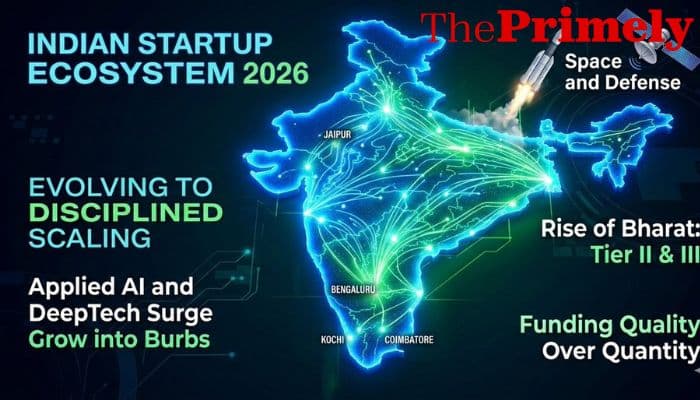
India's startup ecosystem is entering a new phase. For years, the defining metric was growth how fast a company could scale, how large a funding round it could close. That mindset is changing fast.
Across sectors, the India startup ecosystem in 2026 is being reshaped by a quieter but more durable shift. Startups are moving from aggressive expansion to deliberate depth building with AI at the core, embedding sustainability into operations, and strengthening governance frameworks.
This is not a slowdown. It is a maturation. The companies gaining ground today are not just growing faster they are building smarter.
New age solutions for old problems
Some of the most compelling work is happening at the intersection of technology and deeply entrenched inefficiencies.
KisaanSay is redefining the farm to consumer model by focusing on single origin food products and supply chain transparency addressing a longstanding trust deficit in India's food ecosystem. Fresh capital is supporting its expansion across distribution, branding, and supply chain infrastructure.
WorkOnGrid is tackling the complexity of utilities infrastructure. Power, water, and gas systems have long suffered from fragmented data and slow decision making. The company is building a unified data intelligence layer that integrates smart meters, sensors, GIS systems, and financial networks to enable real time automation.
The shift is subtle but important: startups are no longer just digitising industries they are rewiring how those industries function at a structural level
Sustainability as a business model, not a slogan
Climate conscious startups are moving beyond narrative. ECOIL is building a structured ecosystem around used cooking oil redirecting waste toward biofuel and aviation fuel production. Improper disposal of cooking oil is both a public health issue and an environmental one. The company is turning that problem into a commercial opportunity.
This signals a broader shift across the ecosystem. Sustainability is no longer a branding layer applied after the fact. It is being built into core business models from day one, shaping operations, logistics, and long term strategy.
For investors, this also matters. Sustainability embedded businesses tend to have lower regulatory risk and stronger longterm unit economics a combination that resonates in a more cautious funding environment.
AI becomes the foundation, not the feature
The most consequential transformation underway in the India startup ecosystem is the role of artificial intelligence. AI is no longer a product differentiator. It is becoming the base layer on which everything else is built.
H2LooP is targeting one of the most complex bottlenecks in hardware development the software layer that slows down semiconductor and defence grade innovation. By introducing AI native tools into this space, it is compressing development cycles and reducing failure risk in high stakes environments.
Xccelera is developing reusable AI agents and autonomous workflows for enterprise systems, advancing a model where traditional services are replaced by intelligent, self operating software. Its "services as software" thesis reflects where enterprise technology is heading.
The pattern is consistent across sectors. Travel platforms are using AI to personalise and automate. Telecom providers are building AI ready data infrastructure. Product platforms are integrating decision making, development, and post launch intelligence into unified systems.
AI is no longer a vertical. It is becoming the invisible operating layer beneath every industry and the startups that embed it early are building structural advantages that are difficult to replicate
Governance and leadership enter the growth equation
As Indian startups grow in scale and complexity, governance is no longer optional. Companies are actively recruiting experienced board members, independent directors, and senior leaders with backgrounds in banking, healthcare policy, AI strategy, and global consulting.
Investment platforms and innovation hubs are expanding their committees with specialists in venture capital, private credit, and deeptech. The goal is sharper due diligence, more disciplined capital allocation, and better institutional accountability.
This marks a clear turning point. The ecosystem is transitioning from founder led sprint to institutionally governed scale a sign of increasing maturity and readiness for larger capital pools.
Bharat, not just India: expansion into new geographies
The next phase of growth is not happening in Mumbai or Bengaluru alone. Startups are pushing into smaller cities and emerging corridors and building solutions specifically designed for those markets.
Logistics platforms are deploying smaller vehicle formats and tech enabled services in congested urban centres, bringing structure to a historically unorganised sector. Fintech players are combining digital platforms with physical presence in high growth corridors, creating accessible and scalable financial services.
In healthcare, startups are scaling affordable clinic networks using technology to standardise care and improve patient outcomes at lower price points.
The underlying insight is powerful: India's next hundred million users and the next wave of startup revenue will come from beyond the metros.
Edtech pivots from access to outcomes
India's edtech sector is undergoing a quiet but significant reset. The earlier race to offer content at scale has given way to a more focused question: what outcomes does the learner actually achieve?
Subscription based models are gaining ground, reflecting growing willingness among users to pay for measurable value real skills, improved employability, and career progress. Platforms are restructuring leadership to prioritise AI driven learning and workforce transformation.
Newer entrants are building closed loop ecosystems where learners can explore career paths, acquire relevant skills, and access job opportunities all within a single platform. The product is no longer just a course. It is a career pathway.
Global ambitions through strategic acquisitions
Indian companies are also expanding their global reach through targeted acquisitions. Engineering firms are strengthening semiconductor capabilities to offer end to end solutions. Enterprise service providers are acquiring SaaS and implementation competencies to serve global clients more effectively.
In manufacturing and fashion, acquisitions are helping companies diversify and resilience proof their supply chains. Infrastructure players are entering AI driven data centre ecosystems backed by energy integrated platforms.
These are not opportunistic purchases. They are strategic moves designed to build global competitiveness in sectors where India is positioning for long term relevance.
Frequently asked questions
What is driving the shift in India's startup ecosystem in 2026?
A combination of maturing investor expectations, AI adoption, and growing demand for real world impact is pushing startups to prioritise depth, governance, and sustainability over rapid, capital intensive scaling.
Which sectors are leading India's startup transformation?
Agritech, deeptech, edtech, logistics, fintech, and healthcare are all seeing significant evolution driven by AI integration, geographic expansion, and more durable business models.
How is AI changing Indian startups?
AI is shifting from being a product feature to becoming the foundational layer of operations. Startups like H2LooP and Xccelera are building AInative tools and autonomous enterprise workflows from the ground up.
Why are Indian startups focusing on governance now?
As companies grow in scale and seek larger institutional capital, governance becomes essential. Strong boards, independent directors, and disciplined leadership reduce risk and improve longterm accountability.
What is the "Bharat opportunity" for startups?
Tier 2 and Tier 3 cities represent India's next large user base. Startups in logistics, fintech, and healthcare are building solutions tailored to these markets unlocking growth beyond the major metros.
Is India's edtech sector recovering in 2026?
Yes, but on different terms. The sector has pivoted from content access to measurable outcomes skills, employability, and career growth with subscription models and closed loop career platforms gaining traction.
What this shift means for the road ahead
India's startup ecosystem is not slowing down. It is recalibrating. The companies earning attention and capital today are building with purpose solving structural problems, embedding AI into their core, and preparing for institutional grade governance.
The geographic expansion into smaller cities, the focus on measurable outcomes in edtech, and the strategic acquisitions targeting global markets all point in the same direction: Indian startups are building for duration, not just momentum.
For founders, this is an opportunity to differentiate through depth. For investors, it signals a more resilient and outcome oriented portfolio landscape. For the ecosystem as a whole, it represents a transition from its growth obsessed first phase into something more durable and more impactful.
The scale era gave India visibility. The substance era will give it staying power.
Topics
Covering startup news, AI, technology, and business at ThePrimely. Delivering accurate, in-depth reporting on the stories that shape the future.