
Gold record highs after U.S.-Israeli strikes on Iran
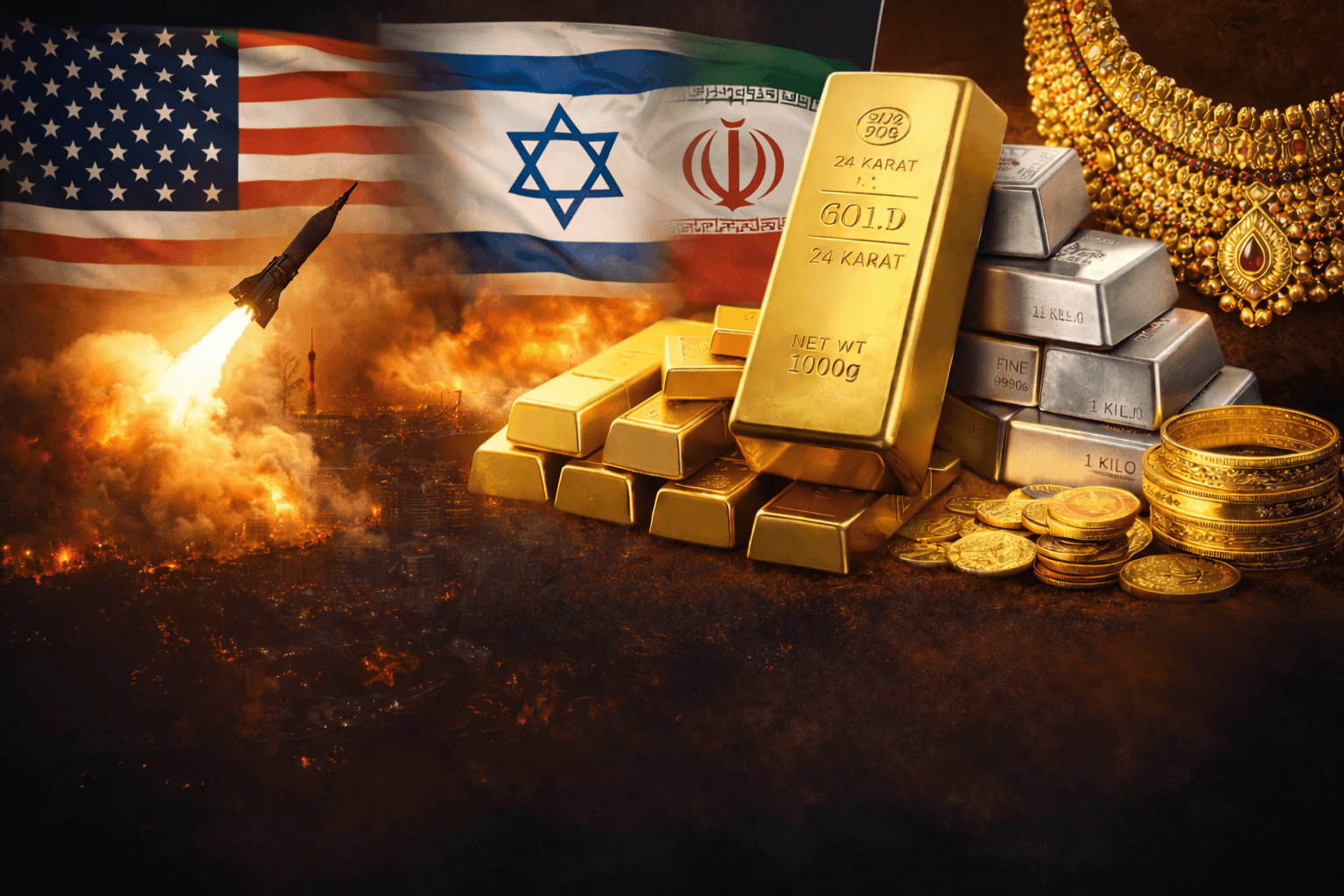
Gold surges as geopolitics reshape global markets
Gold record highs dominated global markets after coordinated military strikes by the United States and Israel on Iran. The escalation triggered a powerful shift toward safe-haven assets, pushing precious metals sharply higher within hours.
Investors reacted to fears of a broader regional conflict. Meanwhile, risk appetite weakened across equities and emerging-market assets. As uncertainty surged, gold reasserted its role as the market’s preferred hedge against geopolitical shock.
Comex gold surged past $5,290 per ounce, marking one of the strongest single-day moves in its history. Spot prices remained close to record territory as buying pressure continued into the weekend.
February delivers a historic breakout for gold
February 2026 has already entered the record books. Gold posted its largest nominal monthly gain ever, rising more than 10% in just four weeks. This surge was not driven by a single factor.
Instead, it reflected a rare convergence of forces. Geopolitical risk intensified sharply, while real yields softened and the U.S. dollar weakened. At the same time, central banks continued to accumulate gold at a steady pace.
These dynamics reinforced each other. As bond yields declined, the opportunity cost of holding gold fell. Meanwhile, geopolitical uncertainty embedded a persistent risk premium into prices.
As a result, gold has now risen in 12 of the last 14 months, placing it nearly 84% above its 52-week low.
Silver outpaces gold as supply stress deepens
While gold grabbed headlines, silver delivered an even more dramatic performance. Prices climbed to around $94 per ounce, extending a rally that has seen the metal more than triple over the past year. Unlike gold, silver’s surge is driven by both fear and fundamentals.
Structural supply deficits have now entered their fifth consecutive year. Cumulative shortages are estimated at more than 800 million ounces.
Industrial demand remains strong. Silver is critical for solar panels, electric vehicles, and advanced electronics. At the same time, above-ground inventories remain historically tight.
Comex registered stocks have fallen below 60 million ounces. Such levels have historically preceded explosive price moves. However, volatility remains extreme, and sharp corrections cannot be ruled out.
India gold prices react instantly
In India, the global rally translated into immediate price shocks. 24-karat gold surged to Rs 1,73,080 per 10 grams in Bengaluru, jumping more than Rs 4,300 in a single day. 22-karat gold also climbed sharply, tracking international prices.
Retail demand showed mixed signals. Investment buying strengthened as consumers rushed to hedge against uncertainty. However, jewellery demand softened in some markets due to record-high prices.
Despite this, long-term sentiment remains bullish. Gold continues to be viewed as a trusted store of value, especially during geopolitical instability.
Why safe-haven demand is accelerating
Safe-haven demand surged for three core reasons. First, the risk of escalation remains high.
Military strikes and retaliatory responses have increased fears of wider disruption across the Middle East.
Second, energy markets are under pressure. Higher oil prices raise inflation risks, strengthening gold’s appeal as an inflation hedge.
Third, currency volatility has intensified. A weaker U.S. dollar has amplified gold’s upside, particularly for international buyers.
Together, these factors have created a powerful feedback loop. Rising prices attract momentum buyers, which further tightens supply and lifts prices.
What happens next for gold and silver
Market volatility is expected to remain elevated when trading resumes. Gold could test $5,500 per ounce if safe-haven flows persist. However, upside momentum may slow if the dollar rebounds or geopolitical tensions ease.
Silver faces an even wider range of outcomes. Supply shortages support the bullish case. Yet, its parabolic rise increases the risk of sharp pullbacks.
The key variable remains geopolitics. Further escalation would likely extend the rally. De-escalation, however, could trigger rapid profit-taking.
Bottom line
Gold’s surge to record levels reflects more than fear alone. It signals deep uncertainty across geopolitics, currencies, and energy markets.
As long as tensions remain unresolved, precious metals are likely to stay at the center of global investor strategy.
For investors and consumers alike, gold and silver are no longer just commodities.
They have become barometers of global risk in an increasingly unstable world.
Topics
Covering startup news, AI, technology, and business at ThePrimely. Delivering accurate, in-depth reporting on the stories that shape the future.