
DAVV AI Integration: A Strategic Shift in India’s Higher Education Model
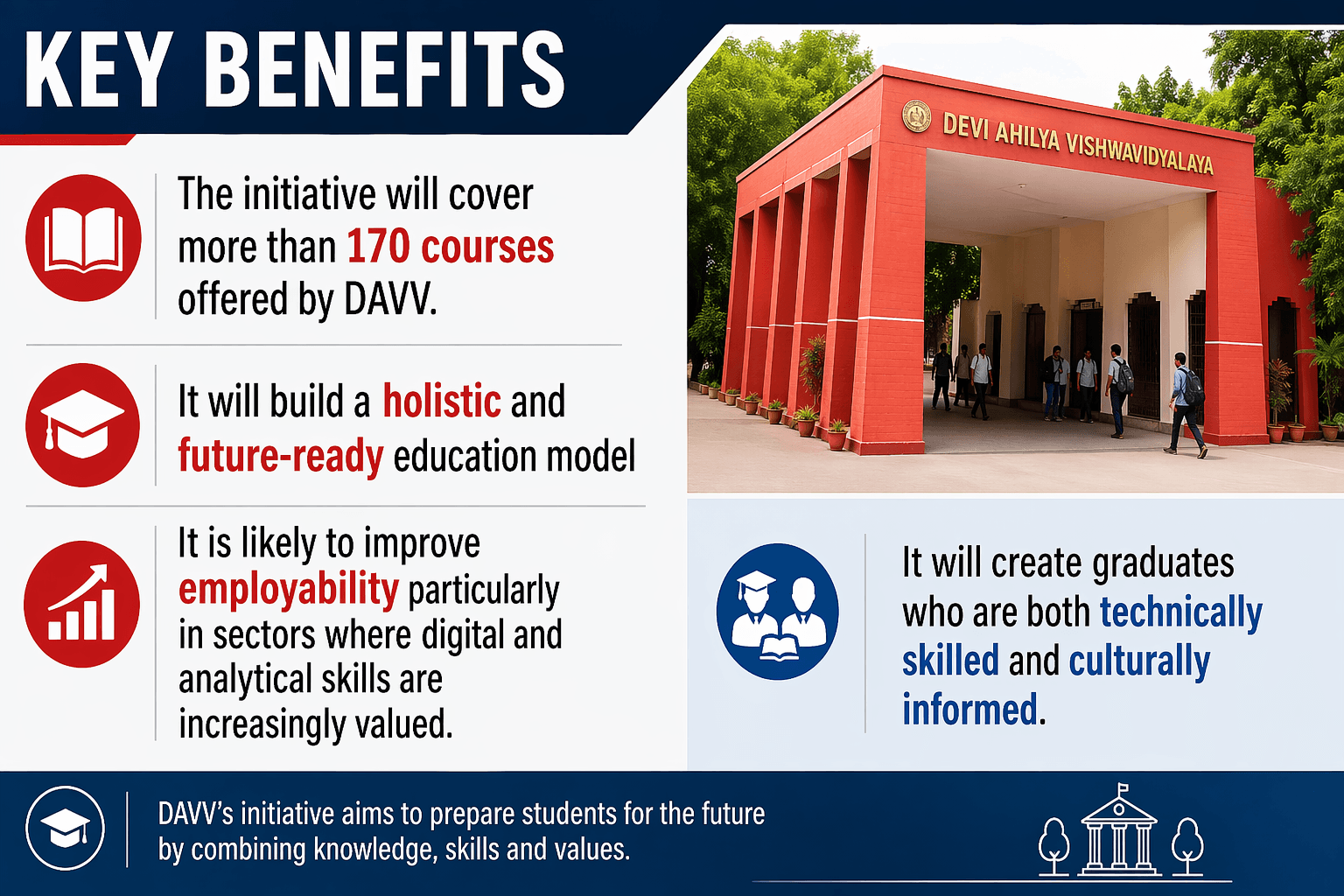
A bold curriculum reform with national implications
Devi Ahilya Vishwavidyalaya has announced a major academic overhaul. From the 2026–27 session, it will integrate artificial intelligence and Indian Knowledge Systems across all courses. This is not a pilot. It is a full scale institutional shift. The move positions DAVV among the first universities in India to combine modern technology education with traditional knowledge frameworks at this scale. It reflects a growing policy push to align education with both innovation and cultural grounding.
Understanding the DAVV AI Integration initiative
The DAVV AI Integration strategy focuses on embedding AI concepts into every discipline. This includes science, commerce, humanities, and professional courses. The goal is not to create specialists alone. Instead, it aims to build AI aware graduates across domains.
At the same time, the university will introduce Indian Knowledge Systems as a parallel academic layer. These include traditional sciences, philosophy, governance models, and indigenous practices. Importantly, this integration is not optional. It will be part of the core curriculum for all students.
Why this shift matters now
India’s higher education system is under pressure to evolve. Industry demand for AI skills is rising sharply. At the same time, policymakers are pushing institutions to preserve and promote indigenous knowledge. DAVV’s move aligns with both priorities. It also reflects the broader direction set by the National Education Policy. The policy emphasizes multidisciplinary learning, skill development, and cultural awareness. By combining AI and Indian Knowledge Systems, the university is attempting to bridge two critical gaps. One is technological readiness. The other is contextual relevance.
Key developments in the rollout plan
Curriculum redesign across departments
All departments will revise their syllabi. AI modules will be tailored to each discipline. For example, commerce students may learn AI in financial analytics, while humanities students may explore AI in social research.
Faculty training and capacity building
The university plans to train faculty members to deliver this new curriculum. This step is crucial. Without faculty readiness, curriculum reform often fails.
Standardized implementation timeline
The rollout will begin in the 2026–27 academic session. This provides time for preparation, resource allocation, and academic alignment.
Integration of Indian Knowledge Systems
Courses will include structured content on traditional Indian sciences and knowledge frameworks. This is expected to provide a broader intellectual foundation to students.
Industry and academic impact
The DAVV AI Integration initiative could reshape graduate employability. Students will graduate with baseline AI literacy, regardless of their field. This increases their adaptability in a technology driven economy. Moreover, the inclusion of Indian Knowledge Systems may create new research opportunities. It can encourage interdisciplinary studies that combine traditional insights with modern tools. From an institutional perspective, this move strengthens DAVV’s positioning. It signals innovation while maintaining cultural depth. Other universities may follow a similar path.
Strategic implications for higher education in India
Shift from specialization to hybrid learning
Traditional education models often separate disciplines. DAVV is moving toward integration. This reflects a broader global trend where skills overlap across fields.
Alignment with future workforce needs
AI is no longer a niche skill. It is becoming foundational. By embedding it across courses, DAVV ensures that students are future ready.
Reinforcement of cultural knowledge
Indian Knowledge Systems provide context and continuity. Their inclusion ensures that modernization does not lead to cultural disconnect.
What comes next
The success of DAVV AI Integration will depend on execution. Curriculum design, faculty training, and student engagement will play key roles. If implemented effectively, this model could scale nationally. It may influence regulatory frameworks and inspire similar reforms across universities. There is also potential for collaboration with industry. AI driven projects, internships, and research partnerships can further strengthen outcomes.
A decisive step toward integrated education
DAVV’s decision marks a turning point. It moves beyond incremental reform and embraces structural change. By combining artificial intelligence with Indian Knowledge Systems, the university is redefining what holistic education looks like. This approach balances innovation with identity. If executed well, it can serve as a blueprint for the future of higher education in India.
FAQ's
What is DAVV AI Integration?
It is a university wide initiative to include artificial intelligence in all academic courses from the 2026–27 session.
Will AI be mandatory for all students?
Yes. AI concepts will be part of the core curriculum across disciplines.
What are Indian Knowledge Systems in this context?
They include traditional Indian sciences, philosophies, and knowledge frameworks integrated into academic courses.
When will the new curriculum start?
The implementation is scheduled for the 2026–27 academic session.
Why is this initiative important?
It prepares students for a technology driven future while preserving cultural and intellectual heritage.
Topics
Covering startup news, AI, technology, and business at ThePrimely. Delivering accurate, in-depth reporting on the stories that shape the future.