
Oil Past $105, Hormuz Shut: Why Crypto Cannot Ignore This
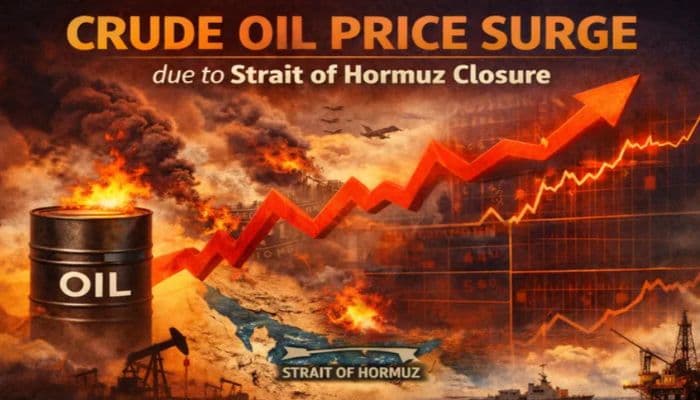
Oil crossed $105 per barrel on April 5, 2026. The Strait of Hormuz through which roughly 20% of the world's seaborne oil flows has been effectively closed since mid March. Tanker traffic is down 90 to 95% from pre conflict levels. And the emergency reserves the world deployed to buy time are running out.
For the crypto market, this is no longer a background story. Bitcoin sits at $66,500. The Fear and Greed Index has held at 12 deep extreme fear territory for 47 consecutive days. Two macro shocks are now hitting simultaneously: the Iran energy crisis and the Liberation Day tariff escalation. Neither shows signs of resolving quickly.
How the Strait of Hormuz became the world's biggest macro risk
The conflict began on February 28, 2026, when the United States and Israel launched joint air strikes on Iranian military infrastructure. Iran's response was swift and economically devastating: it ordered the closure of the Strait of Hormuz, the narrow waterway between Iran and Oman that carries approximately 20 million barrels of oil per day.
That is roughly one in five barrels of seaborne oil traded globally. There is no adequate short term replacement route. Pipelines that bypass the strait exist, but they cannot absorb the volume. Since the closure, tanker traffic through the strait has fallen more than 90%. Oil prices have risen more than 50% from their January 2026 open of $57.42 per barrel in under 45 days one of the fastest supply shock rallies in modern history.
Bitcoin is not behaving like a safe haven
The conventional argument for Bitcoin during geopolitical crises is that it acts like digital gold a neutral store of value that attracts capital fleeing traditional markets. The data in 2026 tells a different story entirely.
Bitcoin's correlation with the Nasdaq 100 has reached 85.4% during oil price spikes this year. That means Bitcoin is currently trading as a high beta tech asset amplifying the moves of growth stocks rather than moving independently of them. When oil spikes and inflation expectations rise, institutional allocators de risk across the board. They sell equities, they sell growth assets, and they sell crypto. Bitcoin goes down with everything else.
Bitcoin's 85.4% correlation with the Nasdaq 100 during 2026 oil spikes means it is behaving as a risk on asset, not an inflation hedge. Capital flows into oil and gold not into BTC when energy prices shock global markets.
The data from the market itself confirms this. When Trump's Iran war speech sent oil above $104, Bitcoin fell from $69,230 to $66,393 within 24 hours. BTC futures open interest on CME dropped 2.70%. The Coinbase Premium which measures US retail buying demand turned negative. Buyers are not stepping in to buy the dip.
The Liberation Day tariff shock adds a second layer
The oil shock alone would be difficult enough for crypto markets to absorb. But April 5 brought a second macro event the implementation of Liberation Day tariffs announced by the Trump administration. The tariffs add another inflationary layer on top of the energy price surge and together, the two shocks are compressing risk appetite in a way that neither would have achieved alone.
The combined effect is visible in the Fear and Greed Index. The index has sat at 12 deep extreme fear territory for 47 consecutive days. That is an unusually long streak of sustained pessimism. Fear spikes typically resolve within days or weeks as markets adapt. Forty seven days of consecutive extreme fear points to structural, not sentiment driven, pressure.
Corporate Bitcoin selling is making things worse
Macro pressure is not the only force pushing Bitcoin lower. Corporate Bitcoin treasuries once treated as a signal of institutional confidence are cracking under sustained price weakness.
Genius Group, an AI education company, liquidated its entire 84 BTC corporate treasury in Q1 2026 to repay $8.5 million in debt. In March, MARA Holdings sold 15,133 BTC for over $1.1 billion. In February, mining company Bitdeer reduced its corporate Bitcoin holdings to zero. These are not isolated cases they reflect a broader pattern where companies that accumulated Bitcoin in 2024 and 2025 are now treating it as a liquidity source rather than a long term reserve asset.
Iran is accepting crypto for Hormuz passage
One unusual development buried in the broader crisis: Iran has reportedly been accepting payments in Chinese yuan and cryptocurrency from vessels seeking safe passage through the Strait of Hormuz. Ships from friendly nations can transit with escort, but some have been required to pay fees before being allowed through. This creates a specific, real world use case for crypto in geopolitical conflict though it is unlikely to move market prices in any meaningful direction.
The April 19 oil cliff: the risk no one is watching closely enough
The most underappreciated risk in the current environment is what BCA Research calls the "oil cliff" the point around April 19 when the IEA's 400 million barrel emergency release and temporary Russian oil export exemptions are both expected to be exhausted.
The IEA release was the largest in the agency's 52 year history. It bought time. It did not solve the problem. Normal Hormuz flows amount to roughly 20 million barrels per day. The 400 million barrel release covers approximately 20 days of that capacity. When it runs out, and if the strait remains blocked, the market will face the full supply shock without the buffer.
BCA Research projects an "oil cliff" around April 19, when IEA emergency reserves and Russian oil exemptions are both exhausted. If Hormuz remains blocked at that point, oil prices could push toward $120 to $150 removing any remaining case for near term Fed rate cuts and stripping Bitcoin of its last macro tailwind.
For Bitcoin, the specific mechanism of harm is the Federal Reserve. Futures markets are already pricing in a 70% probability that the Fed raises rates in 2026 rather than cutting them. The 10 year Treasury yield is at its highest level since the war began. If oil surges further toward $120 to $150, the inflation pulse would make rate cuts politically and economically impossible. Bitcoin, which has leaned heavily on rate cut expectations as a support mechanism, would lose that foundation entirely.
The one signal that actually matters for the oil story
Traders watching Trump's statements about Iran are tracking the wrong signal. The market reaction to individual speeches and social media posts is real but transient. What actually measures whether the Hormuz situation is improving is the ship insurance premium for Strait transits.
Before the war, that premium was less than 1% of ship value. It has since surged to 7.5%. When premiums drop sustainably below 2%, that reflects genuine improvements in transit safety not diplomatic press releases. No speech, announcement, or ceasefire rumor can replicate that signal. It is the only one that reliably precedes a meaningful oil price decline.
Frequently asked questions
Why did oil surge past $105 in April 2026?
Oil breached $105 per barrel due to the ongoing closure of the Strait of Hormuz following US and Israeli air strikes on Iran in late February. The strait carries roughly 20% of global seaborne oil. With tanker traffic down 90to95%, global supply has tightened dramatically. Liberation Day tariffs announced on April 5 added further inflationary pressure.
How does the Hormuz closure affect Bitcoin and crypto markets?
The oil shock raises inflation expectations and reduces the probability of Federal Reserve rate cuts. Bitcoin has traded with an 85.4% correlation to the Nasdaq 100 during oil spikes in 2026, meaning it moves with risk assets rather than acting as an inflation hedge. Higher oil leads to risk off behavior across markets, and crypto sells off alongside equities.
What is the Fear and Greed Index reading for crypto right now?
As of April 5–6, 2026, the Crypto Fear and Greed Index sits at 12 deep extreme fear. It has remained at this level for 47 consecutive days, an unusually sustained streak that reflects structural market pressure rather than a temporary sentiment swing.
What is the April 19 oil cliff?
BCA Research projects that around April 19, the IEA's 400 million barrel emergency oil release and temporary Russian oil exemptions will both be exhausted. If the Strait of Hormuz remains blocked at that point, global oil markets will face the full supply shock without any buffer potentially pushing Brent toward $120 to $150 per barrel.
Is Bitcoin a safe haven during the Iran oil crisis?
No not in 2026. Despite its historical positioning as "digital gold," Bitcoin has traded as a high beta risk asset during this oil shock, falling alongside equities when energy prices spike. The Coinbase Premium has turned negative and ETF outflows have accelerated, confirming that institutional and retail buyers are not treating BTC as a safe haven at this time.
Why are companies selling their Bitcoin treasuries?
Sustained price weakness is forcing companies that accumulated Bitcoin in 2024to2025 to treat it as a liquidity source. Genius Group sold its full 84 BTC reserve to repay debt. MARA Holdings sold over 15,000 BTC in March. Bitdeer liquidated its corporate holdings entirely in February. The trend reflects balance sheet stress rather than a change in long term conviction.
What comes next and what to watch
The near term direction for Bitcoin and crypto markets runs directly through the Strait of Hormuz. Not through Trump's next speech. Not through any single piece of economic data. Through ship insurance premiums and tanker traffic counts.
If Iran and Oman reach a workable transit protocol before the April 19 reserve depletion deadline, oil can begin to stabilize. That would reduce inflation pressure, restore rate cut expectations, and give Bitcoin the macro tailwind it has been waiting for since February. Trump has signaled that once the conflict ends, the strait will reopen, oil will drop, and risk appetite will return. That outcome is possible but it is not on a predictable timeline.
If the oil cliff arrives with the strait still blocked, the scenario shifts meaningfully. Oil at $120 to $150 makes rate cuts impossible in 2026. Bitcoin loses its primary macro support. The $60,000 support level which has held throughout the year would face its most serious test yet. Investors watching the crypto market need to watch the energy market first. Right now, they are the same story.
Topics
Covering startup news, AI, technology, and business at ThePrimely. Delivering accurate, in-depth reporting on the stories that shape the future.