
Lunar Eclipse 2026 India: Timings, Visibility and Scientific Significance
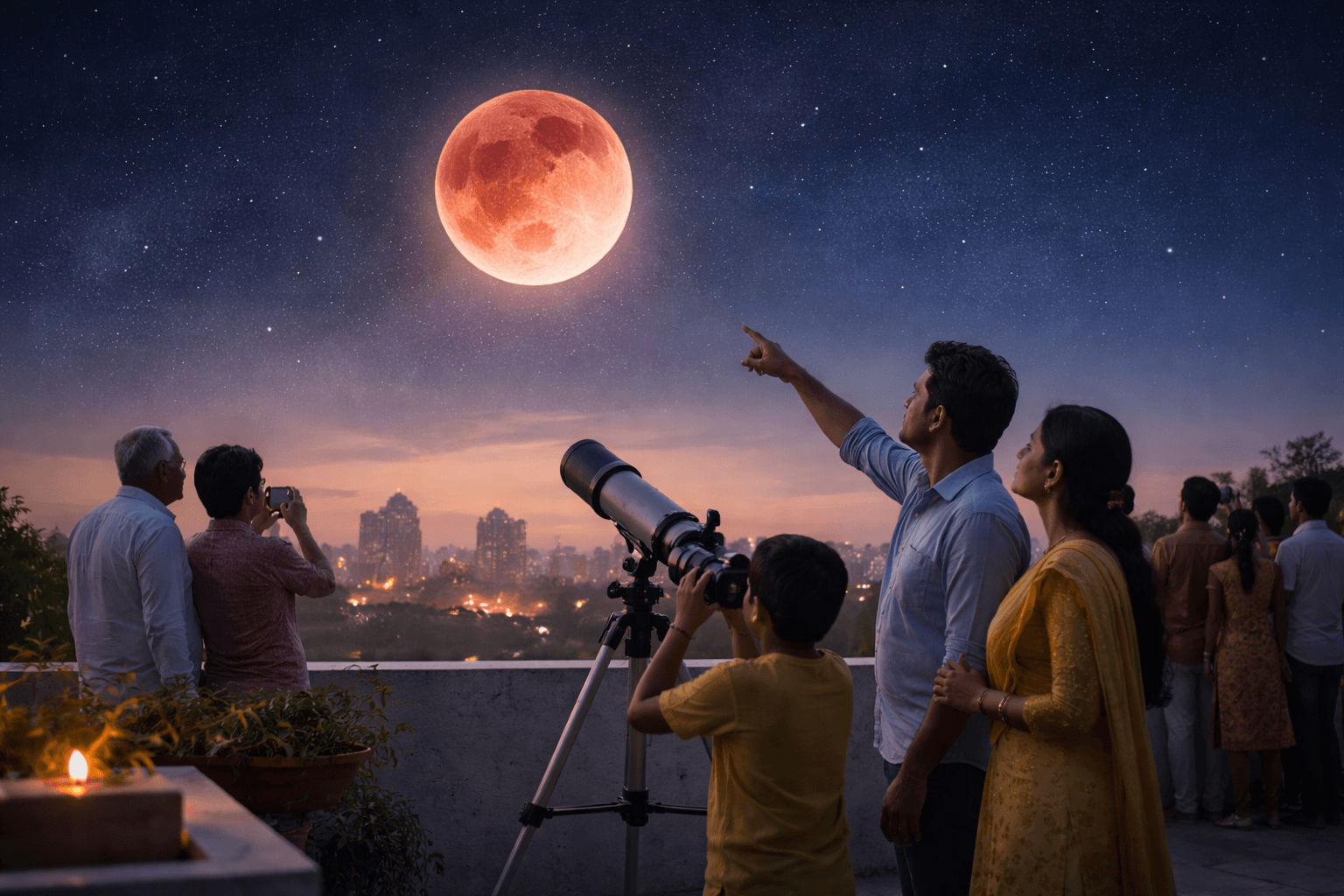
The Lunar eclipse 2026 India is set to be one of the most significant astronomical events of the year. Scheduled for March 3, 2026, the event coincides with the festival of Holi, making it both scientifically and culturally important.
This celestial event will see the Earth move directly between the Sun and the Moon, casting its shadow on the Moon and giving it a reddish appearance, often referred to as a “blood moon.”
However, the viewing experience in India will be limited to specific phases of the eclipse.
Lunar Eclipse 2026 India: Date and Timings
The total lunar eclipse will occur on March 3, 2026, and will last for several hours.
In India, the key timings are as follows:
The eclipse will begin at approximately 3:20 PM IST and end around 6:46–6:47 PM IST, lasting about 3 hours and 27 minutes.
The most favorable viewing window is expected between 6:33 PM and 6:40 PM IST, when the eclipse will be visible after moonrise.
This timing is important because much of the earlier phases will occur when the Moon is still below the horizon in many parts of India.
Visibility Across India: What You Can Actually See
Although the eclipse is total globally, visibility in India will be partial.
Because the Moon rises later in the evening, observers in most parts of India will only see the final phase of the eclipse.
The experience will vary by region. Northeastern states such as Assam, Arunachal Pradesh, and West Bengal will have better visibility due to earlier moonrise.
In contrast, cities like Delhi, Mumbai, Bengaluru, and Chennai will witness only a short window of the eclipse around sunset.
This geographical variation is a key factor in planning observation.
Why the Moon Turns Red During an Eclipse
A lunar eclipse occurs when the Earth blocks sunlight from directly reaching the Moon. However, the Moon does not disappear completely.
Instead, it often appears red.
This effect is caused by Earth’s atmosphere, which scatters shorter wavelengths of light and bends longer wavelengths, such as red light, toward the Moon.
This phenomenon is similar to the reddish color seen during sunrise and sunset.
As a result, the Moon takes on a copper or blood-red hue during totality.
Scientific Importance of the Lunar Eclipse
The Lunar eclipse 2026 India is more than a visual spectacle. It provides an opportunity to understand celestial mechanics.
Astronomers study lunar eclipses to analyze:
The Earth’s atmosphere
Light scattering patterns
Orbital dynamics of the Moon
Unlike solar eclipses, lunar eclipses are safe to observe with the naked eye and can be viewed from a wide geographical area.
They also occur more frequently and last longer, making them ideal for observation and study.
You might Like this :- China’s Parliament Sets a Strategic Roadmap for the Global Technology Race
Cultural Significance in India
In India, a lunar eclipse is known as Chandra Grahan and holds cultural and religious significance.
Traditional beliefs often associate eclipses with rituals and precautions. Many people observe fasting, avoid cooking, and follow specific practices during the eclipse period.
The Sutak period, considered inauspicious, begins several hours before the eclipse and ends after its completion.
However, these practices are based on tradition rather than scientific necessity.
From a scientific perspective, a lunar eclipse is a natural and harmless event.
How to Watch the Lunar Eclipse Safely
One of the key advantages of a lunar eclipse is that it does not require special equipment for safe viewing.
Unlike a solar eclipse, there is no risk to the eyes.
Viewers can observe the event directly with the naked eye. However, for a better experience, binoculars or telescopes can provide more detail.
For optimal viewing, it is advisable to choose an open area with minimal light pollution and a clear view of the eastern horizon.
Weather conditions will also play a crucial role in visibility.
Key Challenges for Observers in India
While the event is significant, observers in India face certain limitations.
The most important challenge is timing. Since the Moon rises late, only a portion of the eclipse will be visible.
Urban areas with high light pollution may further reduce visibility.
Cloud cover can also impact viewing conditions.
These factors make it important for observers to plan in advance.
Future Lunar Eclipses
The March 2026 event is particularly notable because it is one of the prominent eclipses visible from the region.
While lunar eclipses occur periodically, not all are easily visible in India.
Each event offers a unique opportunity for observation and study.
Astronomy enthusiasts often track eclipse cycles to plan future observations.
Topics
Covering startup news, AI, technology, and business at ThePrimely. Delivering accurate, in-depth reporting on the stories that shape the future.