
Strong US Dollar Effect on Gold Prices and Markets
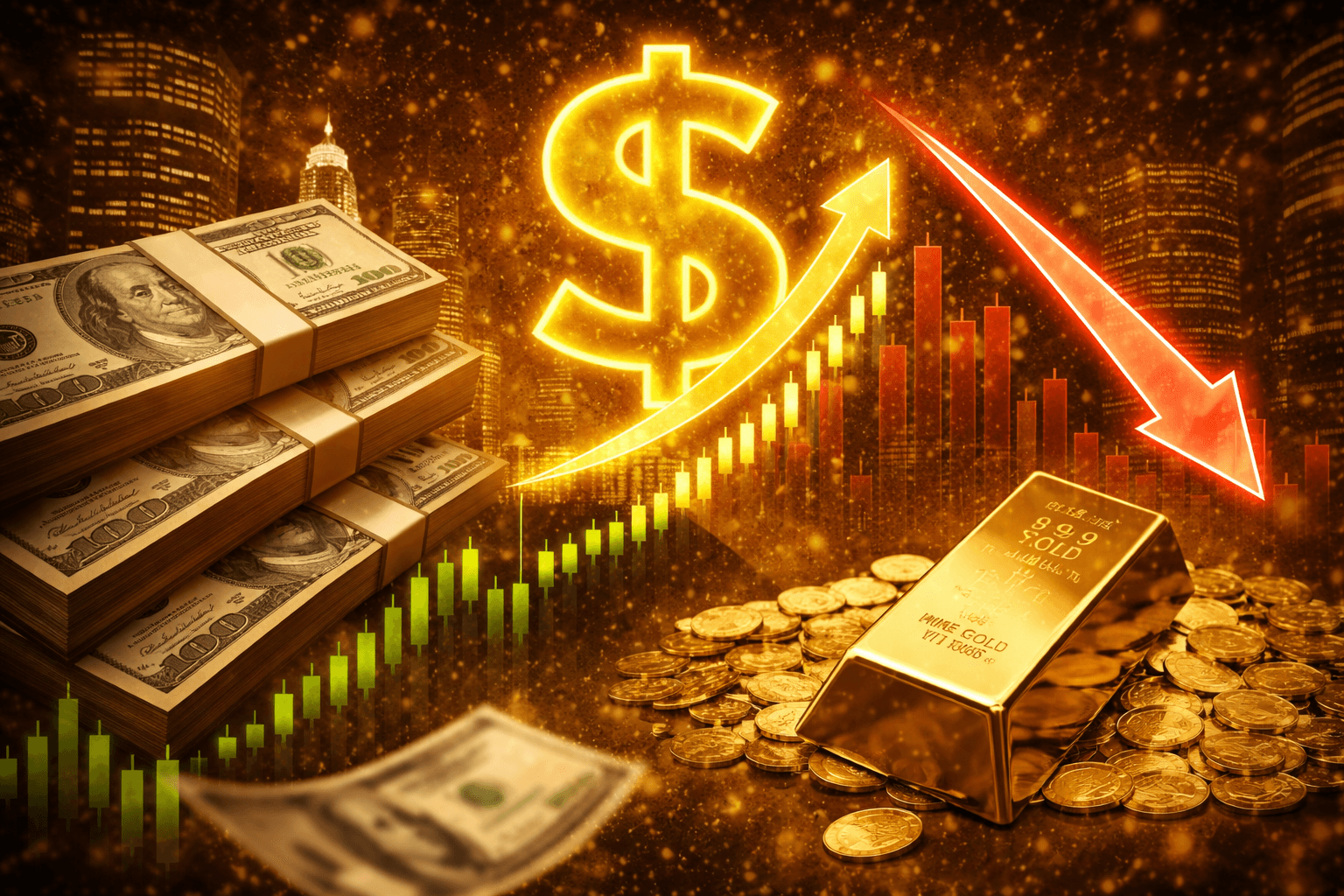
Why Gold Falls When the US Dollar Rises: The Hidden Link Explained
Gold has long been considered a safe investment during uncertain times. When wars, inflation fears or financial crises emerge, investors often turn to gold to protect wealth.
Yet recent market movements have surprised many observers. Even as geopolitical tensions increased, gold prices did not rise as strongly as expected. At the same time, the US dollar strengthened significantly.
This pattern highlights an important financial relationship known as the gold vs strong US dollar effect.
Understanding this connection helps explain why gold prices sometimes fall even when global uncertainty increases.
The Core Relationship Between Gold and the Dollar
Gold and the US dollar often move in opposite directions.
Gold is priced internationally in US dollars. When the dollar becomes stronger, gold becomes more expensive for buyers using other currencies.
As a result, global demand for gold can decline, which puts pressure on prices.
For example, if the dollar rises against currencies such as the euro, rupee or yen, investors in those regions must spend more local currency to buy the same amount of gold.
This reduced affordability often lowers demand in international markets.
Because of this pricing structure, the gold vs strong US dollar relationship plays a central role in global commodity markets.
Interest Rates and Investor Behaviour
Interest rates strongly influence both the dollar and gold prices.
When central banks, especially the US Federal Reserve, maintain higher interest rates, investors often shift money into assets that generate returns.
These include bonds, savings instruments and fixed-income investments.
Gold does not provide regular income such as interest or dividends.
As interest rates rise, investors may prefer assets that produce returns instead of holding gold.
Higher interest rates also tend to strengthen the dollar because international investors move funds into US financial markets.
This combination often creates downward pressure on gold prices.
Is the US-Iran War Affecting Gold and the Dollar?
Geopolitical tensions usually support gold prices because investors seek safer assets.
However, the recent US-Iran war has influenced markets in a more complex way.
The conflict has increased uncertainty in energy markets, particularly around oil supply routes such as the Strait of Hormuz.
Higher oil prices can increase inflation risks, encouraging central banks to maintain higher interest rates.
Higher interest rates often strengthen the dollar, which can reduce gold demand.
This explains why the gold vs strong US dollar relationship has remained visible even during geopolitical tensions.
While gold still benefits from uncertainty, economic forces such as interest rates currently have stronger influence on market direction.
Why Gold Does Not Always Rise During Crises
Many investors expect gold prices to increase whenever global risks rise.
However, financial markets respond to multiple factors at the same time.
Currency strength, inflation expectations, interest rates and investor sentiment all influence gold prices.
If interest rates remain high, the opportunity cost of holding gold increases.
This means investors may prefer income-generating assets even during uncertain periods.
Recent market trends show that economic policy expectations can sometimes outweigh geopolitical developments.
Impact on Indian Gold Buyers
The gold vs strong US dollar relationship also affects domestic prices in India.
Because gold is imported and priced in dollars, changes in currency values influence local prices.
If the dollar strengthens against the rupee, gold may become more expensive even if global prices remain stable.
However, if global gold prices fall significantly, Indian buyers may still see lower retail prices.
Lower prices often increase jewellery demand, especially during wedding and festival seasons.
India remains one of the largest gold consumers in the world, with strong cultural and investment demand.
Market corrections sometimes encourage buyers to increase purchases, helping stabilise demand.
What Happens If the Dollar Continues Rising?
If the dollar continues to strengthen, gold prices may face continued pressure in the short term.
However, long-term trends depend on several factors, including inflation, economic growth and geopolitical stability.
If inflation increases significantly or financial markets experience prolonged uncertainty, gold demand may recover.
Gold has historically remained an important store of value despite short-term fluctuations.
The gold vs strong US dollar trend reflects the complex interaction between currency markets, economic policy and global investor behaviour.
A Relationship That Shapes Global Markets
The connection between gold and the US dollar demonstrates how financial markets are deeply interconnected.
Currency movements influence commodity prices, investment decisions and economic conditions across countries.
While geopolitical tensions such as the US-Iran conflict can influence gold demand, interest rates and currency strength often play an equally important role.
Understanding the gold vs strong US dollar relationship helps investors, policymakers and consumers interpret market changes more clearly.
As global economic conditions evolve, the balance between safe-haven demand and monetary policy will continue shaping the direction of gold prices.
Even in uncertain times, gold’s role in financial markets remains significant, although the forces influencing its price continue to change.
Topics
Covering startup news, AI, technology, and business at ThePrimely. Delivering accurate, in-depth reporting on the stories that shape the future.