
College Graduate Job Market Crisis 2026: Key Trends
A Generation Entering a Slower, Tougher Market
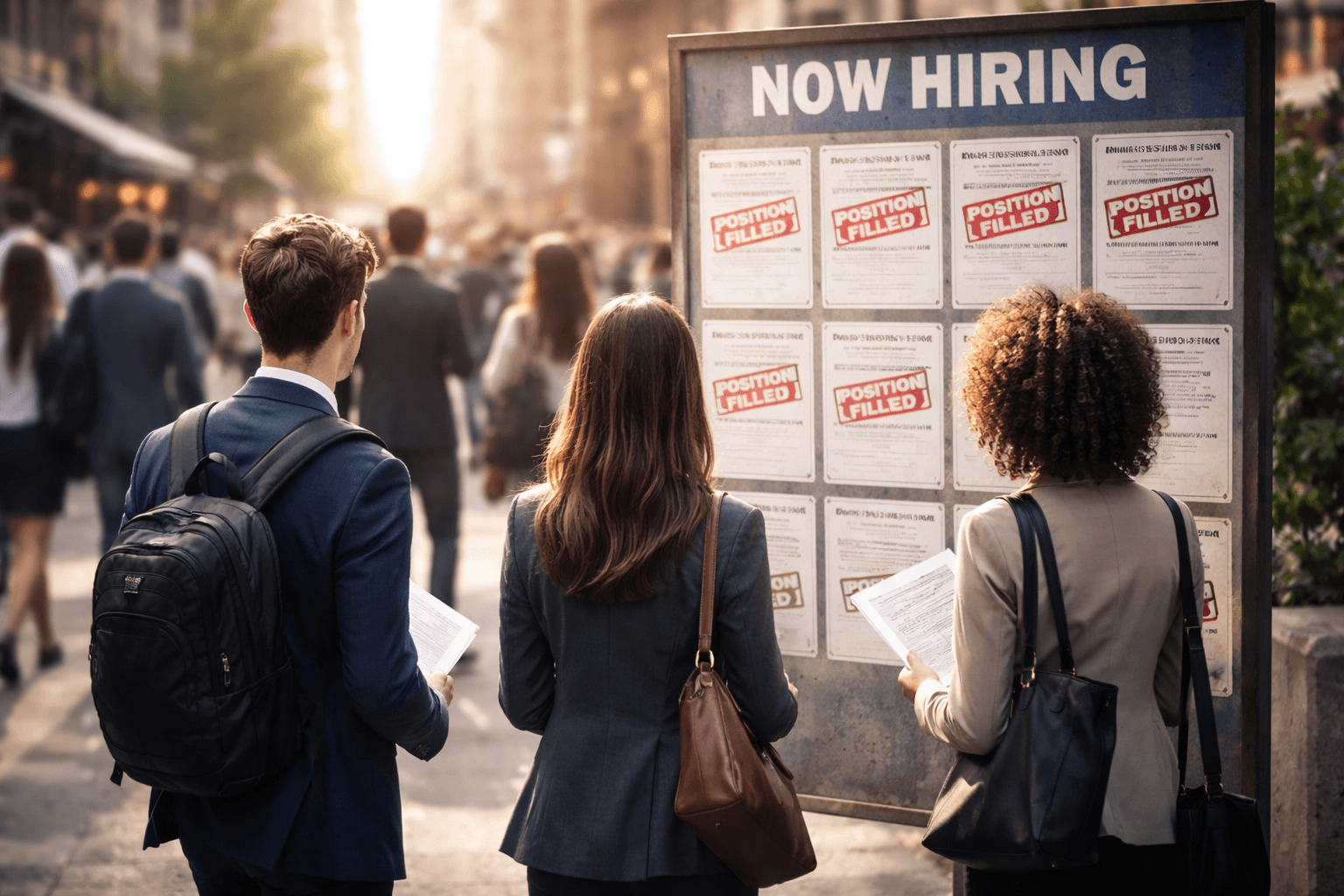
The college graduate job market in 2026 is no longer predictable. Graduates are entering a workforce that looks stable on the surface but is tightening underneath. Hiring continues. However, entry level opportunities are shrinking.
Recent data shows a clear shift. The unemployment rate for recent graduates reached around 5.7% to 5.8%, higher than the broader workforce average of about 4.2% to 4.3%. This gap matters. It signals that new entrants are absorbing the first impact of a cooling labor market.
What Changed?
Oversupply Meets Slower Hiring
For years, a college degree ensured faster employment. That advantage is now weakening. The number of graduates has steadily increased. At the same time, hiring has slowed across white collar sectors. Job postings have declined by 15%, while applications have surged by 30%, intensifying competition. As a result, even qualified candidates struggle to secure interviews.
Entry Level Roles Are Being Redefined
The structure of entry level jobs is changing. Employers are not eliminating roles entirely. Instead, they are raising expectations. Many positions now require prior experience, technical skills, or hybrid capabilities. This shift creates a paradox. Graduates need experience to get jobs. Yet jobs no longer provide that initial experience easily.
AI Is Accelerating, But Not the Only Cause
Artificial intelligence is influencing hiring. However, it is not the sole driver. Some executives warn that AI is replacing certain repetitive entry level tasks. At the same time, broader economic factors play a larger role Slower hiring cycles, Policy uncertainty, Corporate cost control, Post pandemic normalization
In fact, long term data suggests job market pressure on graduates began before widespread AI adoption.
Key Developments Reshaping Graduate Careers
1. Employers Are Hiring Less Aggressively
Hiring has slowed to its weakest pace since the pandemic in some periods. Companies are cautious. Many prefer to optimize existing teams instead of expanding aggressively.
2. Stability Is Replacing Ambition
Graduates are adjusting expectations. Instead of pursuing ideal roles, many now prioritize Job security, Stable income, Long term employability Surveys indicate that a majority of graduates are willing to accept lower salaries for stability.
3. Competition Is Expanding Beyond Graduates
Graduates are not only competing with peers. They now face competition from Experienced workers affected by layoffs, Career switchers, Global talent pools This widens the supply of candidates for every role.
Where Opportunities Still Exist
Despite the slowdown, opportunities remain. However, they are uneven.
Growth Sectors
- Healthcare
- Construction
- Skilled trades
- Hospitality
These sectors continue to add jobs consistently.
Weakening Sectors
- Technology
- Media and communications
- Corporate services
These areas are seeing reduced entry level hiring. This divergence marks a structural shift. The market is moving away from degree centric hiring toward skill based demand.
Strategic Implications for Graduates
The Degree Advantage Is Narrowing
The unemployment gap between degree holders and non degree workers is shrinking. This is a major change from historical trends, where graduates consistently had stronger outcomes.
Career Paths Are Becoming Non Linear
Graduates can no longer expect a direct path from education to career. Instead, success increasingly depends on Skill adaptability, Continuous learning, Strategic job selection
Smaller Firms Offer Hidden Opportunities
Data shows that graduates who start in smaller firms often achieve similar long term outcomes as those in large companies.In many cases, they gain broader experience earlier.
A Reset, Not a Collapse
The college graduate job market is undergoing a structural reset. Opportunities still exist. However, they are harder to access and require a different strategy. Graduates must shift from expectation driven planning to adaptability driven execution. This moment does not signal the end of opportunity. It marks the beginning of a more competitive, skill focused era.
FAQ'S
Why is the unemployment rate higher for recent graduates?
Recent graduates lack experience and are the first affected when hiring slows. This makes them more vulnerable during market shifts.
Is AI the main reason for fewer jobs?
No. AI contributes to changes, but economic conditions and hiring slowdowns play a larger role.
Which sectors are still hiring graduates?
Healthcare, construction, and skilled trades continue to show strong demand.
Are college degrees losing value?
Not entirely. However, the advantage of a degree alone is declining. Skills now matter more.
How can graduates improve job prospects?
Focus on practical skills, networking, smaller companies, and flexibility in job selection.
Topics
Covering startup news, AI, technology, and business at ThePrimely. Delivering accurate, in-depth reporting on the stories that shape the future.