
Record China Trade Surplus 2026 Signals Global Trade Shift
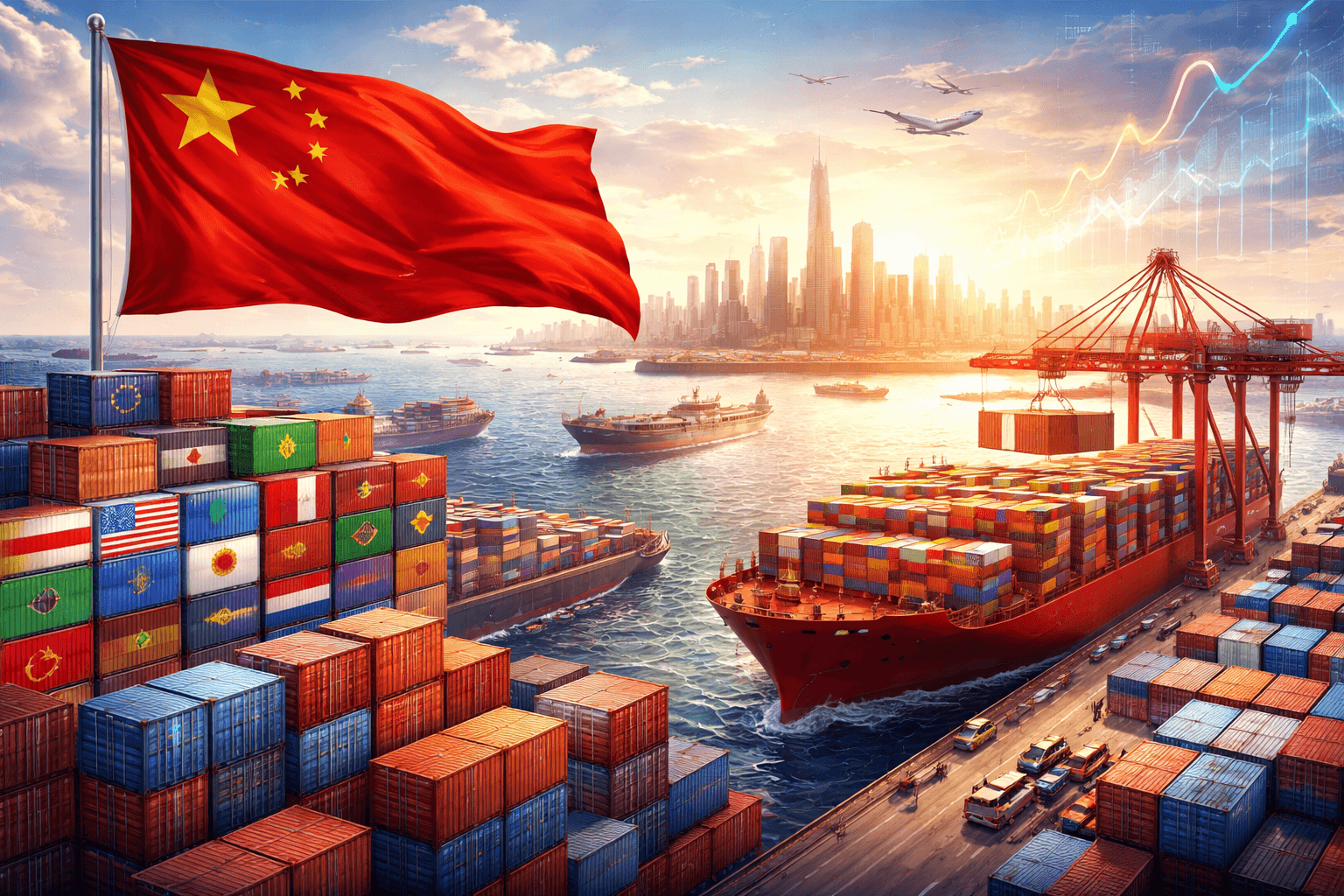
China closed 2026 with the largest trade surplus in its history, resetting expectations about the resilience of its export-driven economy. The China trade surplus 2026 surged to record levels despite years of tariff pressure and an uneven global recovery, underscoring the country’s continued centrality to global commerce.
These results challenge the assumption that tariffs alone can materially curb China’s export dominance. Instead, they highlight an adaptive trade strategy built on diversification, manufacturing scale, and deep integration into global supply chains.
Exports Remain Strong Despite Tariff Pressure
China’s export performance stayed firm throughout 2026, supported by global demand for machinery, electronics, industrial components, and clean-energy equipment. While shipments to the United States declined under ongoing tariff structures, overall export volumes rose as Chinese firms expanded into alternative markets.
Trade flows accelerated toward Southeast Asia, Africa, Latin America, and parts of Europe, showing a shift in trade geography rather than a contraction. This diversification helped offset the Trump tariffs impact, which remains embedded in U.S. trade policy.
As a result, China exports 2026 outperformed many advanced economies even as overall global trade growth slowed.
Slower Imports Deepen the Trade Gap
While exports expanded, imports grew at a slower pace. Soft domestic demand, linked to property-sector stress and cautious consumer spending, reduced demand for foreign goods and raw materials. This widened the gap between exports and imports, reinforcing concerns about the global trade imbalance.
The data reflect a structural feature of China’s economy: growth still leans heavily on external demand. Despite policy efforts to boost domestic consumption, export strength remained the primary driver of external balances in 2026.
Supply Chains Shift But Still Orbit China
Global supply chains have diversified, but not disengaged. Although production has expanded in Southeast Asia, India, and Mexico, many of those networks still rely on Chinese components, materials, and manufacturing inputs.
China’s industrial depthfrom raw materials to final assemblycontinues to anchor global production, particularly in electronics, machinery, and technology sectors. This explains why supply chain relocation slowed export momentum far less than anticipated.
Renewed Strain in US–China Trade Relations
The scale of the surplus has intensified debate around US China trade relations. U.S. officials argue persistent surpluses point to structural distortions and industrial overcapacity, while Beijing attributes its trade performance to competitiveness and global demand.
For policymakers in the United States and Europe, the challenge remains how to rebalance trade without disrupting global supply chains. The experience of 2026 shows that tariffs alone have not fundamentally reshaped trade flows.
Market and Career Implications
For financial markets, the record surplus strengthens China’s external position by supporting foreign-exchange reserves and export-oriented industries. Sectors tied to global logistics, shipping, and manufacturing continue to benefit.
For professionals, the message is clear: expertise in international trade, supply chain management, compliance, and cross-border logistics remains highly relevant. Despite diversification trends, global manufacturing continues to be closely linked to China’s production ecosystem.
Outlook for 2027
Economists expect export growth to moderate as global demand softens and trade policies evolve. At the same time, pressure is mounting on Beijing to rebalance toward domestic consumption.
Yet the message from China trade surplus 2026 is unmistakable: predictions of a rapid decline in China’s trade dominance have not materialized. Global trade remains deeply anchored in Chinese production despite tariffs, geopolitical tensions, and calls for decoupling.
Frequently Asked Questions
Why did China’s trade surplus reach a record in 2026?
Strong export performance combined with slower import growth widened the trade gap.
Did U.S. tariffs reduce China’s exports overall?
They reduced bilateral flows but did not prevent overall export expansion as trade shifted to other markets.
Is global trade imbalance increasing?
Persistent surpluses and uneven demand patterns continue to raise imbalance concerns.
Are supply chains moving away from China?
They are diversifying, but many still depend on Chinese manufacturing inputs.
Topics
Covering startup news, AI, technology, and business at ThePrimely. Delivering accurate, in-depth reporting on the stories that shape the future.